Reference
Research Peptides: Purity, Handling and Documentation
This page sets out how the material in this catalog is characterized and documented: what reverse-phase HPLC measures, what LC-MS/MS adds, what a Certificate of Analysis contains, how lyophilized and reconstituted vials are stored, and what research use only means in practice.
Definition
What Are Research Peptides?
Research peptides are short chains of amino acids, typically 3 to 50 residues joined by amide bonds, that are chemically synthesized for laboratory study rather than for clinical use. They are supplied as lyophilized powder, characterized by HPLC and mass spectrometry, and investigated in vitro for activity at named receptors and signalling pathways.
Every compound in this catalog is a synthesis product. Solid-phase peptide synthesis builds the chain one residue at a time on a resin support, and the finished material is cleaved, purified by preparative chromatography and freeze-dried. Several of these molecules also occur endogenously: GHK-Cu is present in human plasma and MOTS-c is encoded in mitochondrial DNA. That does not change what is in the vial. The material supplied here is chemically synthesized rather than extracted from tissue, which is what makes a residue-level purity figure meaningful in the first place.
Synthesis is never perfectly clean, and a purity figure is the measure of how clean.
What remains alongside the target sequence is predictable: truncated and deletion sequences left by incomplete coupling steps, plus counter-ions such as trifluoroacetate carried over from purification. An HPLC purity figure states the proportion of the material that is the target sequence. It does not state what the rest of it is, which is why identity is confirmed on a second instrument and reported as a separate result on every published Certificate of Analysis.
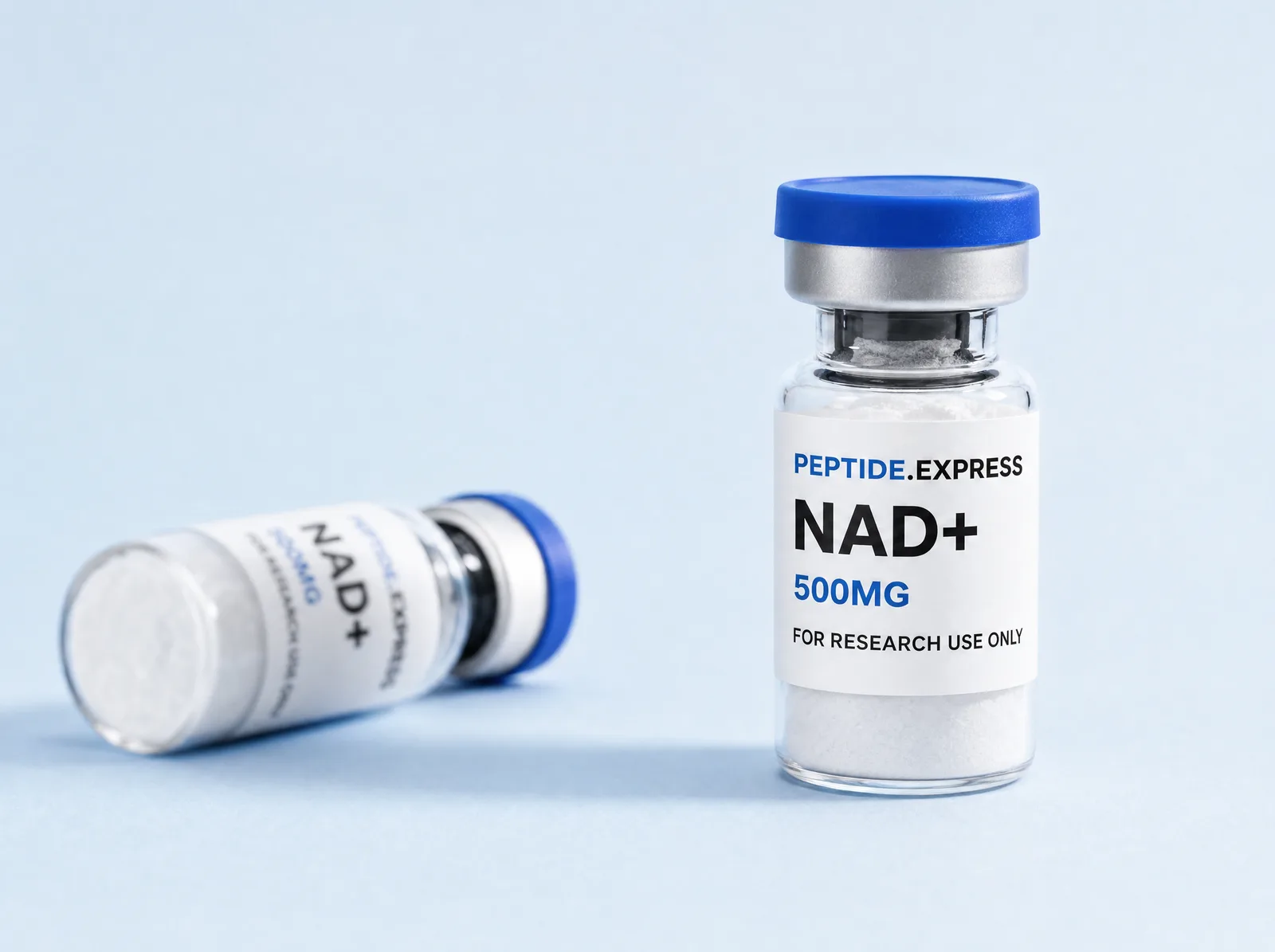
Why research peptides ship as lyophilized powder
Water is what degrades a peptide, so the water is taken out before the vial ships.
Lyophilization freezes the purified material and then pulls the ice off by sublimation under vacuum, leaving a dry porous cake. The reason is chemical rather than logistical: hydrolysis of the amide backbone needs water to proceed, and so do oxidation at methionine and cysteine residues and deamidation at asparagine. A lyophilized peptide held at -20°C carries a 24-month shelf life across this catalog. The same peptide sitting in solution at room temperature can lose measurable material within days, which is why reconstitution is treated as the start of a clock rather than as a preparation step.
The practical consequences of that are set out under the step-by-step peptide reconstitution protocol, and the concentration arithmetic is handled by the peptide reconstitution calculator.
Verified identifiers
What Are the CAS Numbers and Molecular Weights of These Peptides?
18 research compounds sold or blended in this catalog have a CAS registry number, a molecular formula and an average molecular mass on record, and all three are listed below.
These are the same values that populate the ChemicalSubstance structured data on each product page, so the figure in a table row and the figure in the page markup are one number rather than two that have to be kept in step. Masses are average molecular masses in daltons, not monoisotopic masses.
| Compound | CAS Number | Molecular Formula | Mass (Da) | Mechanism Class |
|---|---|---|---|---|
| BPC-157 | 137525-51-0 | C62H98N16O22 | 1,419.5 | Synthetic gastric pentadecapeptide (BPC) fragment |
| CJC-1295 (No DAC) | 863288-34-0 | C152H252N44O42 | 3,367.9 | GHRH analog (short-acting, no albumin-binding DAC) |
| DSIP | 62568-57-4 | C35H48N10O15 | 848.8 | Endogenous nonapeptide studied in slow-wave sleep regulation |
| Enclomiphene | 15690-57-0 | C26H28ClNO | 405.96 | Selective estrogen receptor modulator (trans-isomer of clomiphene) |
| Epithalon | 307297-39-8 | C14H22N4O9 | 390.3 | Synthetic tetrapeptide (telomerase-activation research) |
| GHK-Cu | 89030-95-5 | C14H24CuN6O4 | 403.9 | Copper(II)-binding tripeptide complex |
| Ipamorelin | 170851-70-4 | C38H49N9O5 | 711.9 | Selective ghrelin / GH-secretagogue receptor agonist |
| Kisspeptin-10 | 374675-21-5 | C63H83N17O14 | 1,302.5 | GPR54 / KISS1R agonist |
| KPV | 67727-97-3 | C16H30N4O4 | 342.4 | α-MSH-derived anti-inflammatory tripeptide |
| Melanotan II | 121062-08-6 | C50H69N15O9 | 1,024.2 | Non-selective melanocortin receptor agonist (MC1R/MC3R/MC4R/MC5R) |
| MOTS-c | 1627580-64-6 | C101H152N28O22S2 | 2,174.6 | Mitochondrial-derived peptide (AMPK pathway) |
| NAD+ | 53-84-9 | C21H27N7O14P2 | 663.4 | Dinucleotide redox coenzyme and sirtuin/PARP substrate (not a peptide) |
| PT-141 | 189691-06-3 | C50H68N14O10 | 1,025.2 | Melanocortin receptor agonist |
| Sermorelin | 86168-78-7 | C149H246N44O42S | 3,357.9 | GHRH (1-29) analog |
| SS-31 | 736992-21-5 | C32H49N9O5 | 639.8 | Cardiolipin-binding inner-mitochondrial-membrane protective peptide |
| TB-500 | 77591-33-4 | C212H350N56O78S | 4,963 | Actin-sequestering / Thymosin β-4-related peptide |
| Tesamorelin | 218949-48-5 | C221H366N72O67S | 5,136 | Long-acting GHRH analog |
| Tirzepatide | 2023788-19-2 | C225H348N48O68 | 4,813 | Dual GLP-1 / GIP receptor agonist |
A compound whose molecular formula is not established in that model is left out of this table rather than given a placeholder, and its product page carries whatever identifiers are confirmed for it. Blends and multi-vial kits have no row at all, because a four-peptide vial carries four molecular identities rather than one and each component is listed on its own page. The full catalog, including the compounds absent here, is at the research peptide catalog.
Testing and documentation
How Is Research Peptide Purity Verified?
Purity is measured by reverse-phase HPLC, identity is confirmed separately by LC-MS/MS, and both are run by an independent laboratory that issues a batch-specific Certificate of Analysis.
Peptide.Express runs no in-house purity testing. A laboratory testing its own material has an interest in the result, and an interested party is not a check. Sending each batch to an outside facility produces a document from an organisation with no stake in whether the batch passes, and the name of that laboratory is printed on the certificate.
What reverse-phase HPLC measures
Proportion. A sample is driven under pressure through a nonpolar C18 column against a water and acetonitrile gradient, and molecules leave the column in order of hydrophobicity. A detector records absorbance as material elutes, which is the chromatogram. Purity is the area of the target peak integrated against the total area of every peak on that trace.
It is a share of the material. It is not a statement about what the remainder is.
What LC-MS/MS adds that HPLC cannot
Identity. A chromatogram with one dominant peak establishes that one species dominates the sample; it does not establish which species. LC-MS/MS measures the mass-to-charge ratio of the eluting molecule and sets it against the theoretical mass of the named compound. A peak at 99% means nothing until the mass confirms the peak is the peptide on the label, which is why the two results are reported side by side and never folded into one number.
Why endotoxin is measured rather than inferred
Endotoxin is heat-stable and survives sterile filtration, so a sterile preparation is not automatically a low-endotoxin preparation. LAL testing uses Limulus Amebocyte Lysate, a reagent that clots on contact with the lipopolysaccharide fraction of Gram-negative bacterial cell walls, and the figure is reported per batch. The distinction earns its place in cell-culture work, where endotoxin activates TLR4 signalling and produces inflammatory readouts that have nothing to do with the compound under study.
What a Certificate of Analysis contains
A CoA is a batch document, not a product document. Each one carries the lot number, the HPLC chromatogram and the purity figure integrated from it, the LC-MS/MS mass confirmation, appearance and solubility notes, the endotoxin result, the test date and the name of the laboratory that ran the analysis. Two vials of the same compound from two synthesis runs have two different certificates.
Check the lot number on the vial against the lot number on the document first. Nothing else on the page applies until those agree.
Certificates already issued are published in the Peptide.Express lab results library, which also lists the products awaiting one, and the testing methodology is set out in full under peptide purity and quality standards.
Why 99% is written as a standard and never as a result
The ≥99% figure quoted across this site is the specification Peptide.Express buys to. It is a purchasing standard describing what a batch has to meet before it is accepted, and it is not a measurement of any individual vial.
A measured purity exists only for a batch a laboratory has actually run, and it appears only on that batch’s certificate. The two are kept apart everywhere on this site for that reason. Where a batch has been tested, the measured figure is published against it. Where it has not, the page says so in words rather than showing the sourcing standard in the space where a result would go. A specification presented as an analytical result is an overclaim, and it is one an answer engine and a reviewer can both check against the certificate.
Handling
How Should Research Peptides Be Stored and Handled?
Lyophilized vials are held at -20°C, desiccated and dark. Reconstituted material moves to 2-8°C and has a working window of 14 to 28 days.
For anything under 30 days, 2-8°C is acceptable for a sealed lyophilized vial. Keep it sealed until the moment of reconstitution: the cake is hygroscopic and begins pulling atmospheric moisture as soon as the stopper is open to air. Stored properly at -20°C, 24 months from manufacture is the standard shelf life across this catalog, and a vial whose seal has been breached is no longer described by its certificate whatever the date says.
Choosing a diluent
Bacteriostatic water covers most of the catalog. It is sterile water carrying 0.9% benzyl alcohol as a preservative, and bacteriostatic means growth-inhibiting rather than bactericidal. That inhibitory action is the property that permits repeated access to one vial for up to 28 days under USP guidance. Sterile water for injection carries no preservative and is single-use once the septum has been punctured.
A few compounds with poor aqueous solubility need something else before dilution into aqueous buffer, and the product documentation states which rather than leaving it to be assumed.
Bacteriostatic water for peptide reconstitution is stocked as a catalog item, and the handling sequence is written out in the peptide reconstitution guide.
The working window after reconstitution
Held at 2-8°C and protected from light, a reconstituted peptide is generally usable for 14 to 28 days. The upper end of that range tracks the USP 28-day multi-dose limit for benzyl-alcohol-preserved vials rather than the chemical stability of any one peptide, so it is a handling ceiling rather than a stability finding. A solution that has turned cloudy or discoloured, or that carries visible particulate, is finished regardless of what the calendar says.
Label the vial with the date and the concentration before it goes into the fridge.
Freeze-thaw cycling
Freezing a vial that is in active use is rarely the right call. Each cycle concentrates solutes at the advancing ice front and drives peptide aggregation at the ice-water interface, and repeated cycling is one of the more reliable ways to lose material without noticing. If a solution has to be held past the refrigerated window, aliquot it into single-use volumes first so that nothing is thawed twice.
Concentration arithmetic for a given vial mass and diluent volume is handled by the peptide reconstitution calculator.
Regulatory position
What Research Use Only Means in Practice
It means the material is characterized for laboratory work and for nothing else.
Research-use-only compounds are not manufactured under the pharmaceutical GMP requirements that govern drug products, and they are not sterile-filled for administration. No regulatory body has approved them for use in humans or in animals. A Certificate of Analysis documents purity and identity, which is a narrower claim than it is often read as: it is not a safety assessment, and it says nothing about what a compound does inside a living organism.
Purchase carries an agreement that the material stays in that context.
Approved drug products are a different thing from research-grade material
Several molecules in this catalog exist in approved pharmaceutical form under other manufacturers. Tesamorelin is approved as Egrifta. Tirzepatide is approved under brand names. In each case the approval attaches to a finished drug product made to pharmaceutical standards, not to the molecule in the abstract, and research-grade material of the same sequence is a separate product that carries no approval of any kind.
Retatrutide is investigational and is approved for no indication anywhere.
Anti-doping status
Several catalog compounds appear on the World Anti-Doping Agency Prohibited List. BPC-157, TB-500 and MOTS-c fall under the non-approved-substance and peptide-hormone sections and are prohibited at all times. GHRH analogs and growth hormone secretagogues, among them tesamorelin, CJC-1295, ipamorelin and sermorelin, fall under S2. Enclomiphene falls under S4 as a selective estrogen receptor modulator. That list is revised annually, so anyone competing under it should read the current version rather than any vendor summary, this one included.
Buying for research
Research peptides are legal to purchase in the United States for legitimate laboratory research, and most require no special license. Some compounds are subject to jurisdiction-specific rules, and confirming local law before ordering sits with the buyer. The full ordering, shipping and returns position is set out in the Peptide.Express research FAQ, and the compound reference library is at the research hub.
Where to read further
Compound References, Comparisons and Guides
A compound appears in more than one group where its literature genuinely spans two areas. GHK-Cu sits under both tissue repair and longevity because the copper-binding and the matrix-remodeling work are separate bodies of research on the same molecule, not one body filed twice.
Compound overviews
Side-by-side comparisons
Research application areas
- Research Peptides for Healing & Tissue Repair Research
- Research Peptides for Muscle & Recovery Research
- Research Peptides for Anti-Aging & Cellular Senescence Research
- Research Peptides for Metabolic & Energy Balance Research
- Research Peptides for Sleep & Circadian Research
- Cognitive Research Peptides: What This Catalogue Does and Does Not Support
In-depth research guides
- KLOW Peptide Blend: Complete Research Guide to KPV, GHK-Cu, BPC-157 and TB-500
- GLOW vs KLOW Peptide Blend: Composition, Mechanisms and Research Differences
- KLOW Peptide Research Protocol: 80mg Vial Reconstitution and Concentration Guide
- BPC-157 + TB-500 Wolverine Stack: Complementary Mechanisms in Tissue Repair Research
- GHK-Cu Copper Peptide: Research Guide to Collagen Synthesis, Tissue Remodeling and Anti-Aging Studies
- Tesamorelin Research Guide: GHRH Analog Mechanism, IGF-1 Signaling and Laboratory Protocols
- Research Peptides USA: A Sourcing Guide to HPLC-Verified Laboratory-Grade Compounds
The compound reference library indexes every profiled compound in one place, and the research article library carries the longer-form writing that sits behind these summaries.
Literature
References
The mechanism descriptions across the catalog’s six research areas rest on the following published work. Each entry is the same record cited on the corresponding compound page, and each links straight to the indexed article.
- Tissue repair and regeneration: the actin-sequestering mechanism behind Thymosin beta-4 and TB-500.Goldstein AL, Hannappel E, Kleinman HK. "Thymosin Beta4: Actin-Sequestering Protein Moonlights to Repair Injured Tissues." Trends in Molecular Medicine, 2005. Read the thymosin β4 actin-sequestration and tissue-repair review on PubMed
- Metabolic research: the paper that characterized MOTS-c as a mitochondrial-derived peptide acting on metabolic homeostasis.Lee C, Zeng J, Drew BG, et al. "The Mitochondrial-Derived Peptide MOTS-c Promotes Metabolic Homeostasis and Reduces Obesity and Insulin Resistance." Cell Metabolism, 2015. Read the Lee 2015 Cell Metabolism MOTS-c paper
- Incretin receptor pharmacology: the discovery and receptor-level characterization of the triple GLP-1, GIP and glucagon receptor agonist.Coskun T, Urva S, Roell WC, et al. "LY3437943, a Novel Triple Glucagon, GIP, and GLP-1 Receptor Agonist for Glycemic Control and Weight Loss: From Discovery to Clinical Proof of Concept." Cell Metabolism. 2022. Read the Coskun 2022 retatrutide discovery and receptor pharmacology paper in Cell Metabolism
- Growth hormone axis: the selectivity study that separates a ghrelin-receptor secretagogue from the wider GHRP class.Raun K, et al. "Ipamorelin, the First Selective Growth Hormone Secretagogue." European Journal of Endocrinology, 1998. Read the Raun ipamorelin selectivity study on PubMed
- Mitochondrial bioenergetics: the cardiolipin-binding mechanism studied for inner-mitochondrial-membrane peptides.Birk AV, Liu S, Soong Y, Mills W, Singh P, Warren JD, Seshan SV, Pardee JD, Szeto HH. "The Mitochondrial-Targeted Compound SS-31 Re-Energizes Ischemic Mitochondria by Interacting with Cardiolipin." Journal of the American Society of Nephrology. 2013. Read the Birk 2013 SS-31 cardiolipin binding mechanism study
- Neuroendocrine signaling: the receptor-distribution work underlying melanocortin MC4R pharmacology.Mountjoy KG, Mortrud MT, Low MJ, Simerly RB, Cone RD. Localization of the melanocortin-4 receptor (MC4-R) in neuroendocrine and autonomic control circuits in the brain. Mol Endocrinol. 1994. Read Mountjoy et al. on MC4R distribution in hypothalamic and autonomic circuits
Every Order Ships With Its
Certificate of Analysis.
Browse the catalog, or read the certificates already issued before you order.