Ipamorelin vs Tesamorelin
Ipamorelin is a five-residue GHSR-1a agonist signalling through calcium; tesamorelin is a 44-residue GHRH-receptor analog signalling through cAMP-PKA. Tesamorelin completed phase 3 and holds an FDA approval; ipamorelin stopped at phase 2 with no approval. Designs where cortisol would confound the readout favour ipamorelin; designs needing published clinical pharmacology use tesamorelin.
Quick Answer
Different receptors, different molecular scale, very different evidence. Ipamorelin is a five-residue GHSR-1a (ghrelin receptor) agonist weighing 711.9 Da; tesamorelin is a 44-residue GHRH-receptor analog weighing 5,136 Da. They converge on the same pituitary cell by separate routes, which is why combination designs exist and substitution designs do not. Tesamorelin has completed phase 3 trials and an FDA approval; ipamorelin has not progressed past early-phase work.


Compound Reference Pages
Ipamorelin vs Tesamorelin: At a Glance
| Attribute | Ipamorelin | Tesamorelin |
|---|---|---|
| Receptor target | GHSR-1a (ghrelin / GH-secretagogue receptor) | GHRH receptor (GHRH-R) |
| Mechanism class | Selective GHSR-1a agonist (GHRP class) | Full-length stabilized GHRH analog |
| Signalling cascade | Gq/phospholipase C, calcium-mediated | Gs/adenylate cyclase, cAMP-PKA |
| Peptide length | 5 amino acids (pentapeptide) | 44 amino acids |
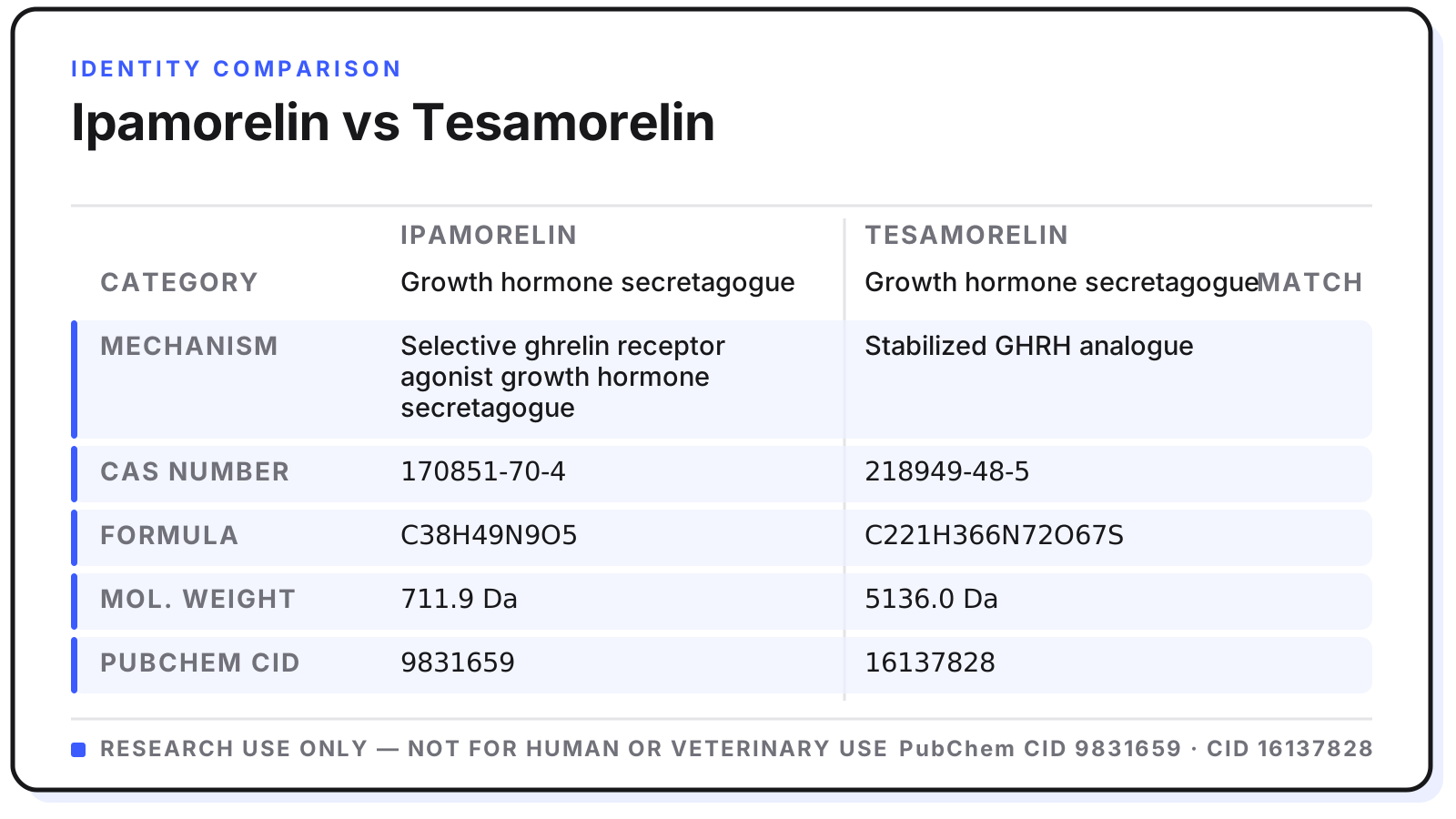
| CAS number | 170851-70-4 | 218949-48-5 |
| Molecular formula | C38H49N9O5 | C221H366N72O67S |
| Molecular weight | 711.9 Da (PubChem CID 9831659) | 5,136 Da (PubChem CID 16137828) |
| Structure | Aib-His-D-2-Nal-D-Phe-Lys-NH2, three non-natural residues | Native GHRH(1-44) with a trans-3-hexenoyl N-terminal cap |
| Cortisol and prolactin release | Minimal in the preclinical models where it was characterised, unlike GHRP-2 and GHRP-6 | Not a reported feature of GHRH-R agonism |
| Highest published human trial stage | Phase 2; development discontinued, no approval | Phase 3 completed |
| Regulatory status | Not approved in any jurisdiction | FDA-approved as Egrifta; research-grade material is not that product |
| Purity (Peptide.Express) | ≥99% by reverse-phase HPLC, batch CoA | ≥99% by reverse-phase HPLC, batch CoA |
How Ipamorelin and Tesamorelin Differ in Research
The comparison only makes sense once you stop treating these as rivals. Growth hormone release from a somatotroph is gated by two receptors, and each of these compounds occupies one of them. Tesamorelin binds GHRH-R and raises intracellular cAMP through the Gs-adenylate cyclase route. Ipamorelin binds GHSR-1a, the ghrelin receptor, and works through Gq and phospholipase C to mobilise intracellular calcium. Activating one does not substitute for the other; activating both is a different experiment again.
Ipamorelin is the stranger molecule of the two. At 711.9 Da it is barely a peptide by mass, and three of its five residues are not proteinogenic — alpha-aminoisobutyric acid, D-2-naphthylalanine and D-phenylalanine. Those unusual residues buy proteolytic resistance and, more importantly for study design, receptor selectivity.
Earlier GHRPs such as GHRP-2 and GHRP-6 provoke cortisol and prolactin release alongside growth hormone, which contaminates any endocrine readout. Ipamorelin was characterised as largely avoiding that, which is what makes it useful when cortisol is a confounder rather than an endpoint.
Worth naming the limit: that selectivity was established in a defined preclinical concentration range, not demonstrated across arbitrary conditions.
The evidence bases are not comparable and should not be presented as though they were. Tesamorelin ran a full clinical programme through phase 3 and emerged with an FDA approval, published pharmacokinetics and a characterised safety profile. Ipamorelin reached phase 2 for a gastrointestinal indication, did not proceed, and its literature is dominated by rodent and pituitary-cell work. There is no head-to-head trial. Any page that ranks these two against each other is inventing a comparison the published record does not support.
Peptide.Express supplies both at ≥99% purity by reverse-phase HPLC with LC-MS/MS mass confirmation and a batch-specific Certificate of Analysis. All material is for in-vitro laboratory research and educational use only.
Ipamorelin vs Tesamorelin: Frequently Asked Questions
Do Ipamorelin and Tesamorelin work the same way?
No. Ipamorelin agonises GHSR-1a, the ghrelin receptor, through a calcium-mediated Gq cascade. Tesamorelin agonises the GHRH receptor through the cAMP-PKA cascade. Both converge on growth hormone release from the same pituitary cell, but through separate receptors and separate second messengers — which is what makes them complementary rather than interchangeable.
Is Ipamorelin better than Tesamorelin?
No published study ranks them, and the two have never been compared head to head. They also sit at opposite ends of the evidence spectrum: tesamorelin completed phase 3 trials and holds an FDA approval, while ipamorelin stopped at phase 2 and is documented mainly through preclinical work. "Better" would require a shared endpoint that does not exist.
Can Ipamorelin and Tesamorelin be studied together?
A GHRH-R analog plus a GHSR-1a agonist is a standard two-pathway design, so the rationale holds. In practice CJC-1295 (No DAC) fills the GHRH arm far more often than tesamorelin does, and that pairing is what Peptide.Express supplies pre-blended. No published trial has tested the ipamorelin-plus-tesamorelin combination specifically.
What is the difference in half-life?
Only one side has a published number. Tesamorelin's is on record in the Egrifta prescribing information, measured in tens of minutes following intravenous administration. Ipamorelin's human plasma half-life is not well characterised in peer-reviewed pharmacokinetic literature, so any specific figure quoted for it should be traced to its source before it is used.
Which has more published research?
Tesamorelin. It carries a completed phase 3 programme, published clinical pharmacology and an approved product built on that record. Ipamorelin's literature is smaller, mostly preclinical, and its clinical development was discontinued after phase 2. That gap is the single most important thing to hold in mind when reading claims about either compound.
Why is Ipamorelin described as selective?
Because unlike GHRP-2 and GHRP-6 it produced minimal cortisol and prolactin release in the models where it was characterised. The three non-natural residues in its sequence are what confer that receptor discrimination. The selectivity is concentration-dependent, established in a specific preclinical range, and not an absolute property.
References
- Raun K, et al. "Ipamorelin, the First Selective Growth Hormone Secretagogue." European Journal of Endocrinology, 1998. Read the Raun ipamorelin selectivity study on PubMed
- Smith RG, et al. "Modulation of Pulsatile GH Release Through a Novel Receptor in Hypothalamus and Pituitary Gland." Recent Progress in Hormone Research, 1996. Read the GH secretagogue receptor and phospholipase C signaling review on PubMed
- Bowers CY, Momany FA, Reynolds GA, Hong A. "On the In Vitro and In Vivo Activity of a New Synthetic Hexapeptide That Acts on the Pituitary to Specifically Release Growth Hormone." Endocrinology, 1984. Read the founding Bowers GHRP hexapeptide study on PubMed
- Falutz J, et al. "Long-term safety and effects of tesamorelin, a growth hormone-releasing factor analogue, in HIV-infected patients with abdominal fat accumulation." AIDS, 2008. Read the tesamorelin long-term safety study on PubMed
- Falutz J, et al. "Tesamorelin Improves Fat Quality Independent of Changes in Fat Quantity." AIDS, 2021. Read the tesamorelin fat quality analysis on PMC
- LiverTox: Clinical and Research Information on Drug-Induced Liver Injury — Tesamorelin. National Institute of Diabetes and Digestive and Kidney Diseases, NIH Bookshelf. Read the LiverTox tesamorelin monograph on NCBI Bookshelf
- Egrifta (tesamorelin for injection) FDA prescribing information, 2024. The authoritative source for the approved indication, pharmacokinetic parameters and monitored laboratory values. Read the Egrifta FDA prescribing information (PDF)
Related Comparisons
Explore More
How This Page Is Sourced
Compiled by the Peptide.Express Research Team. Reviewed by Ben Laythee, Lead Chemist. Molecular identity on this page — name, CAS number, molecular formula and molecular weight — is resolved from a single internal entity record and checked against primary registries (PubChem, CAS Common Chemistry) rather than retyped per page. A field with no verified value is left out instead of estimated. Literature is cited to a DOI, PMID or PMCID permalink so every reference resolves to the specific record it names.