BPC-157 vs TB-500
BPC-157 is a 15-residue gastric pentadecapeptide with no identified receptor, acting predominantly at the injury site; TB-500 is supplied as 43-residue Thymosin β-4, sequestering G-actin through its LKKTET motif and acting systemically. Neither has a completed randomised controlled trial. Local cytoprotection models use BPC-157; actin-dynamics and cell-migration models use TB-500.
Quick Answer
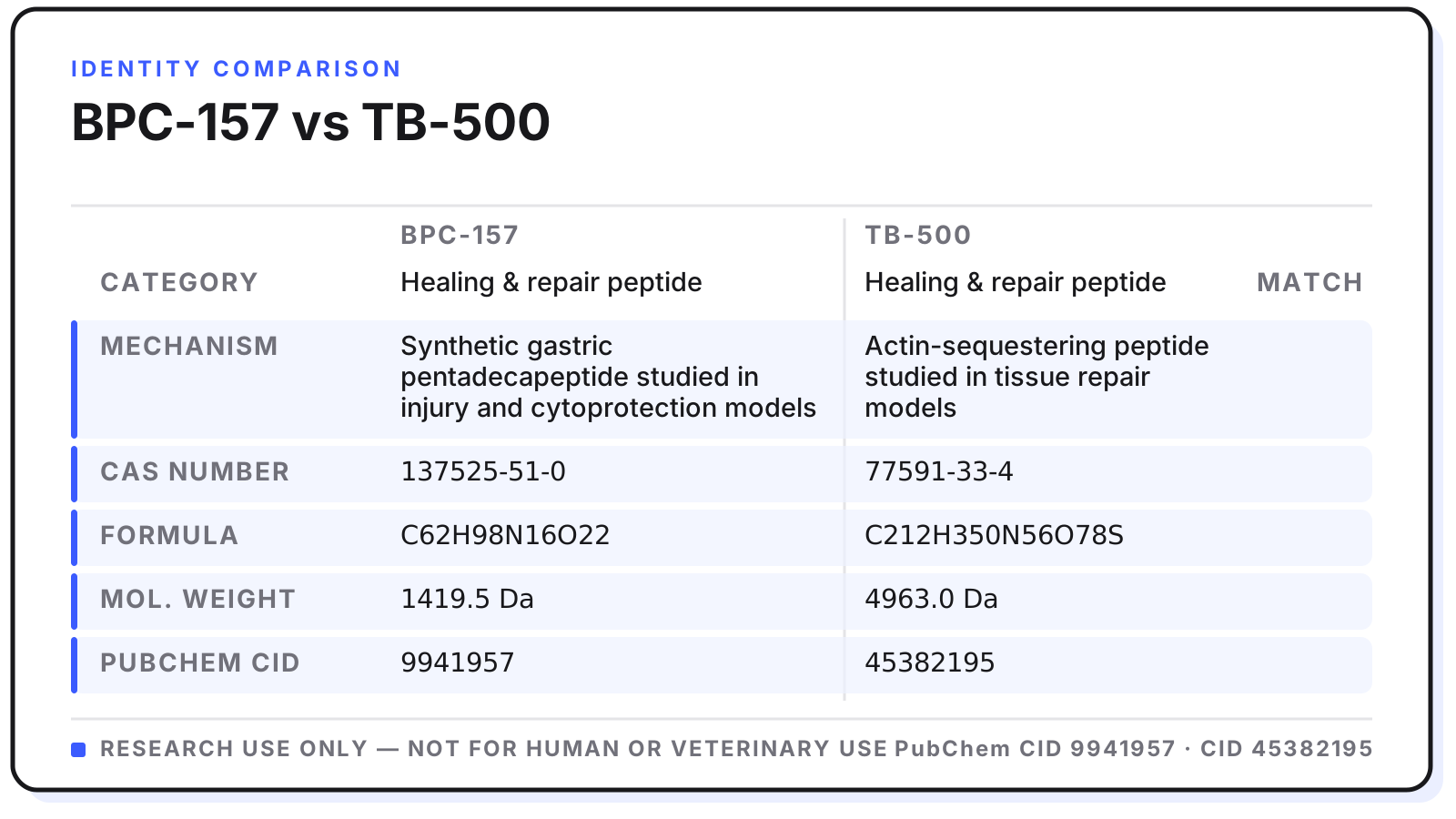
Neither compound is a growth factor, and they act nowhere near each other. BPC-157 is a 15-residue gastric pentadecapeptide (CAS 137525-51-0, 1,419.5 Da) studied for cytoprotection, VEGF-linked local angiogenesis and gut-barrier integrity. TB-500 is supplied here as synthetic Thymosin β-4 (CAS 77591-33-4, 4,963.4 Da), an actin-sequestering protein studied for cell migration. Both evidence bases are almost entirely rodent and cell-culture work; neither has a completed human randomised trial.


Compound Reference Pages
BPC-157 vs TB-500: At a Glance
| Attribute | BPC-157 | TB-500 |
|---|---|---|
| Mechanism class | Gastric pentadecapeptide, cytoprotective | Actin-sequestering protein, cell-migration regulator |
| Molecular target | No single characterised receptor; VEGFR2, nitric oxide and growth-factor pathway effects reported | G-actin monomers, bound through the LKKTET motif |
| Peptide length | 15 amino acids (GEPPPGKPADDAGLV) | 43 amino acids as supplied (full-length Thymosin β-4) |
| CAS number | 137525-51-0 | 77591-33-4 |
| Molecular formula | C62H98N16O22 | C212H350N56O78S |
| Molecular weight | 1,419.5 Da (PubChem CID 9941957) | 4,963.4 Da (Thymosin β-4 record, PubChem CID 45382195) |
| Name ambiguity | None — one molecule, one registry entry | Substantial — "TB-500" is also used for the Ac-LKKTETQ heptapeptide fragment (CAS 885340-08-9, C38H68N10O14, 889.0 Da, PubChem CID 62707662) |
| Primary research area | Cytoprotection, gastrointestinal barrier, tendon and ligament models | Actin dynamics, cell migration, angiogenesis and corneal repair models |
| Scope of action in published models | Predominantly local, at the site of injury | Predominantly systemic, via circulating actin-binding activity |
| Reported plasma half-life | Not established in published human pharmacokinetic literature | Not established in published human pharmacokinetic literature |
| Highest published human trial stage | No completed randomised controlled trial | Early-phase trials of Thymosin β-4 formulations exist; no completed trial of research-market TB-500 |
| Regulatory status | Not approved in any jurisdiction; prohibited by WADA | Not approved in any jurisdiction; prohibited by WADA |
| Purity (Peptide.Express) | ≥99% by reverse-phase HPLC, batch CoA | ≥99% by reverse-phase HPLC, batch CoA |
How BPC-157 and TB-500 Differ in Research
Start with what each molecule physically does. Thymosin β-4 binds monomeric G-actin through its LKKTET motif and holds it in a sequestered pool, which regulates how quickly a cell can build or dismantle its cytoskeleton. That is a direct, structurally understood interaction and it explains the cell-migration and wound-closure findings in the literature.
BPC-157 has no equivalent story: no receptor has been cleanly identified for it. What the published work reports instead is a set of downstream effects — VEGFR2 signalling, nitric oxide system modulation, growth-factor receptor upregulation — observed without a characterised binding partner upstream. That is a real gap, not a detail.
A naming problem sits underneath this comparison and most pages ignore it. "TB-500" is used in the research market for two different molecules. Chemical registries index the name against Ac-LKKTETQ, a seven-residue acetylated fragment of Thymosin β-4 weighing 889.0 Da (CAS 885340-08-9).
Vendors, including this one, more often supply full-length synthetic Thymosin β-4 at 4,963.4 Da. A 5.6-fold mass difference is not a rounding question — it is a different substance. Check the mass on the Certificate of Analysis, and check which molecule a paper actually used before importing its results.
The evidence asymmetry here runs in an unusual direction: both sides are thin. BPC-157 has a large rodent literature concentrated in a small number of research groups, which is a recognised limitation rather than a slur, and no completed randomised controlled trial in humans.
Thymosin β-4 has been through early-phase clinical work in specific formulations, chiefly for corneal and dermal wound indications, but that is not the same material as research-market TB-500 and the results do not transfer automatically. No study has compared the two compounds head to head, and no published trial has tested them in combination despite how often they are sold as a pair.
Peptide.Express supplies both at ≥99% purity by reverse-phase HPLC with LC-MS/MS mass confirmation and a batch-specific Certificate of Analysis. Both are prohibited at all times under the World Anti-Doping Agency list. All material is for in-vitro laboratory research and educational use only.
BPC-157 vs TB-500: Frequently Asked Questions
What is the main difference between BPC-157 and TB-500?
Scale and mechanism. BPC-157 is a 15-residue peptide weighing 1,419.5 Da that acts mostly at the site of injury, with reported effects on VEGF signalling and gut-barrier integrity but no identified receptor. TB-500 as supplied is 4,963.4 Da synthetic Thymosin β-4, which sequesters G-actin through its LKKTET motif and is studied for systemic cell migration.
Which mass belongs on the COA?
It depends which molecule is in the vial, and both are sold as "TB-500". Full-length synthetic Thymosin β-4 is 4,963.4 Da (CAS 77591-33-4); the Ac-LKKTETQ heptapeptide fragment is 889.0 Da (CAS 885340-08-9). Peptide.Express supplies the full-length protein, so a certificate for it should confirm mass near 4,963.4 Da. BPC-157 is unambiguous at 1,419.5 Da (CAS 137525-51-0, C62H98N16O22). Read the mass on the certificate rather than the name on the label: a 5.6-fold difference is not a rounding question, it is a different substance, and a result imported from a paper that used the other one does not transfer.
Is BPC-157 better than TB-500?
No published study ranks them, and no head-to-head comparison exists. They also share the same evidentiary ceiling: neither has a completed randomised controlled trial in humans, and both literatures are dominated by rodent and cell-culture models. Any ranking you find online is inference, not measurement.
Can BPC-157 and TB-500 be studied together?
The pairing is common in research designs and the rationale is that the mechanisms do not overlap — one is a local cytoprotective agent, the other a systemic actin regulator. That said, no published study has tested the combination against either compound alone, so the synergy the pairing is sold on has not been measured.
What is the difference in half-life?
Neither has a well-characterised plasma half-life in published human pharmacokinetic literature. Figures circulating for both trace back to secondary sources rather than primary studies. This is a genuine gap and any specific number quoted for either compound should be traced to its source before use.
Is TB-500 the same thing as Thymosin Beta-4?
It depends who is selling it, which is the problem. Chemical registries index "TB-500" against Ac-LKKTETQ, an 889.0 Da seven-residue fragment (CAS 885340-08-9). Most research suppliers, this one included, ship full-length synthetic Thymosin β-4 at 4,963.4 Da (CAS 77591-33-4). Confirm the mass on the Certificate of Analysis before assuming which molecule you have.
Which has more published research?
BPC-157 has the larger raw volume of preclinical papers, though concentrated in relatively few research groups. Thymosin β-4 has the better-characterised molecular mechanism and some early-phase clinical work in specific topical formulations. Neither has the human trial record that would let a supplier make outcome claims.
References
- "Regeneration or Risk? A Narrative Review of BPC-157 for Musculoskeletal Healing." Biomolecules, 2025. Read the BPC-157 musculoskeletal healing narrative review on PMC
- Sikiric P, Boban Blagaic A, Strbe S, et al. "The Stable Gastric Pentadecapeptide BPC 157 Pleiotropic Beneficial Activity and Its Possible Relations with Neurotransmitter Activity." Pharmaceuticals, 2024. Read the Sikirić BPC-157 pleiotropic-activity review on PMC
- Staresinic M, Sebecic B, Patrlj L, et al. "Gastric Pentadecapeptide BPC 157 Accelerates Healing of Transected Rat Achilles Tendon and In Vitro Stimulates Tendocytes Growth." Journal of Orthopaedic Research, 2003. Read the BPC-157 rat Achilles tendon healing study on PubMed
- Goldstein AL, Hannappel E, Kleinman HK. "Thymosin Beta4: Actin-Sequestering Protein Moonlights to Repair Injured Tissues." Trends in Molecular Medicine, 2005. Read the thymosin β4 actin-sequestration and tissue-repair review on PubMed
- Smart N, Risebro CA, Melville AAD, Moses K, Schwartz RJ, Chien KR, Riley PR. "Thymosin β4 Induces Adult Epicardial Progenitor Mobilization and Neovascularization." Nature, 2007. Read the thymosin β4 epicardial progenitor neovascularization study on PubMed
- Sosne G, Kleinman HK, Springs C, Gross RH, Sung J, Kang S. "0.1% RGN-259 (Thymosin β4) Ophthalmic Solution Promotes Healing and Improves Comfort in Neurotrophic Keratopathy Patients in a Randomized, Placebo-Controlled, Double-Masked Phase III Clinical Trial." International Journal of Molecular Sciences, 2023. Read the RGN-259 thymosin β4 Phase III corneal healing trial on PMC
Explore More
How This Page Is Sourced
Compiled by the Peptide.Express Research Team. Reviewed by Ben Laythee, Lead Chemist. Molecular identity on this page — name, CAS number, molecular formula and molecular weight — is resolved from a single internal entity record and checked against primary registries (PubChem, CAS Common Chemistry) rather than retyped per page. A field with no verified value is left out instead of estimated. Literature is cited to a DOI, PMID or PMCID permalink so every reference resolves to the specific record it names.