CJC-1295 (No DAC) vs Ipamorelin
Two receptors on one pituitary cell, which is why these are usually combined rather than chosen between. CJC-1295 (No DAC) is a 29-residue GHRH-receptor analog signalling through cAMP-PKA; ipamorelin is a five-residue GHSR-1a agonist signalling through calcium. Neither has completed a phase 3 trial. GHRH-arm designs use CJC-1295 (No DAC); ghrelin-arm designs use ipamorelin.
Quick Answer
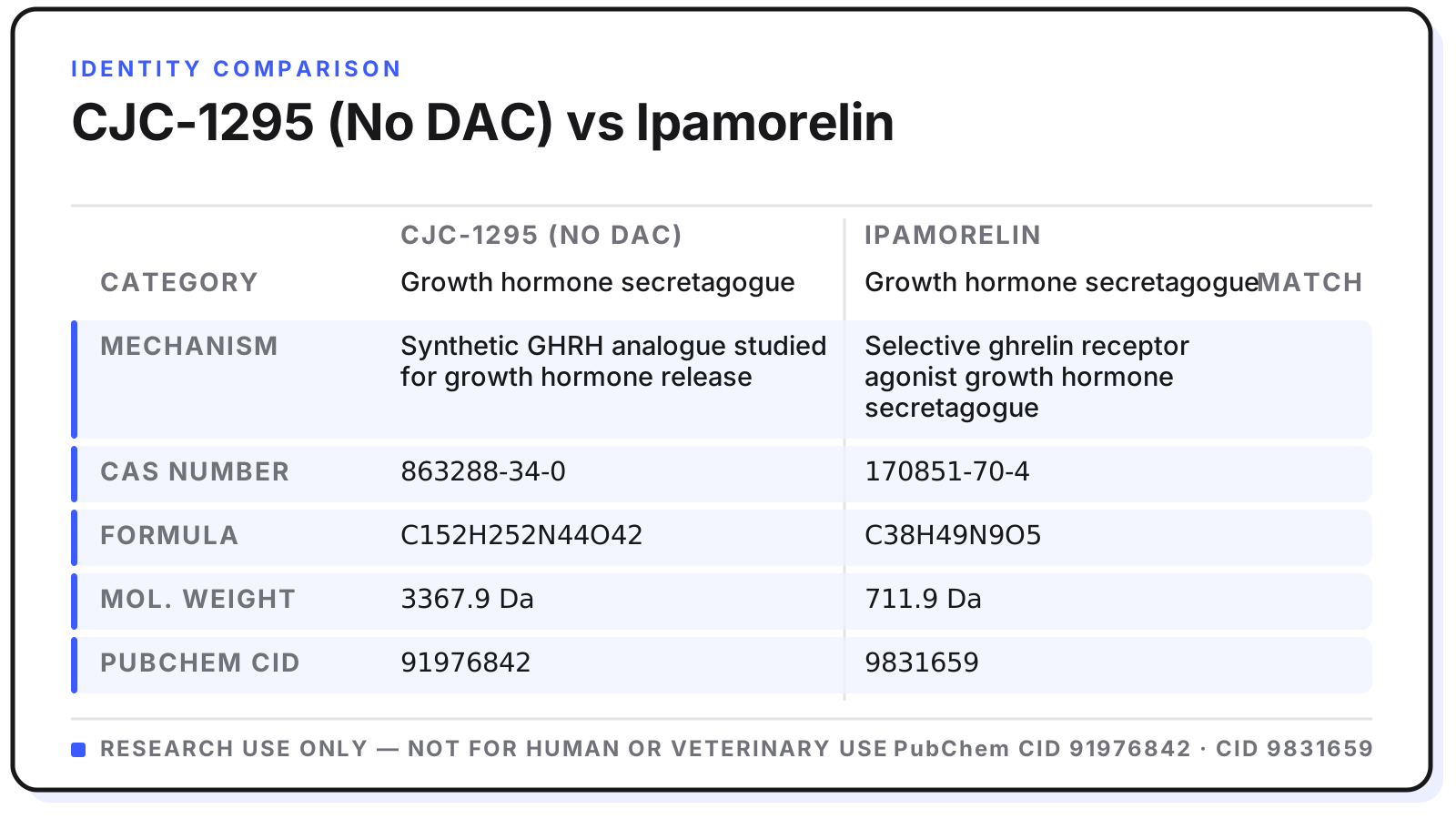
These two are almost never a choice — they are a pair. CJC-1295 (No DAC), also called Modified GRF (1-29), is a 29-residue GHRH-receptor analog (CAS 863288-34-0, 3,367.9 Da) signalling through cAMP-PKA. Ipamorelin is a 5-residue GHSR-1a agonist (CAS 170851-70-4, 711.9 Da) signalling through calcium mobilisation. Two receptors, two second messengers, one pituitary cell. Neither has a completed human phase 3 trial.
Compound Reference Pages
CJC-1295 (No DAC) vs Ipamorelin: At a Glance
| Attribute | CJC-1295 (No DAC) | Ipamorelin |
|---|---|---|
| Receptor target | GHRH receptor (GHRH-R) | GHSR-1a (ghrelin receptor) |
| Mechanism class | Truncated stabilized GHRH analog (Mod GRF 1-29) | Selective GHSR-1a agonist (GHRP class) |
| Signalling cascade | Gs/adenylate cyclase, cAMP-PKA | Gq/phospholipase C, calcium-mediated |
| Peptide length | 29 amino acids | 5 amino acids (pentapeptide) |
| Structure | GRF(1-29) backbone with substitutions at positions 2, 8, 15 and 27 | Aib-His-D-2-Nal-D-Phe-Lys-NH2 |
| CAS number | 863288-34-0 | 170851-70-4 |
| Molecular formula | C152H252N44O42 | C38H49N9O5 |
| Molecular weight | 3,367.9 Da | 711.9 Da (PubChem CID 9831659) |
| Reported plasma half-life | Not established in peer-reviewed pharmacokinetic literature | Not established in peer-reviewed human pharmacokinetic literature |
| Cortisol and prolactin release | Not a reported feature of GHRH-R agonism | Minimal in the preclinical models where it was characterised, unlike GHRP-2 and GHRP-6 |
| Highest published human trial stage | No published human phase trial | Phase 2; development discontinued, no approval |
| Regulatory status | Not approved in any jurisdiction; prohibited by WADA | Not approved in any jurisdiction; prohibited by WADA |
| Purity (Peptide.Express) | ≥99% by reverse-phase HPLC, batch CoA | ≥99% by reverse-phase HPLC, batch CoA |
How CJC-1295 (No DAC) and Ipamorelin Differ in Research
The reason these two are sold in one vial is not marketing convenience. A somatotroph integrates two independent inputs before releasing growth hormone, and each compound supplies one of them. CJC-1295 (No DAC) occupies GHRH-R and drives cAMP up. Ipamorelin occupies GHSR-1a and mobilises intracellular calcium.
Because the second messengers differ, the two signals do not simply add — the combined response in published pituitary models exceeds what either input produces alone. That is the design argument for pairing them, and it is also why "which one should I use" is usually the wrong question.
Structurally they have almost nothing in common. CJC-1295 (No DAC) is the GRF(1-29) fragment with four substitutions, of which the position-2 change carries most of the weight: it removes the dipeptidyl peptidase IV cleavage site that clears native GHRH within minutes. Ipamorelin is a fifth of the mass and three of its five residues are not proteinogenic. Alpha-aminoisobutyric acid, D-2-naphthylalanine and D-phenylalanine give it protease resistance and, more usefully, the receptor discrimination that separates it from GHRP-2 and GHRP-6, both of which stimulate cortisol and prolactin alongside growth hormone.
Where the published record thins out, it thins out for both. Neither compound has completed a phase 3 trial. Ipamorelin reached phase 2 for a gastrointestinal indication and development stopped there; CJC-1295 (No DAC) has no sponsor programme and no published human phase trial at all.
The commonly quoted half-life figures for both — around thirty minutes for the GHRH analog, various numbers for ipamorelin — trace to secondary sources rather than primary pharmacokinetic papers. The synergy claim itself rests on preclinical work on GHRH-plus-GHRP combinations generally, not on a trial of this specific pairing.
One registry note that trips people up: the PubChem entry indexed under the bare name "CJC-1295" (CID 91971820, CAS 446262-90-4) reports 3,647.2 Da, which corresponds to the DAC-bearing form rather than the 3,367.9 Da No-DAC material supplied here. The mass on the Certificate of Analysis is what distinguishes them. Peptide.Express verifies each component at ≥99% purity by reverse-phase HPLC with LC-MS/MS mass confirmation before blending, then re-checks the compositional ratio of the finished vial. For in-vitro laboratory research and educational use only.
CJC-1295 (No DAC) vs Ipamorelin: Frequently Asked Questions
Is CJC-1295 the same as Ipamorelin?
No, and they are not even the same class. CJC-1295 (No DAC) is a 29-residue GHRH-receptor analog, also called Modified GRF (1-29). Ipamorelin is a 5-residue GHSR-1a agonist — a GHRP, not a GHRH analog. Different receptors, different second messengers, a 4.7-fold difference in molecular weight.
Why are CJC-1295 and Ipamorelin studied together?
Because a somatotroph responds to two separate inputs and each compound supplies one. CJC-1295 raises cAMP through GHRH-R; ipamorelin mobilises calcium through GHSR-1a. Combining unrelated second-messenger pathways produces a larger response in preclinical models than either alone. No trial has tested this specific pairing in humans.
Is Ipamorelin better than CJC-1295?
The question does not have an evidence-based answer, because no head-to-head study exists and the two do different jobs. If a design needs the ghrelin arm, ipamorelin is the tool; if it needs the GHRH arm, CJC-1295 (No DAC) is. Neither has completed a phase 3 trial or holds an approval anywhere.
What is the difference in half-life?
Honestly, this is not well established for either. The roughly 30-minute figure quoted for CJC-1295 (No DAC) has no primary pharmacokinetic paper behind it, and ipamorelin's human plasma half-life is likewise uncharacterised in peer-reviewed literature. The long-acting compound in this family is CJC-1295 With DAC, a different molecule with an albumin-binding group.
Which has more published research?
Ipamorelin, marginally, and only because it went through a discontinued clinical programme that generated phase 1 and phase 2 data. CJC-1295 (No DAC) has no published human phase trial. Both bodies of work are dominated by preclinical models, and neither supports outcome claims.
How do I know I have the No DAC form and not CJC-1295 With DAC?
Check the mass on the Certificate of Analysis. CJC-1295 (No DAC) is 3,367.9 Da. The DAC-bearing form is heavier — the PubChem record indexed under the bare name "CJC-1295" reports 3,647.2 Da — because it carries a maleimidopropionyl group that binds serum albumin. That group is the entire reason the DAC version lasts for days.
References
- Teichman SL, Neale A, Lawrence B, Gagnon C, Castaigne JP, Frohman LA. "Prolonged Stimulation of Growth Hormone (GH) and Insulin-Like Growth Factor I Secretion by CJC-1295, a Long-Acting Analog of GH-Releasing Hormone, in Healthy Adults." Journal of Clinical Endocrinology & Metabolism, 2006. Read the CJC-1295 (DAC) human dosing study on PubMed
- Raun K, et al. "Ipamorelin, the First Selective Growth Hormone Secretagogue." European Journal of Endocrinology, 1998. Read the Raun ipamorelin selectivity study on PubMed
- Bowers CY, Reynolds GA, Durham D, Barrera CM, Pezzoli SS, Thorner MO. "Growth Hormone (GH)-Releasing Peptide Stimulates GH Release in Normal Men and Acts Synergistically with GH-Releasing Hormone." Journal of Clinical Endocrinology & Metabolism, 1990. Read the GHRP and GHRH co-administration synergy study on PubMed
- For a GHRH analog with published human trial data, the tesamorelin record is the closest available reference point. Falutz J, et al. Journal of Clinical Endocrinology and Metabolism, 2008. Read the tesamorelin long-term safety study on PubMed
- Smith RG, et al. "Modulation of Pulsatile GH Release Through a Novel Receptor in Hypothalamus and Pituitary Gland." Recent Progress in Hormone Research, 1996. Read the GH secretagogue receptor and phospholipase C signaling review on PubMed
- Bowers CY, Momany FA, Reynolds GA, Hong A. "On the In Vitro and In Vivo Activity of a New Synthetic Hexapeptide That Acts on the Pituitary to Specifically Release Growth Hormone." Endocrinology, 1984. Read the founding Bowers GHRP hexapeptide study on PubMed
Related Comparisons
Explore More
How This Page Is Sourced
Compiled by the Peptide.Express Research Team. Reviewed by Ben Laythee, Lead Chemist. Molecular identity on this page — name, CAS number, molecular formula and molecular weight — is resolved from a single internal entity record and checked against primary registries (PubChem, CAS Common Chemistry) rather than retyped per page. A field with no verified value is left out instead of estimated. Literature is cited to a DOI, PMID or PMCID permalink so every reference resolves to the specific record it names.