Components
- KLOW Blend
- KPV, GHK-Cu, BPC-157, TB-500
- GLOW Blend
- GHK-Cu, BPC-157, TB-500
Compound comparison
For laboratory research use only. Not for human or veterinary use.
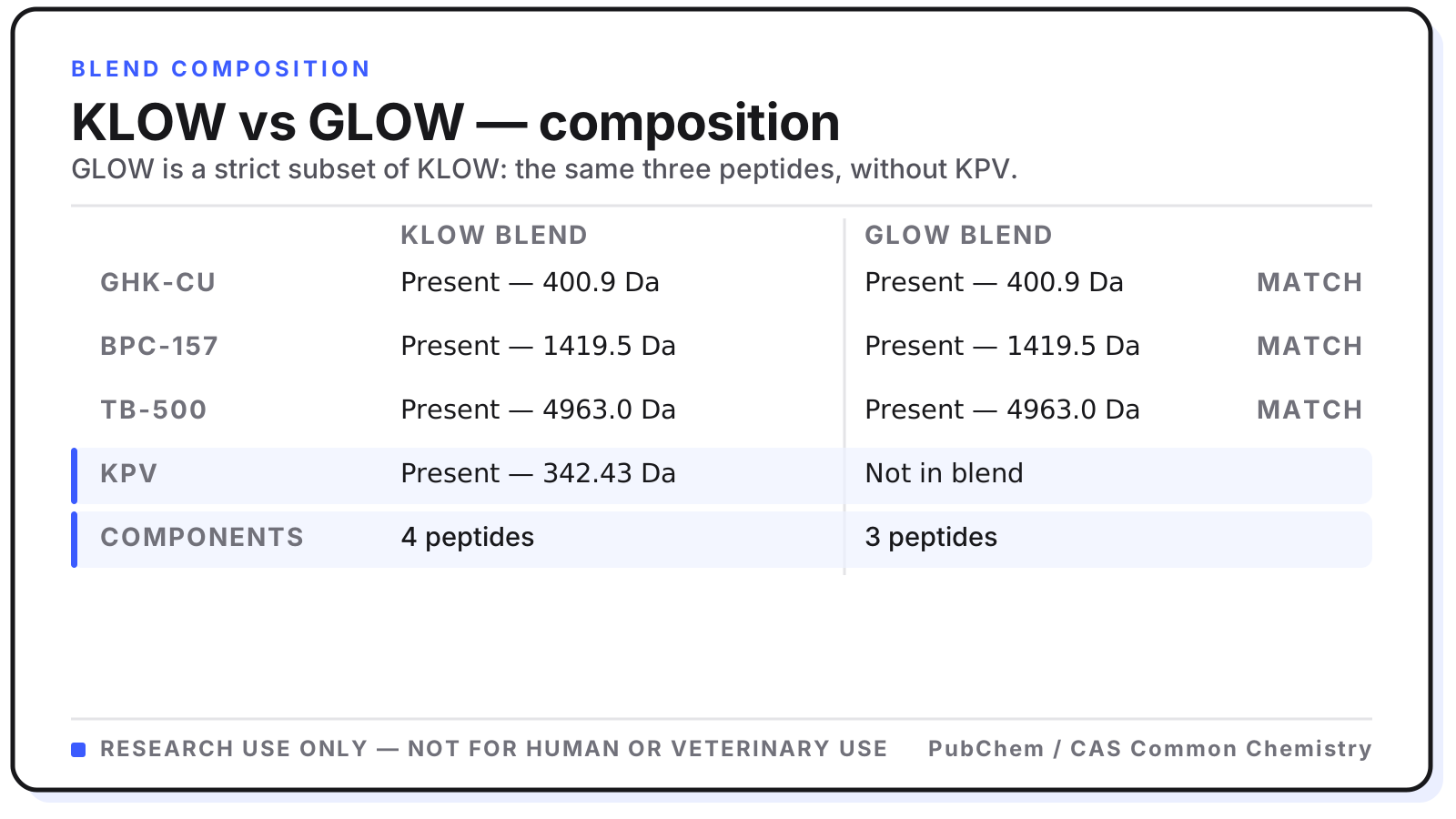
GLOW and KLOW share GHK-Cu, BPC-157 and TB-500. KLOW adds a fourth peptide, KPV (Lys-Pro-Val), and is supplied as an 80 mg vial labeled 50 mg GHK-Cu and 10 mg each of BPC-157, TB-500 and KPV. Neither blend has been tested as a combination in any published study.
Quick Answer
GLOW contains GHK-Cu, BPC-157 and TB-500. KLOW contains those three plus KPV. Neither blend has been tested as a combination in any published study.
Components
Component count
Added compound
Preclinical models: anti-inflammatory mechanism
Preclinical models: gut-barrier relevance
Collagen and matrix remodeling
Local angiogenesis
Systemic cell migration
Component identity verification
Published study of the finished blend
Purity (Peptide.Express)
KLOW Blend compared with GLOW Blend across mechanism, structure and research attributes. Research reference only.
These are not rival formulations. GLOW is a strict subset of KLOW, so every mechanism present in one is present in the other and the comparison collapses to a single question: does adding KPV change the readout in the model you are running?
KPV is the cleanest component to describe because its identity is unambiguous. It is residues 11-13 of alpha-melanocyte-stimulating hormone — lysine, proline, valine — with CAS 67727-97-3, formula C16H30N4O4 and a mass of 342.43 Da. In intestinal epithelial and macrophage models it reduces pro-inflammatory cytokine output by interfering with NF-kappaB nuclear translocation, and it does so without the melanocortin receptor agonism that makes full-length alpha-MSH a pigmentation compound. That mechanism has no counterpart in the other three peptides.
The other components deserve more honesty than blend pages usually give them. BPC-157 is well pinned down: CAS 137525-51-0, C62H98N16O22, 1,419.5 Da, sequence GEPPPGKPADDAGLV. GHK-Cu is a copper coordination complex. PubChem CID 71587328 lists CAS 89030-95-5 and 402.92 g/mol. A second complex record, CID 139035031, describes an anionic species at 400.90 g/mol, so no CAS resolves cleanly across every record.
The CAS used here is 89030-95-5. TB-500 is worse: the name is used commercially for full-length synthetic Thymosin β-4 (4,963 g/mol, CAS 77591-33-4, CID 16132341) and in chemical registries for the Ac-LKKTETQ heptapeptide (CAS 885340-08-9, 889.0 Da). The material in these blends is the full-length protein. Check the Certificate of Analysis mass rather than trusting the name.
The comparison has one unavoidable weakness and it should be stated rather than hidden. No published study has tested the four-component blend against the three-component blend, and no published study has tested either blend at all. Everything asserted about what KPV adds here is inferred from single-compound literature.
For a design where inflammation is the endpoint, KLOW offers two mechanistically independent anti-inflammatory arms. For a design where a non-inflammatory readout is the endpoint, GLOW has one fewer variable, and fewer variables is a real advantage when you need to attribute an effect.
KPV, and nothing else. GLOW contains GHK-Cu, BPC-157 and TB-500. KLOW contains those same three plus KPV (Lys-Pro-Val), a 342.43 Da tripeptide derived from alpha-MSH with CAS 67727-97-3. GLOW is a strict subset of KLOW.
Four peptides: KPV (Lys-Pro-Val, CAS 67727-97-3, 342.43 Da), GHK-Cu (a glycyl-L-histidyl-L-lysine copper complex, roughly 400 Da depending on the species recorded), BPC-157 (GEPPPGKPADDAGLV, CAS 137525-51-0, 1,419.5 Da) and TB-500 supplied as full-length synthetic Thymosin β-4 (CAS 77591-33-4, 4,963.4 Da).
Three peptides: GHK-Cu, BPC-157 and TB-500 — the same three that make up three quarters of KLOW. GLOW is the earlier formulation and KLOW is its four-component extension, not a replacement or a reformulation.
KLOW contains four peptides and GLOW contains three. The only compositional difference is KPV. A design that needs fewer variables uses GLOW. A design that includes KPV uses KLOW. No published study has compared the two blends.
Wolverine contains BPC-157 and TB-500. GLOW adds GHK-Cu. KLOW adds GHK-Cu and KPV.
It suppresses NF-kappaB nuclear translocation, which is mechanistically distinct from GHK-Cu's antioxidant activity — the only other anti-inflammatory arm in either blend. KPV is also the only component with a dedicated intestinal epithelial cytokine literature behind it. It has no receptor overlap with the other three.
That is the cleanest available design, and it is what the comparison is really asking for. Because the two blends differ by exactly one peptide, running both arms isolates the KPV contribution directly instead of inferring it from separate single-compound papers. Nobody has published that experiment yet.
On the blends themselves, none. Every component has its own preclinical literature, but no peer-reviewed study has tested GLOW or KLOW as a formulation, and no study has established whether four peptides in one vial interact, compete or simply coexist. That gap is the honest ceiling on what can be claimed for either.
Yes. Sourced against a ≥99% HPLC purity specification. Third-party Certificates of Analysis are published where on file. All material is for in-vitro laboratory research use only.
Compiled by the Peptide.Express Research Team. Written and reviewed by Peptide.Express Editorial Team. Molecular identity on this page (name, CAS number, molecular formula and molecular weight) is resolved from a single internal entity record and checked against primary registries (PubChem, CAS Common Chemistry) rather than retyped per page. A field with no verified value is left out instead of estimated. Literature is cited to a DOI, PMID or PMCID permalink so every reference resolves to the specific record it names.