Research peptides for Healing Research
Quick Answer
Three compounds carry most of the tissue-repair literature in this catalogue, and they are not three versions of one mechanism. BPC-157 is a 15-residue peptide derived from human gastric juice (CAS 137525-51-0) that upregulates VEGF at the site it is applied to. TB-500 is synthetic Thymosin β-4; it sequesters monomeric G-actin and mobilises cells toward an injury from elsewhere in the body. GHK-Cu carries copper to the enzymes that crosslink collagen. Local angiogenesis, systemic cell recruitment, matrix chemistry — three separable levers, supplied at ≥99% HPLC purity for in-vitro laboratory research only.
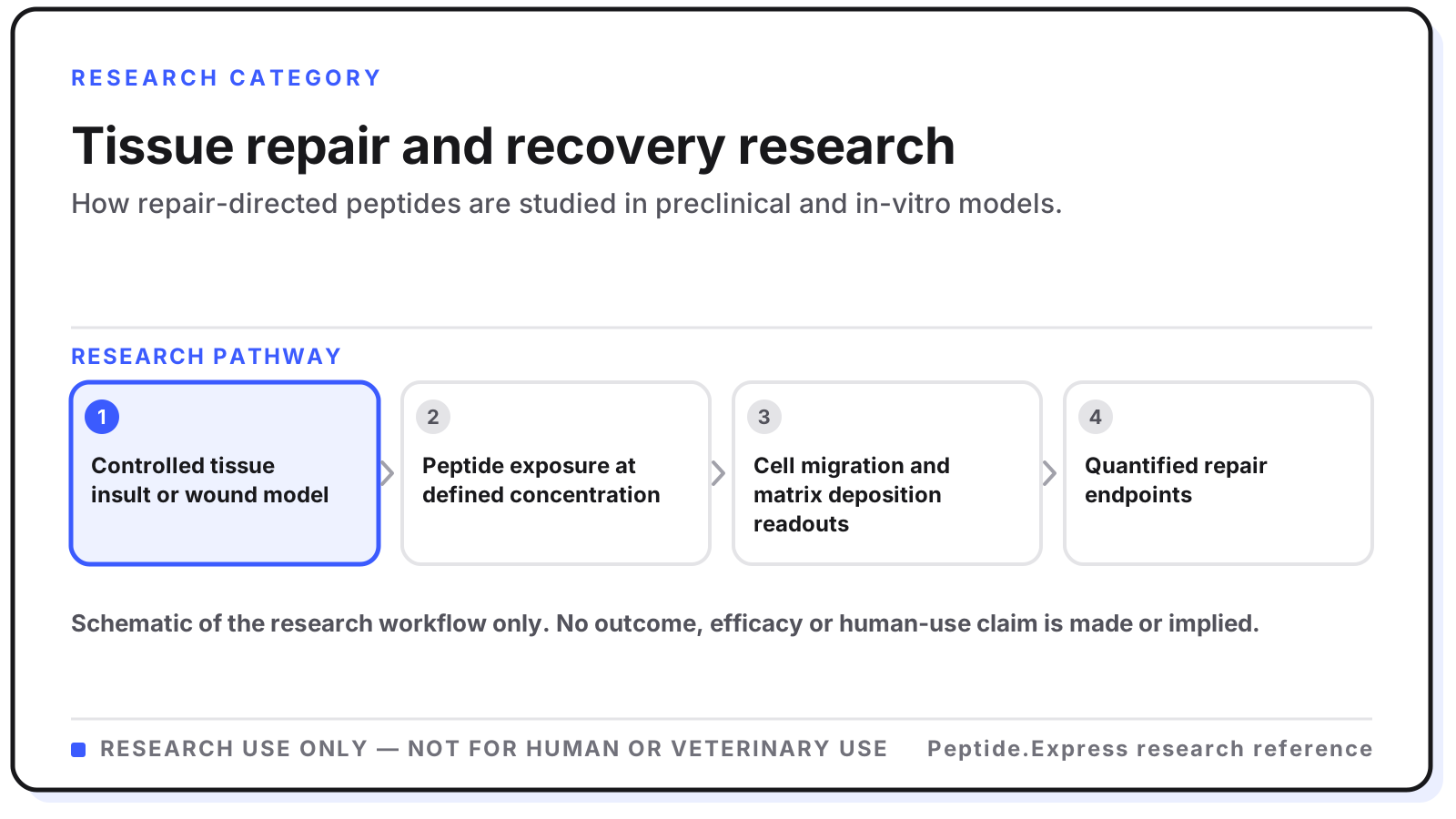
Healing Research Research: Overview
A repair site needs blood supply, arriving cells, and a matrix worth rebuilding into. Those are sequential requirements rather than competing ones, which is why comparative designs run these compounds in separate arms instead of treating them as interchangeable. One caveat belongs at the front: no receptor has ever been identified for BPC-157, despite well over a hundred preclinical studies, and almost all of that work is rodent. TB-500 is the exception in this group — Thymosin β-4 has been through human corneal and cardiac trials, which is more than most compounds in the repair category can say. GHK-Cu sits somewhere between the two, with a well-characterised cell-culture mechanism and a much weaker record in intact tissue.
Recommended Peptides for Healing Research
BPC-157
Upregulates VEGF at the injury site and activates focal adhesion kinase and paxillin — the signalling proteins that decide whether a fibroblast can grip its substrate and move across it. Rat rotator cuff, Achilles and NSAID-induced gastric ulceration models are the standard preparations. The mechanism is a set of downstream observations, not a binding story.
TB-500
Binds free G-actin through the LKKTET motif and shifts the G-to-F-actin equilibrium, which is what allows endothelial cells, keratinocytes and progenitor populations to migrate toward a wound from distant tissue. It acts systemically, not locally — the reason it is paired with BPC-157 in study designs rather than substituted for it.
GHK-Cu
Delivers Cu²⁺ to lysyl oxidase, the copper-dependent enzyme that crosslinks collagen and elastin fibrils, while raising collagen transcription and MMP-1 and MMP-2 activity at the same time. Synthesis without the matrix-clearing arm would give accumulation; the two running together is what produces turnover in culture.
Healing Research Research: Frequently Asked Questions
What peptides are studied in tissue repair research?
BPC-157, TB-500 and GHK-Cu are the three with the largest repair literature. They act at different points: BPC-157 drives VEGF-mediated angiogenesis locally, TB-500 mobilises cells systemically through actin sequestration, and GHK-Cu supplies copper to matrix-crosslinking enzymes. A design that needs to attribute an effect to one of those steps needs separate arms.
Can BPC-157 and TB-500 be studied together?
They are frequently run together, and the rationale is mechanistic rather than additive: local repair activation paired with systemic cell recruitment covers two sequential requirements of the same cascade. What does not exist is combination pharmacokinetic data. Running each compound as an independent arm is the only way to attribute an outcome to migration versus angiogenesis.
Is there human research behind any of these compounds?
For Thymosin β-4, yes — it has been investigated in human corneal and cardiac trials, which is unusual in this compound class. BPC-157 has no completed controlled human evaluation; its record is preclinical and overwhelmingly rodent. GHK-Cu human work is largely topical and dermatological. None of these compounds is approved for human use.
What does the copper in GHK-Cu actually do?
It is doing much of the work. GHK binds Cu²⁺ and acts as a courier, supplying bioavailable copper to lysyl oxidase, which crosslinks newly deposited collagen and elastin. Without that step new matrix has no tensile integrity. Research protocols treat GHK and GHK-Cu as different molecules for exactly this reason.
Do BPC-157, TB-500 and GHK-Cu ship with a batch CoA?
Yes. Every repair-research compound from Peptide.Express is HPLC-verified at ≥99% purity with mass confirmation and a batch-specific Certificate of Analysis. For TB-500 specifically, check the CoA mass: the name is used inconsistently across suppliers for both full-length Thymosin β-4 and shorter LKKTET fragments.
References
- "Regeneration or Risk? A Narrative Review of BPC-157 for Musculoskeletal Healing." Biomolecules, 2025. Read the BPC-157 musculoskeletal healing narrative review on PMC
- Sikiric P, Boban Blagaic A, Strbe S, et al. "The Stable Gastric Pentadecapeptide BPC 157 Pleiotropic Beneficial Activity and Its Possible Relations with Neurotransmitter Activity." Pharmaceuticals, 2024. Read the Sikirić BPC-157 pleiotropic-activity review on PMC
- Staresinic M, Sebecic B, Patrlj L, et al. "Gastric Pentadecapeptide BPC 157 Accelerates Healing of Transected Rat Achilles Tendon and In Vitro Stimulates Tendocytes Growth." Journal of Orthopaedic Research, 2003. Read the BPC-157 rat Achilles tendon healing study on PubMed
- Goldstein AL, Hannappel E, Kleinman HK. "Thymosin Beta4: Actin-Sequestering Protein Moonlights to Repair Injured Tissues." Trends in Molecular Medicine, 2005. Read the thymosin β4 actin-sequestration and tissue-repair review on PubMed
- Smart N, Risebro CA, Melville AAD, Moses K, Schwartz RJ, Chien KR, Riley PR. "Thymosin β4 Induces Adult Epicardial Progenitor Mobilization and Neovascularization." Nature, 2007. Read the thymosin β4 epicardial progenitor neovascularization study on PubMed
- Sosne G, Kleinman HK, Springs C, Gross RH, Sung J, Kang S. "0.1% RGN-259 (Thymosin β4) Ophthalmic Solution Promotes Healing and Improves Comfort in Neurotrophic Keratopathy Patients in a Randomized, Placebo-Controlled, Double-Masked Phase III Clinical Trial." International Journal of Molecular Sciences, 2023. Read the RGN-259 thymosin β4 Phase III corneal healing trial on PMC
- Pickart L, Margolina A. "Regenerative and Protective Actions of the GHK-Cu Peptide in the Light of the New Gene Data." International Journal of Molecular Sciences, 2018. Read the GHK-Cu regenerative gene-data review on PMC
- Pickart L, Vasquez-Soltero JM, Margolina A. "The Human Tripeptide GHK-Cu in Prevention of Oxidative Stress and Degenerative Conditions of Aging." Oxidative Medicine and Cellular Longevity, 2012. Read the GHK-Cu oxidative stress and aging review on PMC
- Review of GHK as an anti-aging peptide, covering the plasma decline observation and the tissue-remodeling gene expression data. Read the GHK anti-aging peptide review on PMC
- Maquart FX, Pickart L, Laurent M, Gillery P, Monboisse JC, Borel JP. "Stimulation of Collagen Synthesis in Fibroblast Cultures by the Tripeptide-Copper Complex Glycyl-L-Histidyl-L-Lysine-Cu2+." FEBS Letters. 1988. Read the Maquart 1988 GHK-Cu fibroblast collagen synthesis study
Compare These Compounds
Explore More Research Areas
Browse All Research Peptides
Explore our complete catalog of HPLC-verified research peptides. Every product includes a Certificate of Analysis documenting purity and identity. Same-day US shipping on orders before 2 PM EST. For in-vitro laboratory research use only.
Browse CatalogHow This Page Is Sourced
Compiled by the Peptide.Express Research Team. Reviewed by Ben Laythee, Lead Chemist. Molecular identity on this page — name, CAS number, molecular formula and molecular weight — is resolved from a single internal entity record and checked against primary registries (PubChem, CAS Common Chemistry) rather than retyped per page. A field with no verified value is left out instead of estimated. Literature is cited to a DOI, PMID or PMCID permalink so every reference resolves to the specific record it names.