Research peptides for GH-axis and muscle-cell models
Quick Answer
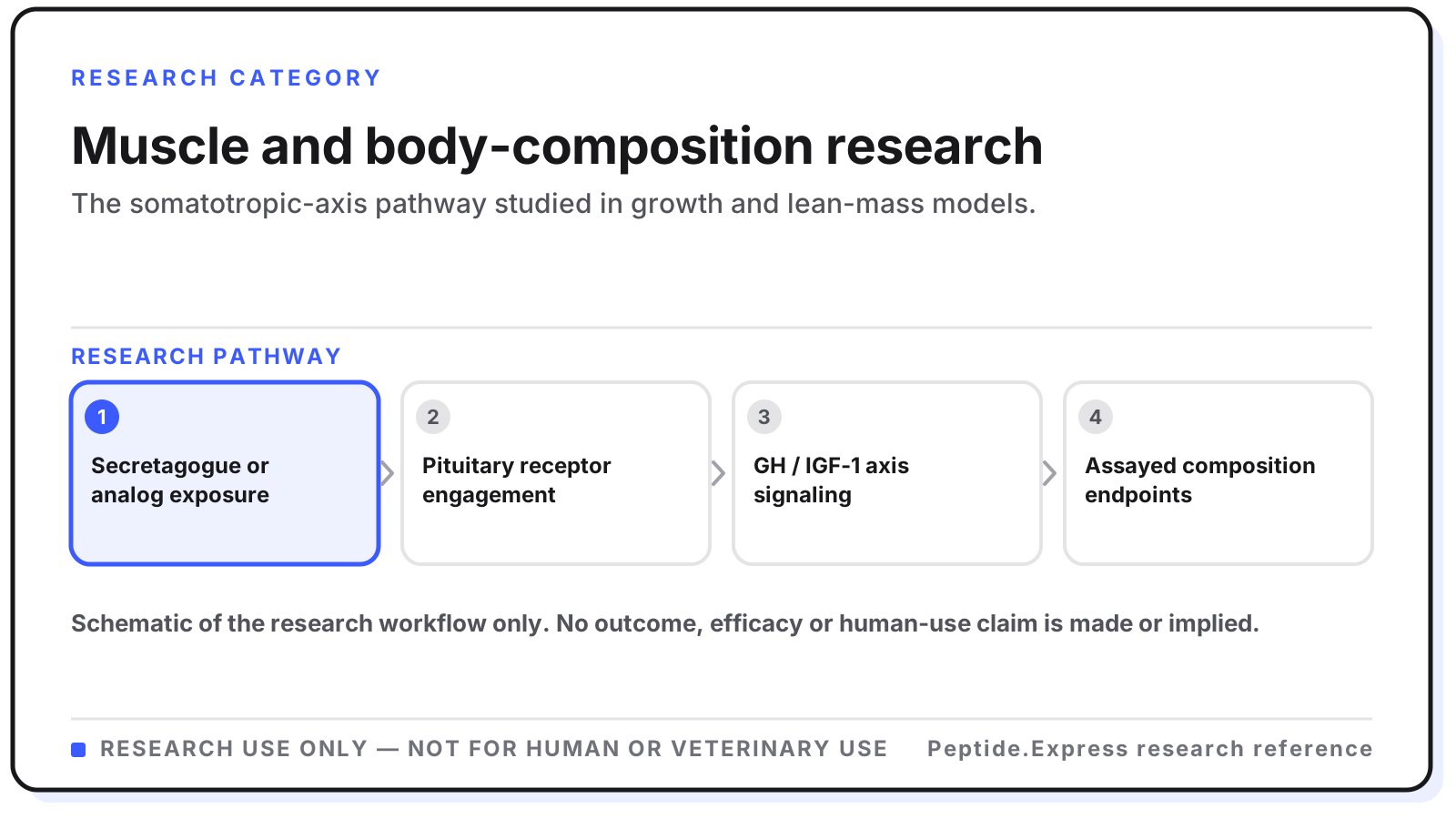
Two separate receptor systems converge on the same pituitary cell, and that convergence is what most muscle and recovery research in this catalogue is built on. GHRH-R couples to Gs and works through cAMP; GHSR-1a couples to Gq and works through calcium. Both end in growth hormone release from the somatotroph, and co-stimulating them produces a larger response than either route alone. BPC-157 sits somewhere else entirely — at the tissue, not the pituitary. Peptide.Express stocks CJC-1295 (No DAC) with Ipamorelin, Ipamorelin on its own, and BPC-157, all at ≥99% HPLC purity for in-vitro laboratory research only.
Muscle-Cell Research Research: Overview
Most of the interesting questions in this area are about pulse architecture rather than total hormone exposure. Somatostatin keeps opposing the somatotroph as GH rises, so a secretagogue produces output that tracks the endogenous rhythm, where recombinant GH flattens it and suppresses the cell. Whether pulsatility matters depends entirely on the endpoint being measured. Two gaps are worth stating: the GHRH-plus-GHRP synergy is replicated across the compound class but has not been characterised for each specific commercial pairing sold as a stack, and BPC-157 musculoskeletal work — rat rotator cuff and Achilles preparations, tensile strength recovery as the endpoint — has no receptor behind it.
Recommended Peptides for Muscle-Cell Research
CJC-1295 (No DAC) + Ipamorelin
Mod GRF(1-29) and Ipamorelin in one vial: GHRH-R through Gs and cAMP alongside GHSR-1a through Gq and calcium, both landing on the same somatotroph. Dual-pathway co-stimulation is the design this format exists for. Combination pharmacokinetics for the specific pairing have not been published, so an effect cannot be apportioned between the two without separate arms.
Ipamorelin
A five-residue GHSR-1a agonist with three non-natural amino acids built in for protease resistance. It was characterised as the first selective GH secretagogue — driving GH release without the ACTH, cortisol and prolactin elevation GHRP-2 and GHRP-6 produce — which is what makes it usable when the HPA axis is a variable in the experiment rather than a confound to explain away.
BPC-157
The tissue-level arm rather than the endocrine one. Rat tendon-to-bone and muscle crush preparations are read out by fibroblast migration, collagen fibre organisation on histology, and VEGF expression with capillary density in the repair zone. No receptor has been identified for BPC-157 and the record is almost entirely rodent. Supplied for in-vitro laboratory research use only.
Muscle-Cell Research Research: Frequently Asked Questions
What peptides are studied in muscle and recovery research?
Growth hormone secretagogues and tissue-repair compounds, which answer different questions. Ipamorelin acts at GHSR-1a, the CJC-1295 (No DAC) plus Ipamorelin format adds a GHRH-R agonist to that, and BPC-157 works at the injury site rather than the pituitary. All are laboratory research compounds, not approved for human use.
Why are GHRH analogs and GHRPs studied in combination?
Because they reach the same output through different second messengers. A GHRH analog raises cAMP through Gs; a GHRP raises intracellular calcium through Gq. Co-stimulating both on one somatotroph gives a GH response larger than either alone, a finding replicated across the class. Ipamorelin also lowers somatostatin tone, removing an inhibition rather than adding a stimulus.
Why choose Ipamorelin over GHRP-2 or GHRP-6?
Selectivity, in designs where cortisol is a measured variable. GHRP-2 and GHRP-6 produce measurable ACTH, cortisol and prolactin release alongside GH; Ipamorelin was engineered to drop those. Read the claim as a wider clean window rather than an absolute property — selectivity in receptor pharmacology is concentration-dependent, and the human data defining that window has not been published.
Do these compounds act directly on muscle tissue?
The secretagogues do not. They act on anterior pituitary somatotrophs, and everything downstream — GH release, hepatic IGF-1 output — is a consequence of that. BPC-157 is the only compound here studied at the tissue itself, in rodent tendon, ligament and muscle crush preparations. Conflating the two mechanisms in one protocol makes the result uninterpretable.
References
- Teichman SL, Neale A, Lawrence B, Gagnon C, Castaigne JP, Frohman LA. "Prolonged Stimulation of Growth Hormone (GH) and Insulin-Like Growth Factor I Secretion by CJC-1295, a Long-Acting Analog of GH-Releasing Hormone, in Healthy Adults." Journal of Clinical Endocrinology & Metabolism, 2006. Read the CJC-1295 (DAC) human dosing study on PubMed
- Raun K, et al. "Ipamorelin, the First Selective Growth Hormone Secretagogue." European Journal of Endocrinology, 1998. Read the Raun ipamorelin selectivity study on PubMed
- Bowers CY, Reynolds GA, Durham D, Barrera CM, Pezzoli SS, Thorner MO. "Growth Hormone (GH)-Releasing Peptide Stimulates GH Release in Normal Men and Acts Synergistically with GH-Releasing Hormone." Journal of Clinical Endocrinology & Metabolism, 1990. Read the GHRP and GHRH co-administration synergy study on PubMed
- For a GHRH analog with published human trial data, the tesamorelin record is the closest available reference point. Falutz J, et al. Journal of Clinical Endocrinology and Metabolism, 2008. Read the tesamorelin long-term safety study on PubMed
- Smith RG, et al. "Modulation of Pulsatile GH Release Through a Novel Receptor in Hypothalamus and Pituitary Gland." Recent Progress in Hormone Research, 1996. Read the GH secretagogue receptor and phospholipase C signaling review on PubMed
- Bowers CY, Momany FA, Reynolds GA, Hong A. "On the In Vitro and In Vivo Activity of a New Synthetic Hexapeptide That Acts on the Pituitary to Specifically Release Growth Hormone." Endocrinology, 1984. Read the founding Bowers GHRP hexapeptide study on PubMed
- "Regeneration or Risk? A Narrative Review of BPC-157 for Musculoskeletal Healing." Biomolecules, 2025. Read the BPC-157 musculoskeletal healing narrative review on PMC
- Sikiric P, Boban Blagaic A, Strbe S, et al. "The Stable Gastric Pentadecapeptide BPC 157 Pleiotropic Beneficial Activity and Its Possible Relations with Neurotransmitter Activity." Pharmaceuticals, 2024. Read the Sikirić BPC-157 pleiotropic-activity review on PMC
- Staresinic M, Sebecic B, Patrlj L, et al. "Gastric Pentadecapeptide BPC 157 Accelerates Healing of Transected Rat Achilles Tendon and In Vitro Stimulates Tendocytes Growth." Journal of Orthopaedic Research, 2003. Read the BPC-157 rat Achilles tendon healing study on PubMed
Compare These Compounds
Explore More Research Areas
Browse All Research Peptides
Explore our complete catalog of HPLC-verified research peptides. Every product includes a Certificate of Analysis documenting purity and identity. Same-day US shipping on orders before 2 PM EST. For in-vitro laboratory research use only.
Browse CatalogHow This Page Is Sourced
Compiled by the Peptide.Express Research Team. Reviewed by Ben Laythee, Lead Chemist. Molecular identity on this page — name, CAS number, molecular formula and molecular weight — is resolved from a single internal entity record and checked against primary registries (PubChem, CAS Common Chemistry) rather than retyped per page. A field with no verified value is left out instead of estimated. Literature is cited to a DOI, PMID or PMCID permalink so every reference resolves to the specific record it names.