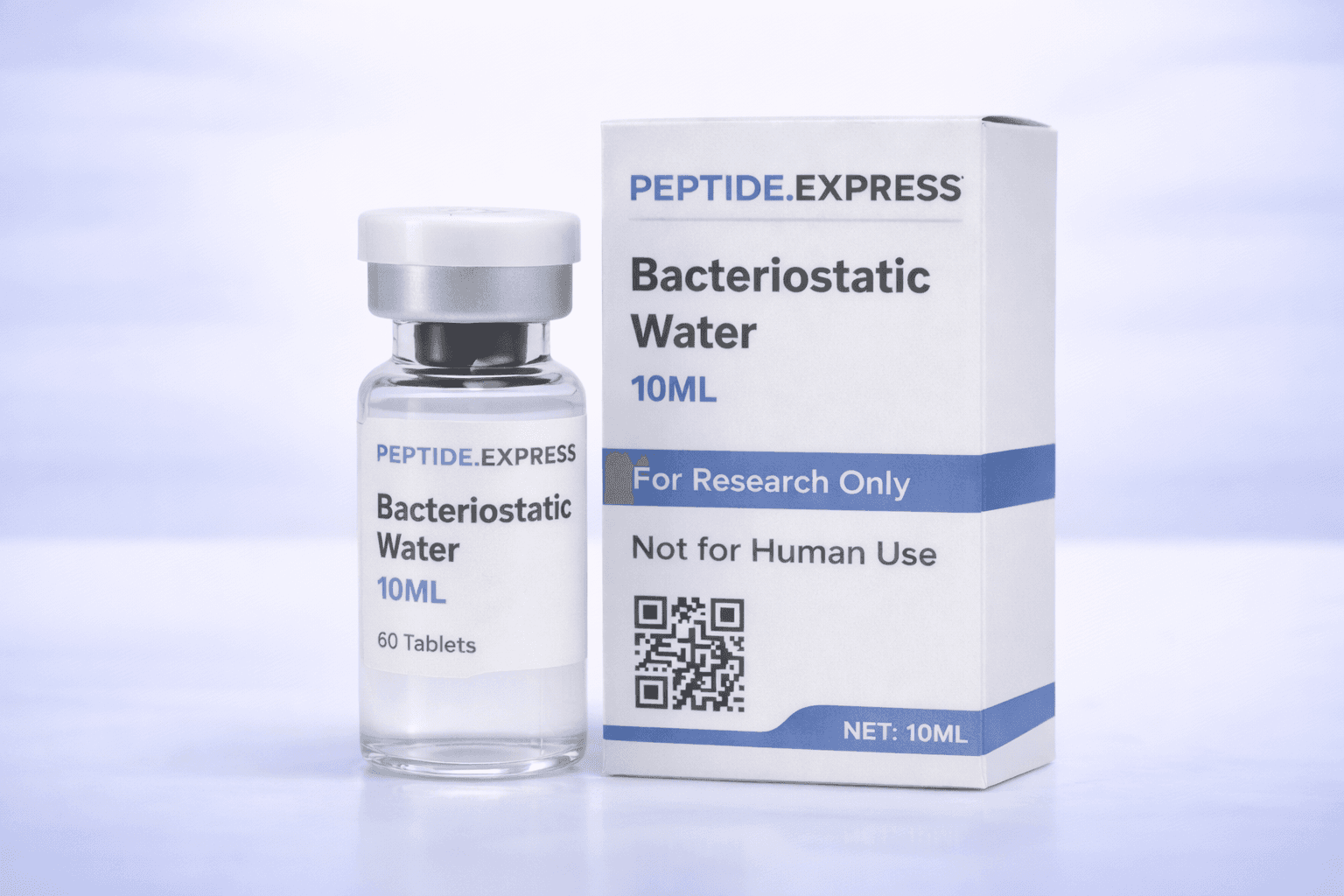
Bacteriostatic Water — Sterile Water for Injection Preserved with 0.9% Benzyl Alcohol | Multi-Use Peptide Reconstitution Diluent
Research-Grade Compound
Bacteriostatic Water for Injection is sterile water preserved with 0.9% benzyl alcohol (9 mg/mL), used as a diluent for reconstituting lyophilized compounds. It is not a research compound, has no pharmacological activity of its own, and is not intended to produce any biological effect — its entire function is to dissolve something else while resisting microbial growth between accesses to the vial.
Select Size
In-depth research overview, mechanism of action, and study applications.
No reviews yet. Be the first to review this product.
What is Bacteriostatic Water?
Bacteriostatic Water for Injection is sterile water preserved with 0.9% benzyl alcohol (9 mg/mL), used as a diluent for reconstituting lyophilized compounds. It is not a research compound, has no pharmacological activity of its own, and is not intended to produce any biological effect — its entire function is to dissolve something else while resisting microbial growth between accesses to the vial.
The preservative is the whole story. Benzyl alcohol at 0.9% is bacteriostatic rather than bactericidal: it inhibits bacterial replication without reliably killing an established population. That distinction is why a single vial can be punctured repeatedly over a defined period — typically stated as up to 28 days from first puncture, consistent with USP practice for benzyl-alcohol-preserved multi-dose containers — whereas unpreserved sterile water for injection is a single-use product from the moment a needle passes the septum. pH sits between 4.5 and 7.0. Peptide.Express supplies it in 3 mL and 10 mL multi-dose vials.
Two limits are worth stating alongside the convenience, because omitting known risks is how reference pages lose their usefulness. Benzyl alcohol is contraindicated in neonates: it was linked to fatal gasping syndrome in newborns receiving benzyl-alcohol-preserved flush solutions, and preserved diluents are excluded from neonatal use for that reason. Separately, 9 mg/mL benzyl alcohol is cytotoxic to cultured cells at anything approaching that concentration, so in-vitro assay work that adds diluent directly to a culture generally calls for preservative-free sterile water instead. Bacteriostatic water is the right default for reconstitution, not for every downstream step.
How Does Bacteriostatic Water Work? Mechanism of Action
Bacteriostatic water has no mechanism in the pharmacological sense. What it has is a preservative with a defined action, and a set of compatibility properties that determine when it is the correct diluent and when it is not.
Bacteriostatic vs Bactericidal — What Benzyl Alcohol Actually Does
Benzyl alcohol is a small aromatic alcohol that partitions into bacterial cell membranes and disrupts their permeability, interfering with the transport processes replication depends on. At 0.9% it holds a bacterial population static — organisms introduced during a septum puncture are prevented from multiplying into a meaningful contamination load. It does not sterilize. A vial that has already been contaminated heavily, or one accessed with a non-sterile needle, is not rescued by the preservative.
That is the practical meaning of bacteriostatic versus bactericidal, and it changes how the 28-day figure should be read. Twenty-eight days is not a guarantee purchased at the point of manufacture; it is the period over which the preservative can be relied on to suppress growth given proper aseptic access. Swab the septum every time, use a fresh sterile needle every time, and never return withdrawn fluid to the vial. Where the preservative system is validated, it is validated by antimicrobial effectiveness testing of the kind described in USP General Chapter <51>, which challenges a preserved formulation with defined organisms and measures whether growth is suppressed over time.
Alcohol content also has an upper bound for a reason. Higher benzyl alcohol concentrations preserve more aggressively but carry more toxicity and more risk of interacting with dissolved protein; 0.9% is the concentration that has been used and validated in preserved parenteral diluents for decades.
Diluent Compatibility and When to Choose Something Else
For lyophilized research peptides, bacteriostatic water is compatible across the board. Benzyl alcohol at 9 mg/mL does not denature peptide structures at the concentrations used in reconstitution, and the mildly acidic to neutral pH range of 4.5 to 7.0 suits most peptides better than an alkaline buffer would — peptide deamidation and disulfide scrambling both accelerate as pH rises.
There are three situations where a different diluent is the better call. Direct-to-culture in-vitro work, where the residual benzyl alcohol would be cytotoxic to the cells being studied — use preservative-free sterile water and control the osmolarity separately. Compounds with solution lifetimes shorter than the preservative advantage is worth, NAD+ being the clearest example at 24 to 48 hours; there is little point preserving a solution for 28 days that will be discarded in two. And any preparation involving neonatal or infant models, where benzyl alcohol is contraindicated outright.
Sterile 0.9% sodium chloride is the other diluent that appears in peptide protocols. It is isotonic where bacteriostatic water is not, which matters for some downstream applications, but standard saline is also unpreserved and therefore single-use. Bacteriostatic sodium chloride exists as a separate preserved product and should not be confused with either.
Research Applications of Bacteriostatic Water
Peptide Reconstitution Workflows
- Standard lyophilized peptide reconstitution: the default diluent across the Peptide.Express catalog, including BPC-157, TB-500, MOTS-c, Epithalon and SS-31.
- Concentration control: because the vial contains a known volume, the resulting mg/mL follows directly from the mass on the label — a 10 mg vial in 2 mL gives 5 mg/mL.
- Multi-vial protocols: a single 10 mL vial supplies diluent for several reconstitutions across a study, which is where the preserved format earns its place over single-use ampoules.
Multi-Use Vial Handling and Aseptic Practice
- First-puncture dating: the 28-day clock starts at first access, not at receipt, so the date belongs on the label rather than in memory.
- Septum antisepsis: 70% isopropyl alcohol with a full 30 seconds of drying time before each access — wet alcohol carried in on the needle does nothing.
- Needle discipline: a fresh sterile needle for every withdrawal, and no returning unused fluid to the vial, which is the single most common way a preserved vial gets compromised anyway.
Choosing Between Diluents
- Preservative-free sterile water for direct-to-culture in-vitro assays, where 9 mg/mL benzyl alcohol would be cytotoxic to the cells under study.
- Sterile 0.9% sodium chloride where isotonicity matters to the downstream application, accepting that unpreserved saline is single-use.
- Bacteriostatic water for anything that will be accessed more than once over days or weeks — which covers most lyophilized peptide work.
Bacteriostatic Water vs Sterile Water for Injection
| Feature | Bacteriostatic Water | Sterile Water for Injection |
|---|---|---|
| Preservative | 0.9% benzyl alcohol (9 mg/mL) | None |
| Antimicrobial action | Bacteriostatic — inhibits growth | None after the container is opened |
| Uses per vial | Multiple, with aseptic access | Single use |
| Duration after first puncture | Up to 28 days | Discard after one use |
| pH | 4.5–7.0 | 5.0–7.0 typical |
| Tonicity | Hypotonic | Hypotonic |
| Format supplied | 3 mL and 10 mL multi-dose vials | Single-dose vial or ampoule |
| Suitable for cell-culture addition | No — benzyl alcohol is cytotoxic at this concentration | Yes |
| Neonatal use | Contraindicated — benzyl alcohol | Permitted |
| Best suited to | Peptide reconstitution accessed over days or weeks | Single-preparation work and in-vitro assays |
The choice comes down to how many times the vial will be entered. One preparation, used immediately, and unpreserved sterile water is cleaner — no benzyl alcohol in the system at all. Anything accessed repeatedly over a working period needs the preservative, because sterility cannot be assumed after the first needle passes the septum.
Bacteriostatic Water Technical Specifications
| Product Name | Bacteriostatic Water for Injection |
|---|---|
| Common Synonyms | Bac water, BW, bacteriostatic water for injection USP, reconstitution solution |
| Classification | Preserved sterile diluent — not a research compound |
| Base | Sterile water for injection, USP |
| Preservative | Benzyl alcohol |
| Preservative Concentration | 0.9% (9 mg/mL) |
| Preservative Action | Bacteriostatic — inhibits bacterial growth; not bactericidal |
| pH Range | 4.5–7.0 |
| Tonicity | Hypotonic (no added electrolytes) |
| Volumes Available | 3 mL and 10 mL multi-dose vials |
| Container | Sealed glass vial with rubber septum and flip-off cap |
| Multi-Use Duration | Up to 28 days from first puncture with aseptic access |
| Preservative Standard | Antimicrobial effectiveness per USP General Chapter <51> |
| Storage | Controlled room temperature (20–25°C) or 2–8°C; do not freeze |
| Compatibility | All lyophilized research peptides in the Peptide.Express catalog |
| Not Recommended For | Direct addition to cell culture (benzyl alcohol cytotoxicity); neonatal or infant models (benzyl alcohol contraindicated) |
| Alternative Diluents | Preservative-free sterile water for injection; sterile 0.9% sodium chloride |
| Visual Standard | Clear, colorless, free of visible particulate |
| Documentation | Product and lot documentation supplied per shipment |
| Intended Use | Diluent for in-vitro laboratory research preparations only |
How to Reconstitute Bacteriostatic Water for Research
These steps describe how to use bacteriostatic water as a diluent — this product is not itself reconstituted. The habit that matters most is writing the first-puncture date on the vial. Twenty-eight days is a rule about elapsed time since the seal was first broken, and a vial with no date on it has effectively no expiry you can defend. Date it the moment the needle goes in.
- Inspect the vial before first use. The solution should be clear, colorless and free of visible particulate; the flip-off cap should be intact and the seal unbroken.
- Remove the flip-off cap and swab the exposed rubber septum with 70% isopropyl alcohol. Allow a full 30 seconds to dry before inserting anything — alcohol works while it evaporates, and a wet septum has not finished the job.
- Write the date of first puncture directly on the vial label. This starts the 28-day multi-use period, and it is the only record of it that will still be legible in three weeks.
- Draw the calculated diluent volume with a fresh sterile needle and syringe. Injecting an equal volume of air first makes withdrawal easier from a vacuum-sealed vial; do this with the same sterile needle, not a second one.
- Transfer the diluent to the peptide vial by running it slowly down the inner wall rather than firing it onto the lyophilized cake. Foaming at the air-liquid interface denatures peptide.
- Never return unused diluent to the bacteriostatic water vial. Anything that has left the vial has been outside a preserved environment and should be discarded.
- Re-swab the septum with fresh alcohol before every subsequent access, and use a new sterile needle each time. The preservative suppresses growth; it does not compensate for a contaminated needle.
- Store the vial at controlled room temperature (20–25°C) or refrigerated at 2–8°C, protected from light. Do not freeze.
- Discard the vial 28 days after first puncture, or immediately at any point if the solution becomes cloudy, develops particulate, or changes color — whichever comes first.
Diluent: bacteriostatic water for peptide reconstitution. Full protocol: step-by-step peptide reconstitution guide. Concentration maths: peptide reconstitution calculator.
Frequently Asked Questions — Bacteriostatic Water
What is bacteriostatic water?
What is the difference between bacteriostatic water and sterile water?
Is bacteriostatic water the same as saline?
What is the pH of bacteriostatic water?
Why was bacteriostatic water delisted from Amazon?
Why is benzyl alcohol used as the preservative?
How long can a bacteriostatic water vial be used after opening?
Does bacteriostatic water kill bacteria?
Can bacteriostatic water be used with all peptides?
Is benzyl alcohol safe?
How much bacteriostatic water should I use to reconstitute a peptide?
How should bacteriostatic water be stored?
What should I do if the vial looks cloudy or has particles in it?
Research References
- Meyer BK, Ni A, Hu B, Shi L. "Antimicrobial Preservative Use in Parenteral Products: Past and Present." Journal of Pharmaceutical Sciences. 2007. Read the Meyer 2007 parenteral preservative review
- Gershanik J, Boecler B, Ensley H, McCloskey S, George W. "The Gasping Syndrome and Benzyl Alcohol Poisoning." New England Journal of Medicine. 1982. Read the Gershanik 1982 gasping syndrome and benzyl alcohol case series
- FDA Drugs@FDA database: the authoritative record for Bacteriostatic Water for Injection USP as an approved drug product, including approved labelling with the benzyl alcohol concentration, pH specification and neonatal contraindication. Read the Bacteriostatic Water for Injection USP approved labelling
- United States Pharmacopeia. "General Chapter <51> Antimicrobial Effectiveness Testing." USP-NF. Read USP General Chapter 51 on Antimicrobial Effectiveness Testing
All products are sold for in-vitro laboratory research use only. Not intended for human consumption, clinical use, or veterinary use. Peptide.Express makes no medical claims. Consult the published literature for research application guidance.