Research Peptides: What "Research Grade" Actually Means
"Research grade" is not a regulatory category. No agency defines it, no body certifies it, and no legal consequence attaches to using the phrase. It is a market convention describing material synthesised and characterised to a standard suitable for laboratory work, sold on the explicit understanding that it is not for human or veterinary use.
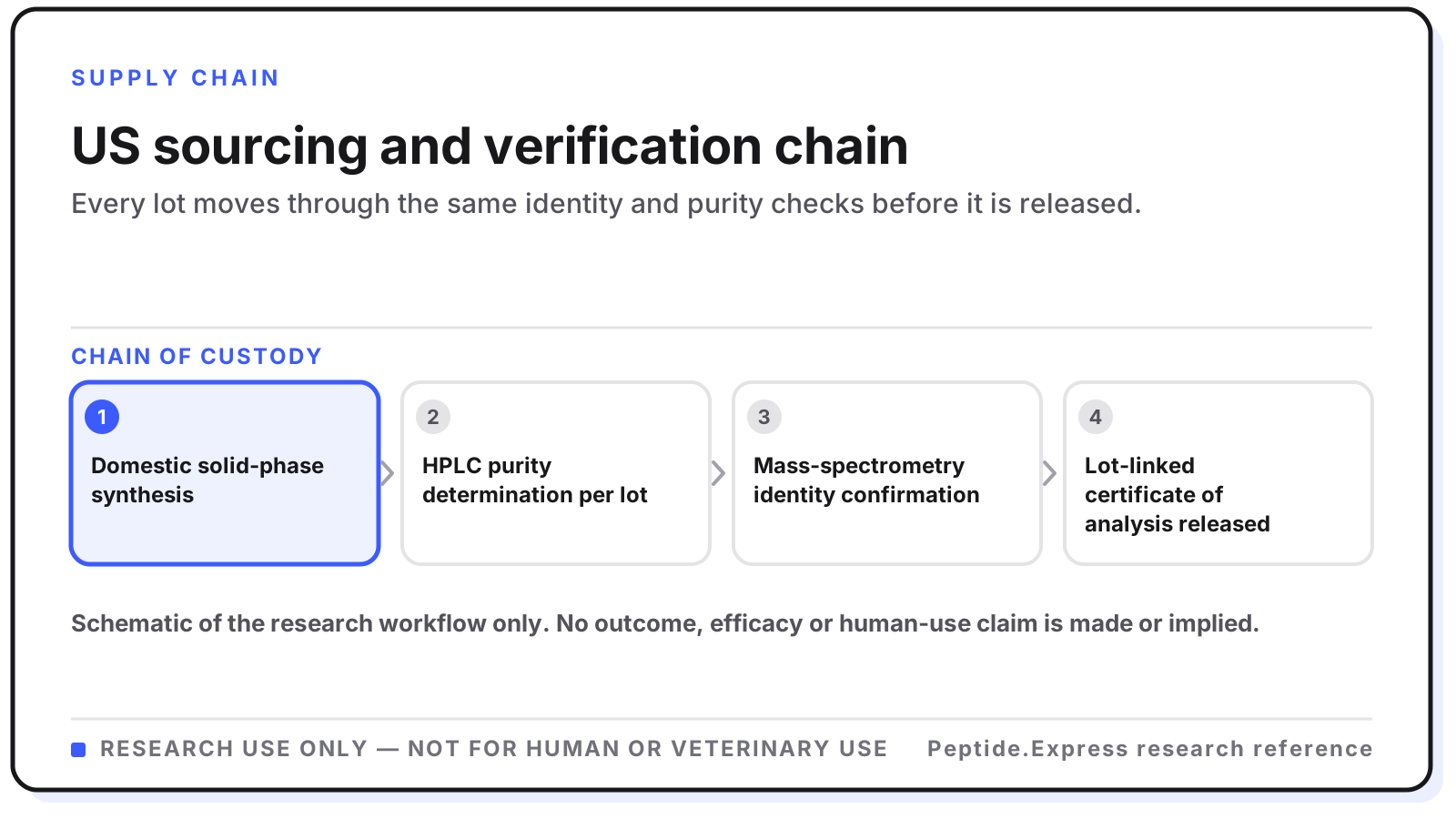
What it does mean in practice, when a supplier is operating seriously, is that the material has been made by solid-phase peptide synthesis, purified by preparative reverse-phase chromatography, and characterised by at least two orthogonal analytical methods before release. What it does not mean is that the material was produced under pharmaceutical Good Manufacturing Practice, that any regulator has reviewed the facility, or that the compound has been evaluated for safety in any species.
The gap between those two lists is where most of the confusion on this market lives. A peptide can be genuinely ≥99% pure by HPLC, correctly identified by mass spectrometry, low in endotoxin, and still be a compound with no human safety data, made in a facility no inspector has ever visited. Purity and provenance are different claims. A supplier that conflates them is either careless or hoping you will be.
The practical reading: treat analytical documentation as evidence about the material, and treat regulatory status as a separate question with a separate answer. Both matter. Neither substitutes for the other.
How to Read an HPLC Purity Figure
High-performance liquid chromatography separates a mixture by pushing it through a column packed with a stationary phase. Components that interact more strongly with the stationary phase move slower and exit later. A detector at the far end — almost always UV absorbance at 214 nm for peptides, since that wavelength catches the peptide bond — records what comes off and when. The output is a chromatogram: a baseline with peaks on it.
Purity is calculated as area under the curve. The software integrates the area of every peak, divides the target peak's area by the total area of all peaks, and reports the result as a percentage. A ≥99% figure means the target peak accounts for at least 99 percent of the total integrated detector response.
Here is what that figure does not tell you. It says nothing about what the other one percent is. A truncation product missing three residues, a deletion sequence, a diastereomer, residual trifluoroacetic acid from purification, a completely unrelated compound — all of them register as area, and none of them are distinguished by the percentage. Area under the curve is a proportion, not an inventory.
It also says nothing about anything the detector cannot see. Inorganic salts, most solvents, and water do not absorb meaningfully at 214 nm. A lyophilized peptide is typically 5 to 20 percent water and counterion by mass, and none of that appears in an HPLC purity figure. The percentage describes the peptide fraction, not the vial contents.
This is why the chromatogram itself matters more than the number derived from it. A clean trace with a single sharp peak and a flat baseline reads differently from a 99 percent figure sitting next to a shoulder on the main peak and three small satellites. A supplier who publishes the number but not the trace is asking you to accept an integration you cannot check.
- Look for the trace, not just the figure — a percentage without a chromatogram is an unverifiable claim.
- Check the baseline. Drift, noise or an unresolved shoulder on the main peak changes how the integration should be read.
- Check that the method is stated: column chemistry, gradient, detection wavelength. Different methods give different numbers on the same material.
- Remember what is invisible at 214 nm — salts, solvent and water do not appear in the purity figure at all.
What LC-MS/MS Adds That HPLC Cannot: Identity
HPLC answers "how much of this is one thing?" It does not answer "what is that thing?" Retention time is a weak identity claim — many peptides elute at similar times under a given gradient, and a wrong peptide of similar hydrophobicity will produce a chromatogram that looks entirely acceptable.
Mass spectrometry answers the identity question directly. The instrument ionises the sample and measures mass-to-charge ratio, giving a molecular weight that can be compared against the calculated value for the intended sequence. Tandem mass spectrometry goes further by fragmenting the molecule and reading the fragment masses, which reconstructs sequence information rather than just total mass. Coupled to liquid chromatography — LC-MS/MS — it gives separation and identification in one run.
The clearest illustration of why this matters is TB-500, and it is the single most useful example on this page.
The TB-500 Naming Problem
The name "TB-500" is applied across the research market to at least two chemically different products. One is the full 43-amino-acid synthetic Thymosin β-4 sequence — molecular formula C212H350N56O78S, molecular weight 4,963.4 Da, CAS 77591-33-4, containing the LKKTET actin-binding motif. The other is a short fragment centred on that same LKKTET motif, which lands somewhere around 890 Da depending on exactly which residues are included and how the termini are capped.
These are not variations on a theme. They differ by a factor of more than five in molecular weight, they have different synthesis costs, different solubility behaviour, and different pharmacological profiles. A study run on one is not comparable to a study run on the other. Yet both ship under the same three-character name, and nothing on the outside of the vial distinguishes them.
The mass on the Certificate of Analysis is the only reliable way to know which one you have. If the CoA reports a mass near 4,963.4 Da, the material is the full-length sequence. If it reports something near 890 Da, it is a fragment. If it reports no mass at all — only an HPLC percentage — then the document does not answer the question, and a supplier who cannot tell you the molecular weight of what they sold you has not characterised it.
| Compound | Expected mass | What the mass distinguishes |
|---|---|---|
| TB-500 (full Thymosin β-4) | 4,963.4 Da | Full 43-residue sequence, formula C212H350N56O78S, CAS 77591-33-4 |
| TB-500 (LKKTET fragment) | Around 890 Da | Short actin-binding motif fragment sold under the same trade name |
| GHK-Cu | 403.9 Da | Copper complex — a 340.4 Da result means the uncomplexed free tripeptide |
| BPC-157 | 1,419.5 Da | Complete 15-residue pentadecapeptide; truncations read low |
| Tesamorelin | 5,135.9 Da | Full 44-residue sequence; truncation products can co-elute with the target |
The general principle: for any peptide where a shorter fragment, a related analog, or an uncomplexed form circulates under the same or a similar name, the mass is the discriminator and the purity figure is not. Check the expected molecular weight against a published value before you read the CoA, not after.
One refinement on that, because a naive comparison against a database will occasionally produce a false alarm. Metal complexes and salt forms can be represented several ways, and different registries pick different ones. GHK-Cu is the standing example: 403.9 Da describes the neutral copper complex C14H24CuN6O4, while PubChem's GHK-Cu record indexes the anionic species C14H21CuN6O4⁻ at 400.9 Da. A 3 Da gap of that kind is a representation difference. A 63 Da gap, which is what separates the copper complex from the free tripeptide, is a different molecule. Knowing which kind of discrepancy you are looking at is the difference between a real finding and a wasted afternoon.
Research Peptides: LAL Endotoxin Testing and What It Measures
The Limulus amebocyte lysate assay detects bacterial endotoxin — lipopolysaccharide from the outer membrane of Gram-negative bacteria. The reagent is derived from horseshoe crab hemolymph, which clots in the presence of endotoxin, and the assay reads that reaction either turbidimetrically, chromogenically or by gel-clot. Results are reported in endotoxin units per milligram or per millilitre.
Endotoxin matters in cell-culture work for a reason that has nothing to do with sterility. Lipopolysaccharide is a potent immunological stimulus at picogram concentrations. It activates TLR4 signaling, drives NF-κB, and triggers inflammatory cytokine release in any cell type carrying the receptor. A peptide preparation contaminated with endotoxin will produce inflammatory readouts in an assay, and the investigator will attribute them to the peptide. Endotoxin contamination is one of the more common explanations for irreproducible inflammation results in the literature.
What LAL does not measure is equally worth knowing. It does not detect Gram-positive bacteria, fungi, mycoplasma or viruses. It does not establish sterility — a preparation can be endotoxin-free and still carry viable organisms. It does not detect non-endotoxin pyrogens. A low LAL result is one specific piece of information, not a general cleanliness certificate.
A CoA that reports endotoxin should state the method and the limit. "Passes LAL" without a numeric result and a specification is a weaker claim than it appears — pass against what threshold, measured how.
Batch-Specific vs Product-Level CoAs
A Certificate of Analysis is a record of tests performed on a specific quantity of material produced at a specific time. That is the entire concept. A CoA that is not tied to a lot is not a certificate of analysis; it is a specification sheet describing what the supplier intends to produce.
The distinction has direct consequences for reproducibility. Peptide synthesis varies batch to batch. Coupling efficiency, purification cut points, lyophilization conditions and residual counterion all shift between runs, and two lots of the same product from the same supplier can differ measurably in purity, impurity profile and salt content. If your experiment consumed material from lot A and the follow-up used lot B, the CoA for lot A tells you nothing about what went into the second run.
A usable CoA carries a lot or batch identifier that matches the label on the vial in your hand, a test date, the analytical methods used, and the numeric results with their specifications. A CoA that says only "≥99% by HPLC" with no lot number, no date and no chromatogram is a marketing document formatted to look like an analytical one.
Checking a CoA in Order
- Find the lot or batch number on the document and confirm it matches the number printed on the vial label. If the vial has no lot number, the document cannot be tied to the material.
- Check the test date. A CoA dated well before the material was synthesised describes a different lot.
- Read the compound name and compare the stated molecular weight against the published value for that sequence before accepting either.
- Look at the chromatogram, not only the purity figure — check the baseline and look for shoulders or satellite peaks on the target.
- Confirm the mass spectrometry result is present and reports an actual measured mass rather than a restated theoretical value.
- Check the endotoxin result for a numeric value and a stated specification, not just a pass.
- Identify the testing laboratory and whether it is the manufacturer or an independent facility.
- Keep the document with the experimental record. A result without the CoA for the lot that produced it is difficult to defend later.
Research Peptides: Why Third-Party Testing Independence Matters
A laboratory testing material its own organisation produced has an incentive that an outside laboratory does not: a failing result costs the company money. That incentive does not mean in-house results are wrong. Plenty of manufacturers run excellent internal analytics and report honestly. It means the check has no structural independence, and structural independence is what makes a result difficult to quietly adjust.
Independent testing removes the conflict by putting the analysis in the hands of a party with no stake in the outcome. The analytical chemistry is identical — same instruments, same methods. What changes is who bears the cost of a failure, and that is the part that makes the number harder to bend.
Verifying independence is more work than reading a logo. The useful questions: is the testing laboratory named on the CoA, is it a separate legal entity from the supplier, does the document carry the laboratory's own reporting format rather than the supplier's branding, and is there a contact route to the laboratory. A CoA presented as third-party but issued on the seller's letterhead with no laboratory named is not evidence of independence.
One honest caveat about the whole framework: none of this is audited. There is no regulator checking that a research peptide supplier's CoAs correspond to the material shipped. The documentation model on this market rests on reputation and on buyers who actually read what they are sent. That is a weaker guarantee than pharmaceutical supply chains provide, and pretending otherwise would be dishonest.
Research Peptides: Red Flags When Evaluating Any Supplier
These apply to every vendor on this market, including the one publishing this page. Each is a signal that documentation is being presented rather than performed.
| Red flag | What it suggests |
|---|---|
| A purity claim with no chromatogram | The integration cannot be checked. The number may be accurate; there is no way to tell. |
| One CoA reused across every batch | The document is a specification sheet, not a record of tests on the material shipped. |
| No lot number on the vial | No document can be tied to the material, which breaks reproducibility at the first step. |
| Molecular weight that does not match published values | Either a different molecule, a different salt form, or a transcription error. All three need resolving before use. |
| "99%+" style claims with no stated method | Purity is method-dependent. A percentage without a method and a wavelength is not a measurement. |
| No mass spectrometry result at all | Identity has not been confirmed. For any compound with a fragment or analog circulating under the same name, this is disqualifying. |
| Endotoxin reported as "passes" with no value | Pass against what limit, by what method. Unspecified thresholds are not results. |
| Human dosing guidance on a research product page | The supplier is not operating within the research-use framing the material is legally sold under. |
A note on the purity string itself, since it is where sloppiness shows first. "99%+" and "≥99%" are not interchangeable notation. The second states a specification with a defined floor; the first is a marketing formulation. Sourced against a ≥99% HPLC purity specification. Third-party Certificates of Analysis are published where on file. The notation is deliberate: a specification you can hold a supplier to has to be written as one.
The broader point stands independently of who is selling. If a supplier cannot produce a batch-specific document naming the testing laboratory, showing the chromatogram, reporting a measured mass and stating an endotoxin figure against a limit, then the analytical claims are assertions. Buy from whoever can produce those four things.
The Regulatory Reality, Stated Plainly
Most compounds sold on the research peptide market are not FDA-approved for human use. Not "pending approval", not "approved elsewhere" — not approved, with no application under review in most cases. BPC-157, TB-500, GHK-Cu, MOTS-c and the majority of the catalog fall into this category. Approval status can be checked directly in the FDA drug database rather than taken from a supplier's description.
A small number of exceptions exist and they are worth understanding precisely. Tesamorelin is FDA-approved as the drug product EGRIFTA SV for the reduction of excess abdominal fat in HIV-infected adult patients with lipodystrophy. That approval covers a specific manufactured pharmaceutical for a specific indication. It does not extend to research-market material carrying the same molecule name, which is not a drug product, is not made under pharmaceutical GMP, and is not sold as a substitute for one.
Several of these compounds are prohibited by the World Anti-Doping Agency, and the category they fall under differs in a way worth getting right. BPC-157 is prohibited at all times under S0, the non-approved substances catch-all. TB-500 sits in S2 instead, as a growth factor affecting tissue regeneration. GHRH and its analogues — tesamorelin, sermorelin, CJC-1295 — are prohibited at all times as growth hormone releasing factors. Check any specific compound against the current Prohibited List rather than against this paragraph: the list is revised annually and substances move between sections. Any research involving competitive athletes as subjects has a regulatory problem no Certificate of Analysis addresses.
And the manufacturing point, which is the one most often left unsaid: research-market peptide is not produced under pharmaceutical GMP. There is no facility inspection regime, no batch release by a qualified person, no regulatory filing describing the process. Good analytical documentation raises confidence in a specific lot. It does not convert research material into pharmaceutical material, and no supplier claim should be read as though it does.
Frequently Asked Questions
What does "research grade" mean for peptides?
It is a market convention, not a regulatory category. In practice it describes material made by solid-phase synthesis, purified chromatographically and characterised by at least two analytical methods, sold for laboratory use only. It does not mean the material was produced under pharmaceutical GMP, inspected by a regulator, or evaluated for safety in any species.
What does an HPLC purity percentage actually measure?
Area under the curve. The chromatography software integrates every peak in the trace and divides the target peak area by the total, reporting the result as a percentage. It tells you what proportion of the detector response comes from the target peptide. It does not tell you what the remaining fraction consists of, and it does not see anything transparent at the detection wavelength — salts, solvent and water do not appear in the figure at all.
Why does a chromatogram matter if the purity figure is already stated?
Because the figure is an integration and the trace is the data behind it. A clean single peak on a flat baseline reads very differently from the same percentage sitting next to a shoulder on the main peak and several small satellites. Without the trace you are accepting an integration you cannot check.
What does LC-MS/MS add that HPLC cannot?
Molecular identity. HPLC separates and quantifies but identifies only by retention time, which is a weak claim — a different peptide of similar hydrophobicity elutes at a similar point. Mass spectrometry measures mass-to-charge ratio directly, giving a molecular weight comparable against the calculated value for the intended sequence, and tandem MS fragments the molecule to reconstruct sequence information.
Why is TB-500 the standard example of why mass confirmation matters?
Because the name is applied across the market to at least two different molecules. One is the full 43-amino-acid synthetic Thymosin β-4 sequence at 4,963.4 Da containing the LKKTET actin-binding motif. The other is a short LKKTET-centred fragment landing around 890 Da. They differ by more than a factor of five in molecular weight and are not interchangeable in any study. Nothing on the vial distinguishes them — the mass on the CoA is the only reliable discriminator.
What is the molecular weight of full-length TB-500?
4,963.4 Da, molecular formula C212H350N56O78S, CAS 77591-33-4, as the complete 43-residue synthetic Thymosin β-4 sequence.
What does LAL endotoxin testing detect?
Bacterial endotoxin — lipopolysaccharide from the outer membrane of Gram-negative bacteria. The horseshoe-crab-derived reagent clots in its presence, and the reaction is read turbidimetrically, chromogenically or by gel-clot, reported in endotoxin units per milligram or millilitre.
Does a low endotoxin result mean the material is sterile?
No. LAL detects one specific class of contaminant. It does not detect Gram-positive bacteria, fungi, mycoplasma, viruses or non-endotoxin pyrogens, and a preparation can be endotoxin-free while carrying viable organisms. Endotoxin testing and sterility are separate questions with separate methods.
Why does endotoxin contamination matter in cell culture?
Lipopolysaccharide activates TLR4 signaling at picogram concentrations, drives NF-κB, and triggers inflammatory cytokine release in any cell expressing the receptor. A contaminated peptide preparation produces inflammatory readouts that the investigator then attributes to the peptide. It is one of the more common explanations for irreproducible inflammation results.
What is the difference between a batch-specific and a product-level CoA?
A batch-specific CoA records tests performed on the actual lot you received, tied to a lot number that matches the vial label. A product-level document describes what the supplier intends to produce. Since synthesis varies run to run in coupling efficiency, purification cut points and residual counterion, only the batch-specific document tells you anything about the material in your hand.
What should a usable Certificate of Analysis contain?
A lot or batch identifier matching the vial label, a test date, the analytical methods used, an HPLC chromatogram with the purity figure, a measured mass from mass spectrometry, an endotoxin result with a stated specification, and the name of the testing laboratory. A document listing only a purity percentage is a specification sheet formatted to resemble an analytical record.
Why does third-party testing independence matter?
A laboratory testing material its own organisation produced bears the cost of a failing result. That does not make in-house analytics wrong — many manufacturers run good internal testing and report it honestly. It means the check has no structural independence. An outside laboratory with no stake in the outcome removes the incentive, which is what makes the number harder to bend.
How can I tell whether testing was genuinely independent?
Check whether the testing laboratory is named on the CoA, whether it is a separate legal entity from the supplier, whether the document uses the laboratory's own reporting format rather than the seller's branding, and whether there is a contact route to the laboratory. A document presented as third-party on the seller's letterhead with no laboratory named is not evidence of independence.
What are the clearest red flags when evaluating a supplier?
A purity claim with no chromatogram, a single CoA reused across every batch, no lot number on the vial, a molecular weight that does not match published values for the sequence, "99%+" style claims with no stated test method, no mass spectrometry result at all, and human dosing guidance appearing on a research product page. Each indicates documentation being presented rather than performed.
Is "99%+" the same as "≥99%"?
Not as notation. "≥99%" states a specification with a defined floor that a supplier can be held to. "99%+" is a marketing formulation with no stated method behind it. Purity is method-dependent — the same material gives different numbers under different columns, gradients and detection wavelengths — so a percentage without a method is not a measurement.
Are research peptides FDA-approved?
Most are not. BPC-157, TB-500, GHK-Cu, MOTS-c and the majority of the market have no FDA approval for human use. Tesamorelin is the notable exception, approved as the drug product EGRIFTA SV for reduction of excess abdominal fat in HIV-infected adult patients with lipodystrophy — an approval covering a specific manufactured pharmaceutical for a specific indication, which does not extend to research-market material of the same molecule. Approval status can be checked directly in the FDA drug databases.
Which research peptides are WADA-prohibited?
BPC-157 is prohibited at all times under S0, the non-approved substances category. TB-500 is prohibited at all times under S2 as a growth factor affecting tissue regeneration. GHRH and its analogues — tesamorelin, sermorelin, CJC-1295 — are prohibited at all times as growth hormone releasing factors. The Prohibited List is revised annually and substances move between sections, so check the current edition for any specific compound. Any study involving competitive athletes as subjects carries a regulatory issue that analytical documentation does not address.
Is research peptide material made under pharmaceutical GMP?
No. There is no facility inspection regime, no batch release by a qualified person and no regulatory filing describing the process for research-market peptide. Good analytical documentation raises confidence in a specific lot. It does not convert research material into pharmaceutical material, and no supplier claim should be read as though it does.
References
- U.S. Food and Drug Administration. "Analytical Procedures and Methods Validation for Drugs and Biologics: Guidance for Industry." July 2015. Read the FDA guidance on analytical procedures and methods validation
- United States Pharmacopeia. "General Chapter <85> Bacterial Endotoxins Test." USP-NF. Read USP General Chapter 85 on Bacterial Endotoxins Testing
- Drugs@FDA, the FDA database of approved drug products. The authoritative route for checking whether a given compound holds a US approval and for which indication, rather than relying on a supplier description. Check approval status in the FDA drug databases
- EGRIFTA SV (tesamorelin for injection) prescribing information, Theratechnologies Inc., via DailyMed. Included as a worked example of what regulator-reviewed documentation contains, against which a research-market Certificate of Analysis can be read. Read the EGRIFTA SV prescribing information on DailyMed