What the Wolverine Stack Is, and Where the Name Came From
The "Wolverine Stack" is a research-market name for the combination of BPC-157 and TB-500. It has no formal designation, no regulatory identity and no standards body behind it — the name is borrowed from the comic-book character with accelerated healing, and it stuck because it describes the intent of the combination rather than its chemistry.
What sits underneath the name is a real pharmacological argument, and it is more specific than "two repair peptides are better than one." BPC-157 and TB-500 do not compete for the same target. They act at different points of the tissue-repair cascade, on different cell populations, with different spatial scope. One activates repair machinery where it is introduced. The other mobilises the cells that repair machinery needs.
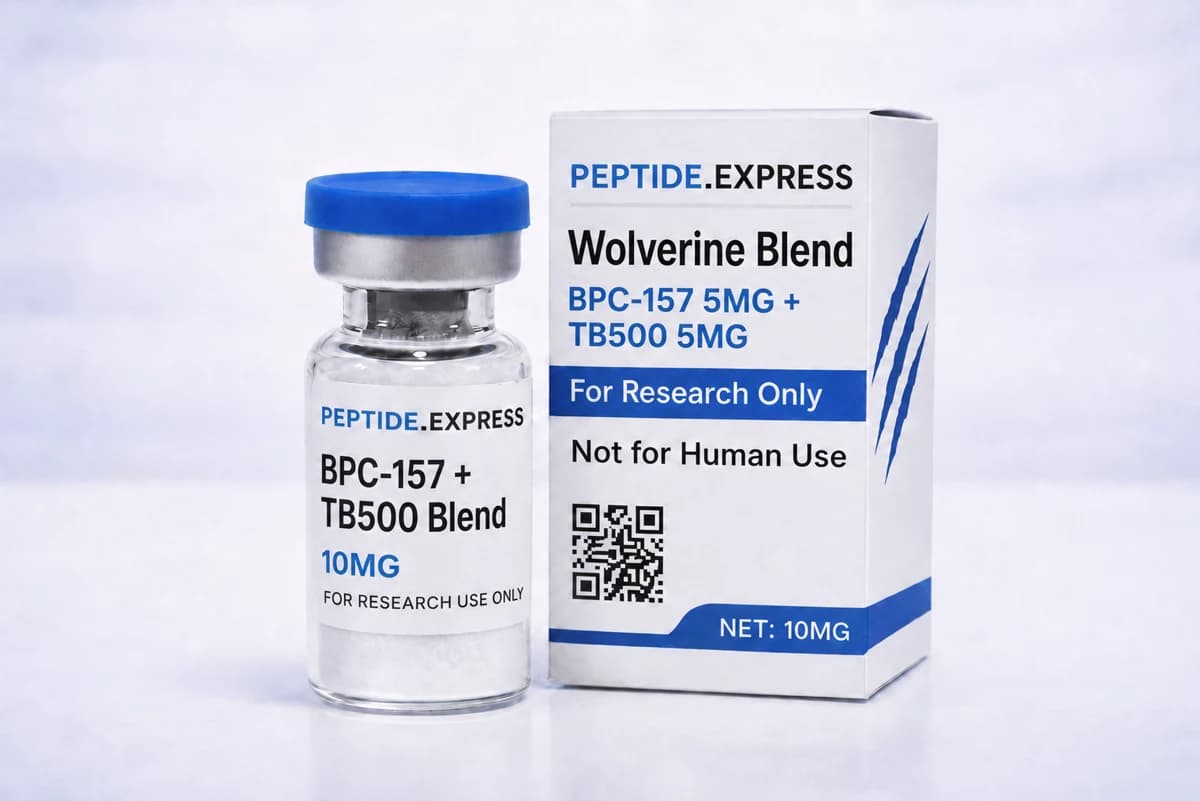
Peptide.Express supplies the pairing two ways: as a pre-blended single vial (Wolverine Blend) and as a two-vial kit with each compound separate. That is not a packaging preference — it is a study-design decision, and the section on experimental design below explains why the separate-vial format is the only one that supports mechanism attribution.
BPC-157 vs TB-500: Full Comparison
| Property | BPC-157 | TB-500 |
|---|---|---|
| Full name | Body Protection Compound-157 | Synthetic Thymosin β-4 (Tβ4) |
| Origin | Fragment of a protein sequence in human gastric juice | Endogenous protein present in nearly all nucleated human cells |
| Amino acid count | 15 (pentadecapeptide) | 43 |
| Sequence | GEPPPGKPADDAGLV | Ac-SDKPDMAEIEKFDKSKLKKTETQEKNPLPSKETIEQEKQAGES (the LKKTET motif is residues 17–22) |
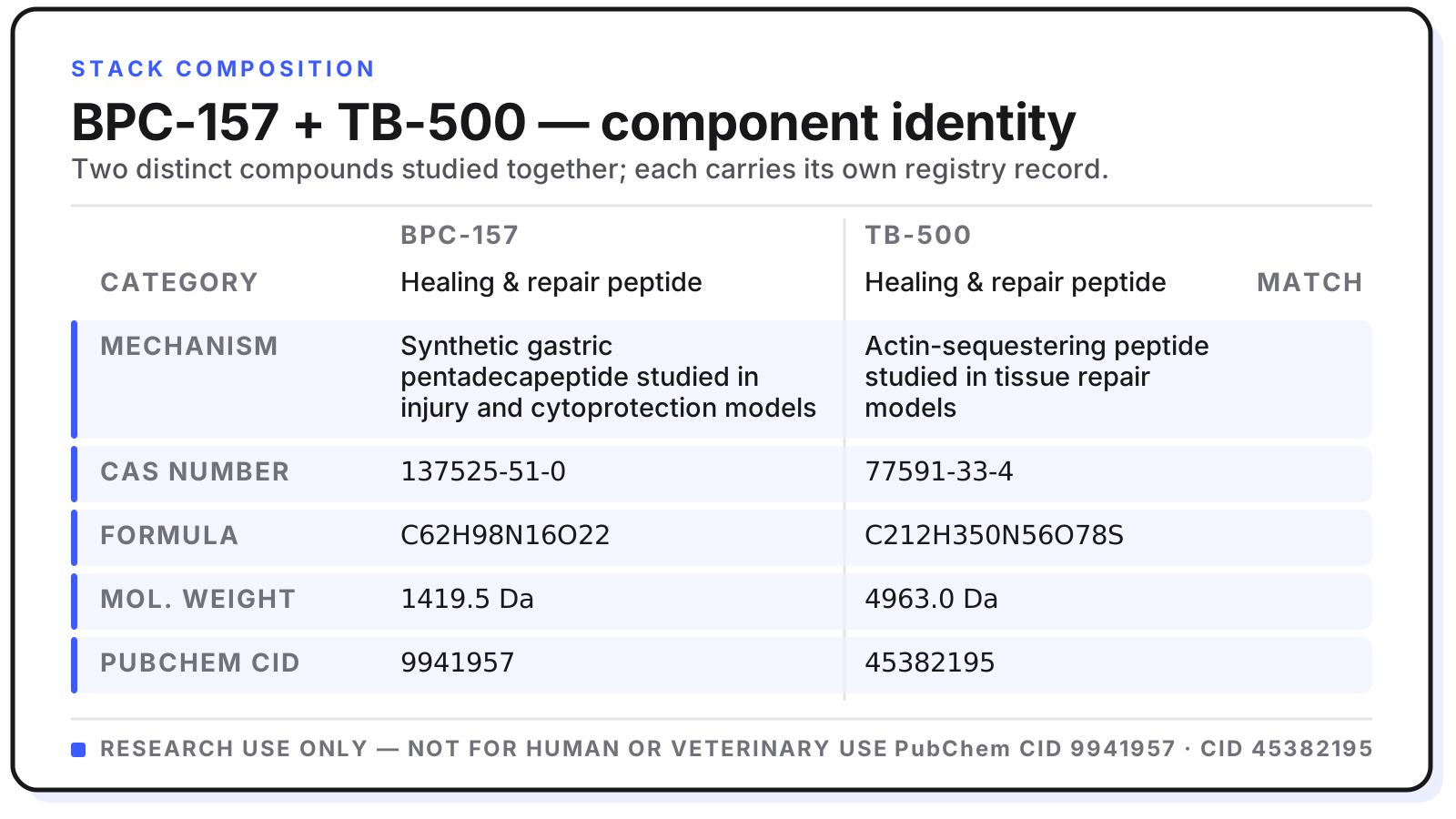
| Molecular formula | C62H98N16O22 | C212H350N56O78S |
| Molecular weight | 1,419.5 Da | 4,963.4 Da |
| CAS number | 137525-51-0 | 77591-33-4 |
| Primary mechanism | VEGF upregulation driving angiogenesis | G-actin sequestration via the LKKTET motif |
| Secondary mechanism | Focal adhesion kinase and paxillin activation; nitric oxide synthase pathway interaction | Angiogenic activity; reduction of pro-inflammatory cytokine activity |
| Spatial scope | Largely local to the site of introduction | Systemic across multiple tissues |
| Cell populations affected | Fibroblasts, endothelial cells at the local site | Endothelial cells, keratinocytes, progenitor populations system-wide |
| Identified receptor | None identified | None identified; acts through direct actin binding |
| Gastrointestinal evidence | Strong — the compound’s origin tissue | Limited |
| Tendon and ligament evidence | Strong (rodent Achilles tendon models) | Strong |
| Human clinical work | None completed | Thymosin β-4 investigated in corneal and cardiac trials |
| WADA status | Prohibited at all times | Prohibited at all times |
| FDA status | Not approved; Category 2 for bulk compounding | Not approved |
The rows that carry the argument are spatial scope and cell population. Everything else in the table describes two peptides that happen to appear in the same research area. Those two rows describe two peptides that occupy adjacent positions in one process.
BPC-157: Activating Repair Where It Is Placed
BPC-157 is a synthetic 15-amino-acid pentadecapeptide — GEPPPGKPADDAGLV, molecular formula C62H98N16O22, molecular weight 1,419.5 Da, CAS 137525-51-0 — corresponding to a partial region of a protein found in human gastric juice. It does not occur naturally as a standalone peptide; the fragment was designed for research and has been studied far more than the parent protein it derives from.
The most replicated preclinical mechanism is upregulation of VEGF, the vascular endothelial growth factor that drives new capillary formation. Vasculature is the rate-limiting input to a repair site — nutrients, oxygen and circulating cells all arrive through it — which is why a single angiogenic mechanism accounts for so much of the observed effect across injury models that otherwise have nothing in common. Gastric mucosa and Achilles tendon are not similar tissues, and BPC-157 shows activity in both.
A second arm runs through focal adhesion kinase and paxillin. These proteins govern how a cell grips its substrate and whether it can move across it, and their activation accelerates fibroblast migration into a wound bed. In tendon work the downstream consequence shows up as collagen fiber alignment rather than only collagen quantity, which matters because tensile strength depends on organisation as much as on mass.
A third arm involves the nitric oxide synthase pathway, which appears to underlie much of the compound’s anti-inflammatory activity and its counter-regulation of NSAID-induced gastric damage in rodent preparations.
What none of this includes is a receptor. More than a hundred preclinical papers and no BPC-157 receptor has been identified. VEGF upregulation and focal adhesion kinase activation are downstream observations, not a binding story, and a study design that treats either as a proximal event is claiming more than the literature supports. That gap is worth stating explicitly in a methods section rather than glossing.
TB-500: Recruiting Cells From Elsewhere
TB-500 is the research-market name for synthetic Thymosin β-4 — 4,963.4 Da, CAS 77591-33-4, molecular formula C212H350N56O78S. Thymosin β-4 is endogenous and abundant. The Goldstein, Hannappel and Kleinman review cited below puts cytosolic concentrations in the region of 0.5 mM across virtually all nucleated human cells, which is enough to place it among the most plentiful intracellular proteins there is. The peptide carries the LKKTET hexapeptide at residues 17–22, and that is where the actin binding happens.
The mechanism is mechanical in the most literal sense. Actin exists in two states: G-actin, the free monomeric form, and F-actin, the polymerised filaments that make up the cytoskeleton. The equilibrium between them determines whether a cell is locked into its current shape or able to remodel and move. TB-500 binds free G-actin and shifts that equilibrium, which releases cells from actin-mediated immobility.
The consequence is migration. Endothelial cells, keratinocytes and progenitor populations become able to travel toward a repair site from wherever they happen to be in the system. Migration is not an optional accelerant in tissue repair — it is a prerequisite. A repair site with adequate vasculature and no arriving cells does not heal, and that fact is the entire basis of the combination argument in the next section.
TB-500 also shows angiogenic activity of its own and reduces pro-inflammatory cytokine activity in injury models. Its strongest preclinical signal appears in cardiac, corneal and dermal wound preparations. Thymosin β-4 has reached human clinical investigation in corneal and cardiac indications, which is more than can be said for most compounds in this category and is worth knowing when weighing the evidence bases of the two peptides against each other.
Why the Two Are Complementary Rather Than Redundant
The common framing — "both help tissue repair, so stack them" — gets the conclusion right for the wrong reason. Two compounds hitting the same target would be redundant, and a redundant combination adds cost, adds a variable and adds nothing else. BPC-157 and TB-500 are interesting precisely because they do not overlap.
Lay the mechanisms out in sequence and the structure becomes visible. Tissue repair requires, in rough order: a vascular supply to the damaged region, a signal that recruits cells capable of rebuilding, the physical arrival of those cells, and then matrix deposition and organisation. BPC-157 acts on the first of those and contributes to the last through fibroblast behaviour and collagen alignment. TB-500 acts on the third, releasing the cytoskeletal brake that determines whether cells can travel at all.
Spatial scope reinforces the separation. BPC-157 acts largely where it is introduced — in rodent tendon and gastrointestinal models the effect concentrates at the local site rather than distributing. TB-500 does the opposite, moving through the system and coordinating migration across multiple tissues at once. Local activation plus systemic recruitment is not two attempts at the same thing. It is two halves of one process.
That said, the strength of this argument should be characterised accurately. It is a mechanistic inference drawn from separate literatures. Each compound’s mechanism is reasonably well described on its own; the claim that combining them produces the sequential cascade described above has not been demonstrated in a published experiment. Reasonable inference and demonstrated result are different categories of evidence, and conflating them is how this field ends up with confident claims that nothing supports.
The TB-500 Naming Problem — Verify by Mass
There is a real and under-discussed problem with the label "TB-500," and it will silently invalidate a comparison between studies or between suppliers if nobody checks for it.
Some suppliers use "TB-500" for the full 43-residue synthetic Thymosin β-4 sequence at 4,963.4 Da. Others use the same name for short fragments containing the LKKTET actin-binding motif — a seven-residue peptide such as Ac-LKKTETQ, which comes in around 890 Da. That is roughly a fifth of the mass. Two vials labelled identically can contain molecules that differ by a factor of five and a half.
Whether the short fragment reproduces the activity of the full-length protein is a legitimate open question and not the point here. The point is that if a protocol assumes full-length Tβ4 and the vial contains a heptapeptide, then the molar quantity is wrong by roughly 5.5-fold, and every conclusion drawn about concentration-dependence is wrong with it. A study comparing "TB-500" results against a published Thymosin β-4 paper may be comparing two different compounds without knowing it.
The fix is straightforward and takes one look at the paperwork. The molecular weight reported on a certificate of analysis, where one is on file, tells you which molecule is in the vial. Full-length synthetic Tβ4 confirms at 4,963.4 Da. A short LKKTET fragment confirms near 890 Da — roughly a fifth of that. Peptide.Express supplies the full sequence and the CoA states the mass. The general practice matters more than any one vendor: read the mass, do not read the name.
Wolverine Stack: Designing a Study That Can Attribute an Effect to Either Compound
Four arms are the minimum for attributing an in-vitro result to either compound: vehicle, each compound alone, and the combination. A design with only a combination arm and a vehicle arm cannot tell you anything about mechanism. It can tell you that something happened. It cannot tell you which compound produced it, whether both contributed, or whether one is doing all the work while the other adds nothing but expense.
That distinction matters more here than it would for a combination of two compounds with overlapping targets, because the whole justification for this pairing is a claim about mechanism. If the claim is that BPC-157 supplies local vascular activation and TB-500 supplies systemic recruitment, then the design has to be capable of separating those two contributions. A pre-blended vial cannot do that, which is the practical argument for the two-vial kit format in mechanistic work.
Minimum arm structure for mechanism attribution
- Vehicle control — diluent alone, establishing the assay baseline and the spontaneous repair rate of the model system.
- BPC-157 single-compound arm — isolating the local, VEGF-driven contribution against vehicle.
- TB-500 single-compound arm — isolating the actin-mediated migration contribution against vehicle.
- Combination arm — prepared so that each compound is present at the same concentration used in its own single-compound arm, otherwise a combination effect is confounded with a concentration change.
- Confirm both compound identities by the molecular weight reported on the certificate of analysis, where one is on file (1,419.5 Da for BPC-157 and 4,963.4 Da for TB-500) before the experiment begins, and record the batch identifiers alongside the results.
With those four arms in place, the interesting readouts become available. Combination greater than the sum of the two single-compound arms indicates synergy. Combination approximately equal to the sum indicates independent additive action, which is what the sequential-cascade model actually predicts. Combination approximately equal to the better single-compound arm indicates that one compound is carrying the result — a finding that is more useful than an unattributed positive, and one that a two-arm design would have hidden entirely.
Endpoint choice deserves the same care. VEGF expression and local capillary density read the BPC-157 arm. Cell migration assays — scratch closure, transwell migration, G-actin to F-actin ratio — read the TB-500 arm. A study measuring only gross healing outcome collects the sum of both mechanisms and can attribute it to neither. Running a mechanistic readout for each compound alongside the functional endpoint is what converts a result into an explanation.
What the Evidence Does Not Cover
No published pharmacokinetic study exists for BPC-157 and TB-500 administered together. Not a limited one — none. There is no combined plasma concentration profile, no assessment of whether either compound alters the absorption, distribution or clearance of the other, and no half-life figure for the pairing. Everything written about the Wolverine Stack, including this guide, is assembled from two separate single-compound literatures.
The individual evidence bases are also less symmetrical than the pairing implies. BPC-157 has a large preclinical corpus, dominated by rodent models and by one research group in particular, with no completed human trial. Thymosin β-4 has a smaller preclinical corpus in this application but has reached human clinical investigation in corneal and cardiac indications. Those are different kinds of evidence at different stages, and a combination protocol inherits the weaker of the two for any claim that depends on both.
A third gap concerns formulation. In the pre-blended format, two peptides differing by a factor of 3.5 in molecular weight share a vial and a diluent. Whether their dissolution behaviour, stability or shelf life in solution differs from either compound alone has not been characterised in print. The two-vial kit sidesteps the question entirely, which is a second reason to prefer it where the study design permits.
None of this makes the combination unreasonable to study. It makes it exploratory, and a study record that says so is more defensible than one that presents inferred mechanism as established fact.
On sourcing: components are sourced against a ≥99% HPLC purity specification; where a third-party certificate of analysis is on file, it is published on the lab results page. For this pairing the mass confirmation is doing more work than usual, because of the TB-500 naming problem described above. A CoA that states the measured mass is what turns a market name into a known molecule.
Frequently Asked Questions
What is the Wolverine Stack?
A research combination of BPC-157 and TB-500, named for the comic-book character rather than by any formal designation. The pairing is studied because the two compounds act at different points of the tissue-repair cascade: BPC-157 drives local angiogenesis through VEGF upregulation, and TB-500 enables systemic cell migration through G-actin sequestration.
What is the difference between BPC-157 and TB-500?
Size, mechanism and scope. BPC-157 is a 15-amino-acid peptide (GEPPPGKPADDAGLV, 1,419.5 Da) that upregulates VEGF and acts largely at the site where it is introduced. TB-500 is synthetic Thymosin β-4 (4,963.4 Da), roughly 3.5 times the molecular weight, which binds monomeric G-actin through the LKKTET motif and enables cell migration throughout the system. They occupy adjacent steps of one repair process rather than competing for the same target.
Why are BPC-157 and TB-500 used together in research?
Because tissue repair needs both a locally activated repair site and cells arriving at it. BPC-157 supplies the first through VEGF-mediated angiogenesis; TB-500 supplies the second by releasing the actin-mediated brake that keeps cells stationary. A repair site with adequate vasculature and no arriving cells does not heal, which is the sequential logic behind the pairing.
Are BPC-157 and TB-500 redundant with each other?
No. They act on different cell populations, through different mechanisms, at different spatial scope. Neither one substitutes for the other in a study design that depends on both arms.
Is there any study of BPC-157 and TB-500 administered together?
No published pharmacokinetic study of the combination exists. There is no combined plasma profile, no half-life for the pairing, and no assessment of whether either compound affects the disposition of the other. Everything written about the combination is inferred from two separate single-compound literatures.
What is the LKKTET motif?
The six-residue actin-binding sequence within Thymosin β-4. It is where the peptide binds monomeric G-actin, which is how it shifts the G-actin to F-actin equilibrium that determines whether a cell can change shape and migrate.
Is TB-500 the same as Thymosin beta-4?
It depends on the supplier, which is exactly the problem. Some sell "TB-500" as the full 43-residue synthetic Tβ4 at 4,963.4 Da; others sell short LKKTET-containing fragments such as Ac-LKKTETQ, roughly 890 Da, under the same name. Confirm the molecular weight reported on the certificate of analysis, where one is on file, rather than trusting the label.
How do I check which TB-500 molecule I actually have?
Read the molecular weight reported on the certificate of analysis, where one is on file. Full-length synthetic Thymosin β-4 confirms at 4,963.4 Da. A short LKKTET fragment confirms near 890 Da. If the paperwork does not state a measured mass, the molecular identity of the vial is unverified and any molar calculation from it is unreliable.
Why does the TB-500 naming ambiguity matter for a study?
Because a 5.5-fold mass difference between the full-length peptide and a short fragment means a protocol built on one and run with the other is off by that factor in molar terms. Every concentration-dependence conclusion inherits the error, and a comparison against published Thymosin β-4 literature may be comparing two different molecules.
Does BPC-157 have a known receptor?
No. Despite more than a hundred preclinical papers, no BPC-157 receptor has been identified. VEGF upregulation and focal adhesion kinase activation are downstream observations rather than a binding mechanism, and study designs should say so rather than treating them as proximal events.
Should I use the pre-blended Wolverine Blend or the separate-vial kit?
For mechanism work, the separate-vial kit. Attributing an effect to either compound requires single-compound arms alongside the combination arm, and a pre-blended vial cannot produce those. The blend is appropriate where the combined condition is the only one being studied and attribution is not a goal.
What control arms does a BPC-157 plus TB-500 study need?
Four at minimum: vehicle, BPC-157 alone, TB-500 alone, and the combination, with each compound present in the combination arm at the same concentration as in its own single-compound arm. Without the two single-compound arms, a positive result cannot be attributed to either compound, and the combination may be carried entirely by one of them.
What endpoints separate the two mechanisms?
VEGF expression and local capillary density read the BPC-157 contribution. Migration assays — scratch closure, transwell migration, or the G-actin to F-actin ratio itself — read the TB-500 contribution. A study measuring only gross healing outcome collects both and can attribute neither.
Are BPC-157 and TB-500 banned by WADA?
Yes. Both are prohibited at all times, in and out of competition.
Is either compound FDA-approved?
Neither is approved for human therapeutic use. BPC-157 was placed in FDA Category 2 of the bulk drug substances review for compounding. Thymosin β-4 has been investigated in human corneal and cardiac trials but holds no approval, and TB-500 as sold for research is not an approved product.
How are BPC-157 and TB-500 verified before shipping?
Components are sourced against a ≥99% HPLC purity specification. A Certificate of Analysis is published where one is on file, and for TB-500 the stated mass is the check that resolves the naming ambiguity.
References
- McGuire FP, Martinez J, Lenz CG, Skinner CM, Cushman DM. "Regeneration or Risk? A Narrative Review of BPC-157 for Musculoskeletal Healing." Current Reviews in Musculoskeletal Medicine, 2025;18(12):611–619. Covers the VEGF and focal adhesion kinase mechanisms and is direct about the limits of the current evidence base. Read the BPC-157 musculoskeletal healing review on PMC
- Sikiric P, Boban Blagaic A, Strbe S, et al. "The Stable Gastric Pentadecapeptide BPC 157 Pleiotropic Beneficial Activity and Its Possible Relations with Neurotransmitter Activity." Pharmaceuticals, 2024. Read the Sikirić BPC-157 pleiotropic-activity review on PMC
- Staresinic M, Sebecic B, Patrlj L, et al. "Gastric Pentadecapeptide BPC 157 Accelerates Healing of Transected Rat Achilles Tendon and In Vitro Stimulates Tendocytes Growth." Journal of Orthopaedic Research, 2003. Read the BPC-157 rat Achilles tendon healing study on PubMed
- Goldstein AL, Hannappel E, Kleinman HK. "Thymosin Beta4: Actin-Sequestering Protein Moonlights to Repair Injured Tissues." Trends in Molecular Medicine, 2005. Read the thymosin β4 actin-sequestration and tissue-repair review on PubMed