Shop
QualityLab ResultsPartner
Log In
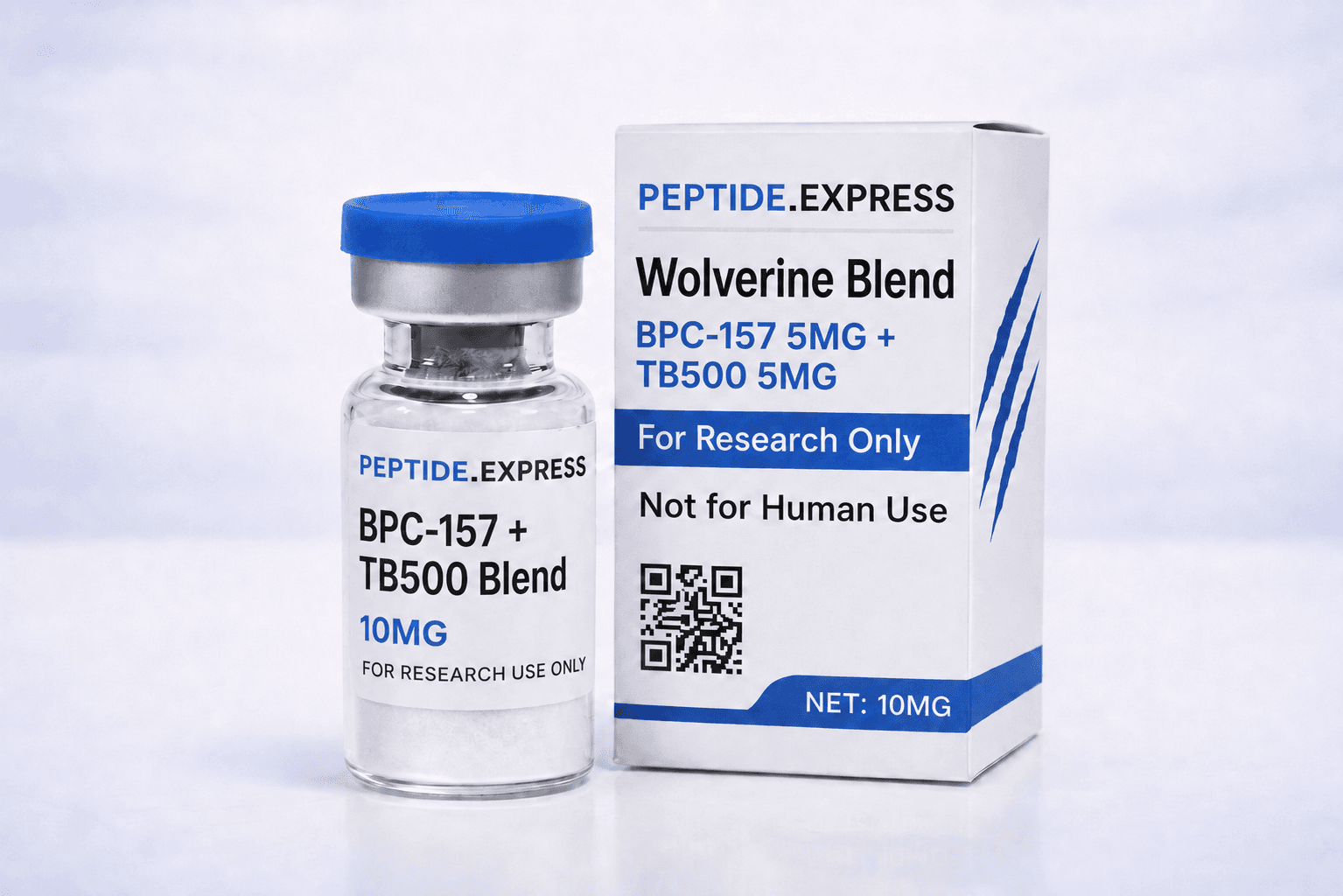
Wolverine Blend BPC+TB500 — research-grade lyophilized peptide vial from Peptide.Express, ≥99% HPLC purity
Expand Image
≥99% PurityUS SynthesizedIn Stock

Wolverine Blend — BPC-157 + TB-500 Research Stack | Dual-Mechanism Tissue Repair Formulation

Research-Grade Compound

Wolverine Blend is a two-peptide research formulation combining BPC-157 (Body Protection Compound-157, a 15-amino-acid gastric pentadecapeptide, GEPPPGKPADDAGLV, 1,419.5 Da) and TB-500 (synthetic Thymosin β-4, 4,963.4 Da, containing the LKKTET actin-binding motif).

Purity standard: Wolverine Blend BPC+TB500 is sourced to ≥99% by HPLC. That is the specification every batch must meet, not a measurement of any one vial — the measured figure for a batch is on that batch's Certificate of Analysis.

Select Size

$75.00$100.00USD / Unit
1
HPLC Verified
Same Day Shipping
BPC-157 + TB-500 Wolverine Stack research guide

In-depth research overview, mechanism of action, and study applications.

Showing CoA for 10mg
Certificate Details
Purity≥99%
Methodology
HPLCLC-MS/MS
SequenceTwo-peptide blend: BPC-157 + TB-500

This Certificate of Analysis was issued by an independent third-party laboratory. Peptide.Express does not conduct in-house testing. Results are provided as-is from the testing facility and confirm batch identity, purity, and analytical methodology. For questions about specific CoA results, contact support@peptide.express.

≥99% by HPLCLC-MS/MS VerifiedCoA Every BatchIn-Vitro Research Use Only

What is Wolverine Blend?

Wolverine Blend is a two-peptide research formulation combining BPC-157 (Body Protection Compound-157, a 15-amino-acid gastric pentadecapeptide, GEPPPGKPADDAGLV, 1,419.5 Da) and TB-500 (synthetic Thymosin β-4, 4,963.4 Da, containing the LKKTET actin-binding motif).

Researchers and the wider community call it the "Wolverine Stack" — a nickname, not a formal designation. The name stuck because the two compounds together cover more of the tissue-repair cascade than either does alone, and that framing has become the common way the combination is described in practitioner and research discussion.

Each component in the Peptide.Express blend is independently synthesized and verified at ≥99% purity by HPLC with LC-MS/MS mass confirmation before compounding. A Certificate of Analysis is issued per component.

How Does Wolverine Blend Work? Mechanism of Action

The two compounds do not compete for a target. They occupy sequential steps of the same process, which is the entire mechanistic argument for combining them.

BPC-157 — Local Angiogenesis and Repair Activation

BPC-157 upregulates VEGF expression, driving new blood vessel formation at the site where it is introduced. It also activates focal adhesion kinase and paxillin signaling, which accelerates tendon fibroblast migration and shapes collagen fiber organization, and it interacts with the nitric oxide synthase pathway in a way associated with its anti-inflammatory activity in rodent models.

TB-500 — Systemic Cell Recruitment

TB-500 binds monomeric G-actin through the LKKTET motif, shifting the G-actin to F-actin equilibrium and releasing cells from cytoskeletal immobility. Endothelial cells, keratinocytes and progenitor populations become able to migrate toward the injury site from tissue elsewhere in the system — a systemic action rather than a local one.

Why the Combination Is Studied

Tissue repair requires both that a site be made receptive (vasculature, growth factor signaling) and that cells arrive there. BPC-157 addresses the first; TB-500 addresses the second. Because the pathways are unrelated, a combined preparation produces two independent readouts rather than an amplified version of one.

The honest caveat: almost all Wolverine Stack research is mechanistically inferred rather than directly tested. Investigators are reasoning from single-compound data to a combination effect. There is no published pharmacokinetic interaction study for BPC-157 and TB-500, and no controlled trial of the combination against either component alone. Study designs should include single-compound arms rather than assuming the blend behaves as the sum of its parts.

Research Applications of Wolverine Blend

Soft Tissue Repair Models

  • Tendon and ligament injury preparations: the most common application, with tensile strength and collagen organization as endpoints.
  • Skeletal muscle crush models: capillary density (BPC-157 arm) and cell infiltration rate (TB-500 arm) measured separately.
  • Combined-mechanism study design: the blend is used when investigators want maximal repair signal, with single-compound controls to attribute effect.

Angiogenesis and Cell Migration

  • VEGF expression quantification: the BPC-157-attributable mechanism, measurable independently of migration endpoints.
  • G-actin / F-actin ratio assays: the TB-500-attributable mechanism, giving a cytoskeletal readout that VEGF assays cannot capture.
  • Wound-edge closure kinetics: a functional composite endpoint influenced by both mechanisms.

Wolverine Blend vs KLOW Blend

FeatureWolverine BlendKLOW Blend
ComponentsBPC-157, TB-500KPV, GHK-Cu, BPC-157, TB-500
Component count2 peptides4 peptides
Local angiogenesisBPC-157 (VEGF)BPC-157 (VEGF)
Systemic cell migrationTB-500 (actin)TB-500 (actin)
Matrix / collagen remodelingNot addressedGHK-Cu (fibroblast collagen, MMPs)
NF-κB anti-inflammatory armNot addressedKPV
Best suited toFocused tissue-repair mechanism studiesBroad multi-pathway regenerative models

Wolverine is the narrower formulation, and narrower is often the right choice — fewer variables makes attribution easier. KLOW adds matrix remodeling and inflammation arms that the Wolverine pair does not touch at all.

Wolverine Blend Technical Specifications

Technical specifications for Wolverine Blend, including molecular data, purity standard, testing methods and storage requirements.
Compound NameWolverine Blend (BPC-157 + TB-500 research formulation)
Common SynonymsWolverine Stack, BPC-157/TB-500 blend, Wolverine peptide
Component 1BPC-157 — GEPPPGKPADDAGLV, C62H98N16O22, 1,419.5 Da, CAS 137525-51-0
Component 2TB-500 — synthetic Thymosin β-4, C212H350N56O78S, 4,963.4 Da, CAS 77591-33-4
Purity≥99% per component by HPLC
Purity ConfirmationLC-MS/MS molecular weight verification per component
Blend VerificationCompositional ratio verification post-blend
Endotoxin TestingLAL (Limulus Amebocyte Lysate) method
Physical FormLyophilized powder blend
AppearanceWhite to off-white powder
ReconstitutionBacteriostatic water or sterile 0.9% sodium chloride
Storage (lyophilized)-20°C, desiccated, protected from light
Storage (reconstituted)2–8°C, use within 14–28 days
Shelf Life24 months from manufacture (lyophilized)
Testing MethodsHPLC, LC-MS/MS, LAL Endotoxin
DocumentationCertificate of Analysis (CoA) per component
WADA StatusBoth components prohibited at all times
Intended UseIn-vitro laboratory research only

How to Reconstitute Wolverine Blend for Research

A blend containing a 1,419 Da peptide and a 4,963 Da peptide will not dissolve at a uniform rate. The BPC-157 goes into solution first; the TB-500 lags. Judge completion by the absence of visible cake, not by elapsed time.

  1. Bring the vial to room temperature.
  2. Draw the calculated volume of bacteriostatic water. Volume depends on total blend mass — check the vial label and Certificate of Analysis for the per-component split.
  3. Swab the septum with alcohol; allow 30 seconds to dry.
  4. Inject the diluent slowly against the inner vial wall.
  5. Swirl gently for 60–90 seconds, or longer if any lyophilized cake remains visible. Do not shake.
  6. Confirm a clear, colorless solution with no particulate matter.
  7. Label with reconstitution date, total concentration, and per-component concentration.
  8. Store at 2–8°C, use within 14–28 days.

Diluent: bacteriostatic water for peptide reconstitution. Full protocol: step-by-step peptide reconstitution guide. Concentration maths: peptide reconstitution calculator.

Frequently Asked Questions — Wolverine Blend

What is the Wolverine Stack?

An informal name for a research combination of BPC-157 and TB-500. It is not a formal pharmacological designation — the name arose in practitioner and research discussion because the two compounds together cover more of the tissue-repair cascade than either alone.

What is in the Wolverine Blend?

Two peptides: BPC-157 (GEPPPGKPADDAGLV, 1,419.5 Da, CAS 137525-51-0) and TB-500 (synthetic Thymosin β-4, 4,963.4 Da, CAS 77591-33-4). Each is independently HPLC-verified at ≥99% purity before blending.

How do BPC-157 and TB-500 work together?

They address sequential requirements rather than a shared target. BPC-157 upregulates VEGF and activates focal adhesion kinase signaling, making the injury site vascularized and receptive. TB-500 sequesters G-actin, freeing cells elsewhere in the system to migrate toward that site. Local activation plus systemic recruitment.

Is the Wolverine Blend the same as BPC-157 + TB-500?

Chemically, yes — the blend contains exactly those two compounds. The practical difference is format: the blend is a single pre-combined vial, while the BPC-157 + TB-500 Kit supplies them separately for protocols requiring independent dose or timing control.

What is the difference between Wolverine Blend and KLOW Blend?

Wolverine contains two peptides; KLOW contains four. KLOW adds GHK-Cu (collagen synthesis and matrix remodeling) and KPV (NF-κB anti-inflammatory signaling) on top of the same BPC-157 and TB-500 base. Wolverine is the more focused formulation.

Do BPC-157 and TB-500 interact pharmacologically?

Unknown. No published pharmacokinetic interaction study exists for this pair. The mechanisms are unrelated at the molecular level, which is a reasonable basis for expecting no interference — but absence of a known interaction is not evidence of absence. Combination protocols should be treated as exploratory.

Is TB-500 or BPC-157 more relevant for tendon research?

Both have tendon data. BPC-157 has the larger rodent tendon literature, particularly around tendon-to-bone healing and collagen fiber organization. TB-500 contributes the migration mechanism that brings fibroblasts into the repair zone. Which is "more relevant" depends on whether the endpoint is vascular, cellular, or mechanical.

Is the Wolverine Blend WADA prohibited?

Yes. Both components are on the WADA Prohibited List at all times — BPC-157 under section S0 and TB-500 under section S2. Neither is FDA-approved for human use.

How do I reconstitute Wolverine Blend?

Add bacteriostatic water slowly against the inner vial wall and swirl for 60–90 seconds. Because the two peptides differ substantially in molecular weight, they dissolve at different rates — keep swirling until no lyophilized cake remains rather than stopping at a fixed time. Store the result at 2–8°C for 14–28 days.

What purity standard does Peptide.Express use for Wolverine Blend?

Each component is verified at ≥99% purity by reverse-phase HPLC before blending, with LC-MS/MS confirming molecular identity at 1,419.5 Da and 4,963.4 Da respectively. The finished blend then receives compositional ratio verification.

How should Wolverine Blend be stored?

Lyophilized at -20°C, desiccated and light-protected, for up to 24 months. Once reconstituted, at 2–8°C for 14–28 days without freezing.

Where is the Certificate of Analysis for Wolverine Blend?

On this page and in the Peptide.Express lab results library. A CoA is issued per component, so the blend ships with documentation for both BPC-157 and TB-500 — including the mass confirmation that distinguishes full-length Thymosin β-4 from shorter LKKTET fragments.

Research References

  1. "Regeneration or Risk? A Narrative Review of BPC-157 for Musculoskeletal Healing." Biomolecules, 2025 — covers the VEGF and FAK mechanisms attributable to the BPC-157 component. Read the BPC-157 musculoskeletal healing review on PMC
  2. Goldstein AL, Hannappel E, Kleinman HK. "Thymosin Beta4: Actin-Sequestering Protein Moonlights to Repair Injured Tissues." Trends in Molecular Medicine, 2005. Read the thymosin β4 actin-sequestration and tissue-repair review on PubMed
  3. Sikiric P, Boban Blagaic A, Strbe S, et al. "The Stable Gastric Pentadecapeptide BPC 157 Pleiotropic Beneficial Activity and Its Possible Relations with Neurotransmitter Activity." Pharmaceuticals, 2024. Read the Sikirić BPC-157 pleiotropic-activity review on PMC

All products are sold for in-vitro laboratory research use only. Not intended for human consumption, clinical use, or veterinary use. Peptide.Express makes no medical claims. Consult the published literature for research application guidance.
Further Reading