What Is a Peptide Pen?
A peptide pen is a pen-shaped device that holds a cartridge of peptide material, so the peptide can be handled as one pre-assembled unit instead of a vial, a syringe and a separate bottle of diluent. The term covers two cartridge designs that behave very differently over time.
- Pre-mixed cartridge pens
The peptide is already in solution, so a pre-mixed peptide pen has no mixing step. The trade-off is that the peptide sits in water from the day of filling, which means its working life follows solution stability and not lyophilized shelf life.
- Dual-chamber cartridge pens
Lyophilized peptide sits in one chamber and diluent in a second chamber, kept apart until the operator combines them. The peptide stays dry until activation, so the dissolution happens at the bench, on a day the researcher chooses.
The Peptide.Express Retatrutide Pen is a dual-chamber peptide pen, and the rest of this guide describes that design.
Dual-Chamber Peptide Pen: Parts and What Each One Does
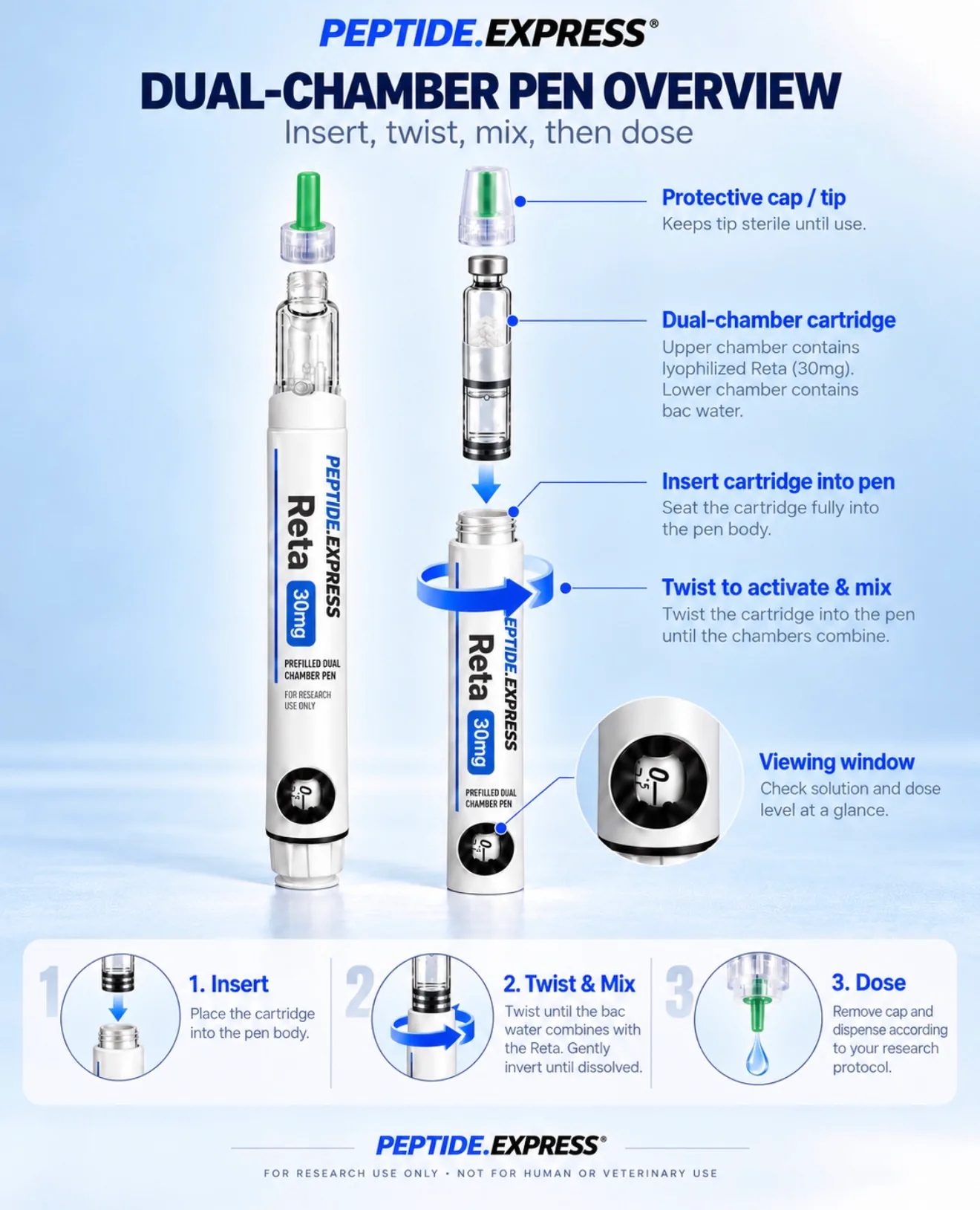
A dual-chamber peptide pen has five parts worth knowing before the first activation. The overview diagram at the top of this page labels them, and the table gives the same information as text.
| Part | What it is | What it does |
|---|---|---|
| Protective cap and tip | The cap over the green tip at the top of the pen. | Covers the tip until the pen is used. |
| Dual-chamber cartridge | A glass cartridge divided into an upper and a lower chamber. | The upper chamber holds lyophilized peptide (retatrutide, 30 mg in the pen pictured). The lower chamber holds bacteriostatic water, called bac water. |
| Pen body | The white barrel that receives the cartridge. | Holds the seated cartridge and supplies the twisting action that combines the two chambers. |
| Twist action | Turning the cartridge into the pen body. | Combines the chambers so the bac water meets the lyophilized peptide. |
| Viewing window | A round window near the base of the pen. | Shows the solution and the counter reading on the pen. |
How to Prepare a Dual-Chamber Peptide Pen for Research: Step by Step
Preparing a dual-chamber peptide pen takes three mechanical actions, insert, twist and invert, followed by an inspection and a record. The sequence follows the manufacturer diagram, which labels its three stages Insert, Twist & Mix and Dose. This guide calls the last stage dispensing, because it describes laboratory handling and gives no dosing guidance.
- 1
Check the carton, the lot and the cartridge
Match the lot on the carton to your records, then look at the cartridge before opening anything. The upper chamber should hold a white lyophilized solid and the lower chamber a clear liquid. Set aside any unit with a cracked cartridge, a cloudy liquid or a solid that already looks wet.
- 2
Prepare a clean workspace and your records
Wipe the work surface, put on nitrile gloves, and have the written research protocol and a label within reach. Activating the pen starts dissolution and the stability clock, so everything else should be ready first.
- 3
Insert the cartridge into the pen body
Place the cartridge into the pen body and seat it fully. A cartridge that is not fully seated will not combine the chambers properly in the next step.
- 4
Twist to activate and mix
Turn the cartridge into the pen until the chambers combine. This is the step that brings the bacteriostatic water into contact with the lyophilized peptide.
- 5
Invert gently until dissolved
Tilt and invert the pen slowly until the solid has dissolved. Do not shake it and do not vortex it. If the solid has not cleared after a minute or two, wait and invert gently again instead of agitating harder.
- 6
Inspect the solution through the viewing window
The solution should be clear and colorless. Discard the unit if it is cloudy, if particles are visible, or if opalescence persists after mixing. Do not filter a solution that looks wrong.
- 7
Remove the cap and dispense according to your written research protocol
Take the protective cap off the tip and dispense the solution as your written research protocol specifies. This guide gives no volumes, doses or schedules, because the right amount is a property of the experiment and not of the pen.
- 8
Record, label and store
Write the activation date, the lot and the concentration on the pen label or in your notebook. Take the concentration from the lot documentation and not from the strength alone. Then store the mixed pen at 2 to 8 °C, protected from light.
Peptide Pen Storage Before and After Mixing
A sealed dual-chamber peptide pen is stored as its carton label says. Storage advice written for lyophilized vials, -20 °C and desiccated, does not transfer to a pen automatically, because the lower chamber of a pen holds water that would freeze alongside the peptide.
Once the chambers are combined, the pen holds a reconstituted peptide solution and follows the same rules as any reconstituted solution: 2 to 8 °C, protected from light, labelled with the activation date, and not frozen. In bacteriostatic water the working window is generally 14 to 28 days. That figure is a convention set by the USP multi-dose limit and not a measurement for one peptide, so the lot documentation governs.
Inspect a mixed peptide pen before every use. Clear and particle-free means the solution is intact. Cloudiness, visible particles or a colour change means discard, and the full reasoning is in the storage section of the peptide reconstitution guide.
Peptide Pen vs Vial: What Changes and What Stays the Same
A peptide pen and a lyophilized vial can hold the same molecule at the same sourcing specification. What changes is the container and, with it, who controls concentration.
| Feature | Dual-chamber peptide pen | Lyophilized vial |
|---|---|---|
| Container | Pen body holding a two-chamber cartridge | Single glass vial |
| Diluent | Bacteriostatic water preloaded in the lower chamber | Supplied separately, so the operator chooses the volume |
| Mixing step | Twist the cartridge, then invert gently | Run diluent down the vial wall, then swirl |
| Peptide before mixing | Lyophilized, kept apart from the diluent | Lyophilized |
| Concentration | Set by the cartridge fill | Set by the operator through diluent volume |
| Flexibility | One concentration per unit | Any concentration, and aliquots are possible |
| Records to keep | Lot, activation date, concentration from the lot documentation | Lot, reconstitution date, calculated concentration |
| Intended use | In-vitro laboratory research only | In-vitro laboratory research only |
The same peptide is also sold as vials on the retatrutide vial page, and neither presentation has published data showing the other behaves identically.
Common Peptide Pen Mistakes
Shaking the pen instead of inverting it
Shaking adds shear and foam, and peptide adsorbed at an air-liquid interface denatures and aggregates. Fatty-acylated peptides such as retatrutide are especially prone to it. Invert slowly and give the solid time.
Activating the pen before the protocol is ready
Twisting the cartridge combines the chambers and starts the stability clock, and a mixed pen cannot be returned to its dry state. Finish the workspace, the label and the protocol first.
Assuming the concentration from the strength
A 30 mg pen does not state its own concentration, because the diluent volume is set at filling. Take the figure from the lot documentation or the label and write it down at activation.
Skipping the viewing-window check
A solution that looks clear in a quick glance can still hold undissolved solid or opalescence. Hold the pen against a light background and confirm before anything is dispensed.
Applying vial storage advice to a pen
The usual advice for lyophilized vials, -20 °C, does not transfer to a pen, because the lower chamber holds water that would freeze alongside the peptide. Store a sealed pen as its carton label says.
Using one strength’s certificate for another
Certificates of Analysis are issued per strength. A strength with no certificate on file has none, and another strength’s document is not a substitute for it.
Peptide Pens Available at Peptide.Express
Peptide.Express currently lists one dual-chamber peptide pen, the Retatrutide Pen, in 15 mg and 30 mg strengths. Its product page carries the Certificate of Analysis for the strength shown, the molecular identity data and the full specification table.
Retatrutide (LY3437943) is an investigational peptide that agonizes GLP-1R, GIPR and GCGR, and it is not approved by the FDA for any indication. The retatrutide reference page covers its structure and research record.
Peptide Pen FAQ
What is a peptide pen?
A peptide pen is a pen-shaped device that holds a cartridge of peptide material so it can be handled as one pre-assembled unit instead of a vial, a syringe and a separate bottle of diluent. Cartridges are either pre-mixed solutions or dual-chamber designs that keep the peptide dry until activation. For laboratory research use only.
What is a dual-chamber peptide pen?
A dual-chamber peptide pen has a cartridge with two compartments. Lyophilized peptide sits in the upper chamber and bacteriostatic water sits in the lower chamber, apart from each other until the operator twists the cartridge into the pen body and the chambers combine.
How does a dual-chamber peptide pen work?
The cartridge is seated in the pen body and twisted until the chambers combine, which brings the bac water into contact with the lyophilized peptide. Gentle inversion finishes the dissolution, the viewing window lets the operator check the solution, and the protective cap comes off the tip for dispensing according to a written research protocol.
How do you mix a dual-chamber peptide pen for research?
Insert the cartridge and seat it fully, twist until the chambers combine, then invert the pen gently until the solid has dissolved. Never shake or vortex it. Inspect the solution through the viewing window, and discard the unit if it is cloudy or contains particles.
Why is the peptide kept dry in a dual-chamber pen?
Water is what degrades peptides. Backbone hydrolysis, methionine and cysteine oxidation and asparagine and glutamine deamidation all need it. A lyophilized peptide held at -20 °C is stable for around 24 months, while the same peptide in solution can degrade measurably within days, so a dual-chamber pen delays contact with water until activation.
Do you add bacteriostatic water to a dual-chamber peptide pen?
No. The bacteriostatic water is preloaded in the lower chamber, so there is no diluent to draw and no volume to calculate. The resulting concentration is set by the cartridge fill, and it should be taken from the lot documentation or the label.
What is the viewing window on a peptide pen for?
The viewing window shows the solution and the counter reading on the pen. After mixing, it is where the operator confirms that the solution is clear and colorless and that no solid remains.
How should a mixed peptide pen be stored?
Treat a mixed peptide pen as a reconstituted solution: 2 to 8 °C, protected from light, labelled with the activation date, and not frozen. A sealed pen is stored as its carton label says, because vial advice such as -20 °C does not transfer to a cartridge that also holds water.
How long does a mixed peptide pen last?
Reconstituted peptides in bacteriostatic water are generally held for 14 to 28 days at 2 to 8 °C. The upper bound tracks the USP 28-day multi-dose limit for benzyl alcohol preserved containers and not the chemistry of one peptide, so the lot documentation governs, and a solution that turns cloudy or particulate is finished regardless of the date.
What is the difference between a peptide pen and a vial?
The peptide can be identical, and what changes is who controls concentration. A vial arrives as dry powder and the operator chooses the diluent volume. A dual-chamber pen arrives with the diluent preloaded, so mixing is a twist and the concentration is fixed by the cartridge fill.
Is a peptide pen for human use?
No. Peptide.Express pens are supplied for in-vitro laboratory research only and are not for human or veterinary use. This guide describes laboratory handling and contains no dosing, administration or schedule guidance.
Does the Retatrutide Pen come with a Certificate of Analysis?
Certificates are published per strength where one is on file, and the Retatrutide Pen product page shows the lot, accession, measured HPLC and testing laboratory for the strength selected. A strength with no certificate on file shows none. The 99% HPLC figure on a listing is a sourcing specification and not a measurement of any one pen.
Related Research Resources
Research Use Only.
This guide describes laboratory handling of dual-chamber research pens for in-vitro research compounds. It contains no dosing, administration, or frequency guidance, and nothing here is medical advice or instruction for human or veterinary use.