Research peptides for cellular aging and mitochondrial models
Quick Answer
Aging biology has no single target, so the five compounds here answer five different questions. Epithalon (AEDG, CAS 307297-39-8) is the tool for the telomerase hypothesis. MOTS-c (CAS 1627580-64-6) is encoded inside mitochondrial DNA rather than the nuclear genome, activates AMPK, and translocates to the nucleus under metabolic stress. SS-31 (elamipretide, CAS 736992-21-5) binds cardiolipin and works on mitochondrial membrane structure. NAD+ (CAS 53-84-9) is the consumed substrate that sets a ceiling on sirtuin and PARP activity — a coenzyme, not a peptide. GHK-Cu addresses the extracellular matrix, whose renewal capacity declines measurably with age. The quality of evidence behind each differs sharply, and those differences matter more than the shared "anti-aging" label. All are supplied at ≥99% HPLC purity for in-vitro laboratory research only.
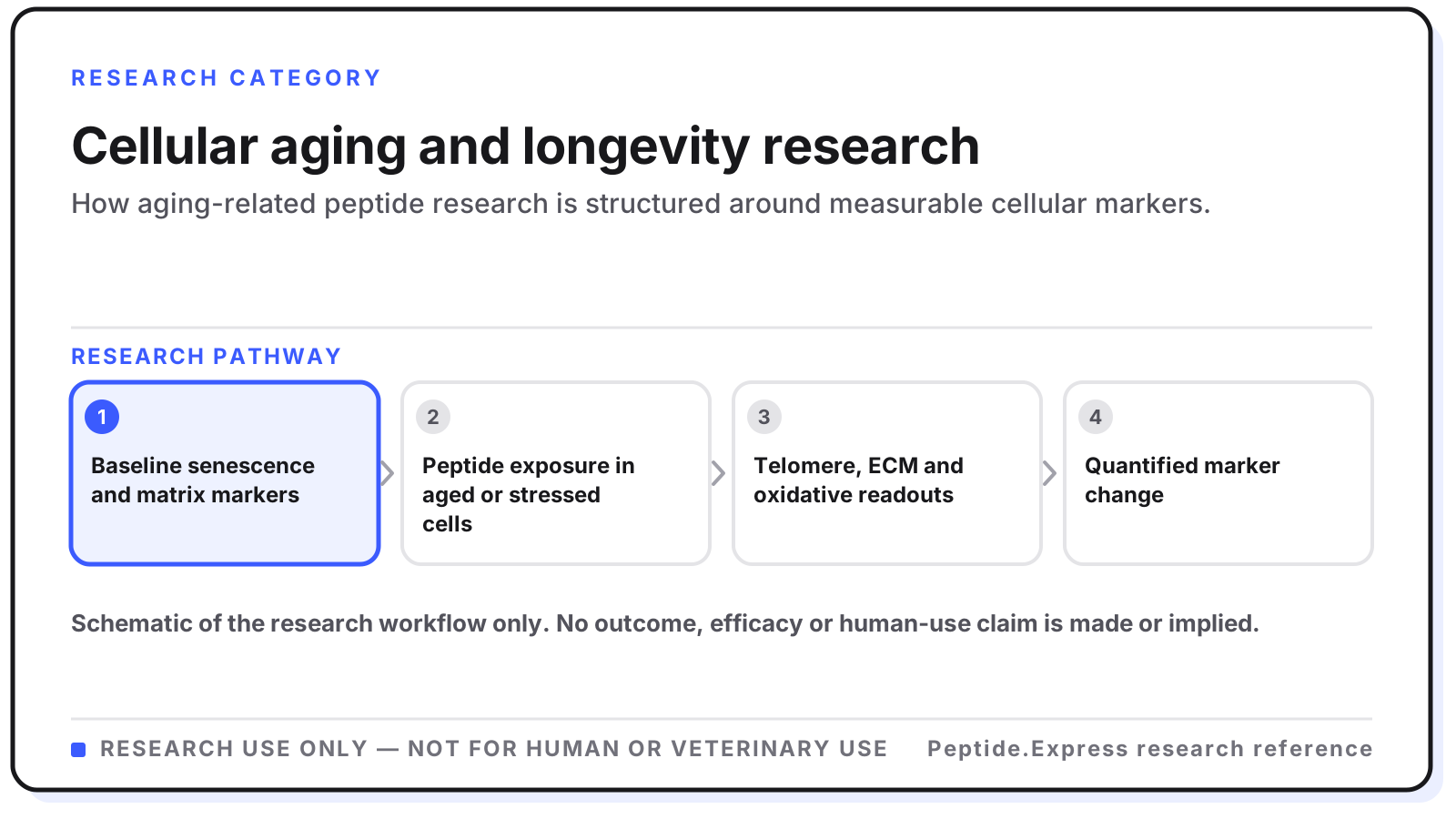
Cellular Aging Research Research: Overview
Epithalon is where a reader should apply the most scrutiny. Nearly the entire telomerase literature on AEDG originates with Vladimir Khavinson's group at the St. Petersburg Institute of Bioregulation and Gerontology, and independent replication outside it is thin; the proposed mechanism — short peptides binding promoter sequences directly — has molecular docking support but nothing at crystallographic or ChIP level. MOTS-c has the cleaner preclinical case, with AMPK activation replicated across independent models, though human trial data remains limited and the rodent-to-human translation has not been demonstrated at the magnitude the preclinical work implies. The mitochondrial compounds split the same organelle three ways and should not be treated as substitutes: MOTS-c is the signal, SS-31 protects the membrane the respiratory chain is built into, and NAD+ is the substrate those reactions spend. SS-31 carries the longest clinical record on this page and no approval to show for it, which is worth holding in mind before reading its preclinical bioenergetics as a functional result. GHK-Cu plasma concentration falls from roughly 200 ng/mL at age 20 to around 80 ng/mL by 60; that correlation is documented, the causal step is not.
Recommended Peptides for Cellular Aging Research
Epithalon
A four-residue peptide (Ala-Glu-Asp-Gly) associated with hTERT upregulation and delayed replicative senescence in cultured human somatic cells. The endpoints are quantitative PCR for hTERT transcript, TRAP assay for enzymatic activity, and population doubling counts. No receptor has been identified, and no pharmacokinetic study establishes that an intact tetrapeptide reaches a nucleus in an intact organism.
MOTS-c
A 16-residue peptide translated from a short open reading frame inside the mitochondrial 12S rRNA gene. It activates AMPK through folate-methionine cycle interference and AICAR accumulation rather than through an AMP:ATP shift, and it moves to the nucleus to regulate transcription directly. One of very few tools available for studying mitochondrial-to-nuclear retrograde signalling.
SS-31 (Elamipretide)
A cell-permeable tetrapeptide, D-Arg-2',6'-Dmt-Lys-Phe-NH2, that binds cardiolipin in the inner mitochondrial membrane and protects it from peroxidation. Because oxidised cardiolipin disorganises respiratory supercomplexes and the resulting electron leak oxidises more cardiolipin, the intervention point is a loop rather than a single lesion. Its alternating aromatic-cationic pattern makes uptake independent of membrane potential, so it reaches depolarised mitochondria. Read the mechanism against its clinical record: Phase 2 and Phase 3 programmes in Barth syndrome and primary mitochondrial myopathy have produced mixed primary endpoints and no approval.
NAD+
The substrate arm, and not a peptide — a dinucleotide coenzyme, C21H27N7O14P2, 663.4 Da. Sirtuins, PARPs and CD38 consume NAD+ stoichiometrically rather than catalytically, so pool size limits their activity directly, and sirtuin Km values sit close enough to physiological concentrations that a decline is not buffered away. Whether intact NAD+ crosses the plasma membrane is genuinely disputed, so a design that turns on the answer needs a precursor comparison arm. Reconstituted solutions last 24 to 48 hours, not weeks.
GHK-Cu
The matrix arm. Type I and Type III collagen transcription alongside MMP-1 and MMP-2 activation gives turnover rather than accumulation, and the copper-delivery mechanism links the metal to lysyl oxidase crosslinking. A secondary antioxidant arm — reactive oxygen species scavenging and superoxide dismutase upregulation — overlaps with senescence endpoints.
Cellular Aging Research Research: Frequently Asked Questions
What peptides are studied in cellular aging research?
Epithalon for telomere and telomerase questions, MOTS-c for mitochondrial signalling through AMPK, SS-31 for cardiolipin and inner-membrane structure, GHK-Cu for extracellular-matrix turnover. NAD+ belongs on the list as the substrate those signalling reactions spend, though it is a coenzyme rather than a peptide. Each targets a different hallmark of aging, so they function as separate research tools rather than as a stack. All are supplied for in-vitro laboratory research only.
Is the Epithalon telomerase evidence independently replicated?
Not substantially. Nearly all of it comes from one research programme in St. Petersburg conducted over several decades. A mechanism supported largely by a single laboratory sits in a different evidentiary category than one confirmed by competing groups. Treat the hTERT finding as a hypothesis worth testing rather than as settled biology when designing around it.
What makes MOTS-c different from other peptides?
Its origin. Almost every peptide in biology is transcribed from nuclear DNA; MOTS-c is encoded inside mitochondrial DNA and signals outward. It also regulates transcription directly after nuclear translocation rather than acting purely as a receptor ligand — no MOTS-c receptor has been identified.
How do the three mitochondrial compounds on this page differ?
They divide one organelle three ways. MOTS-c is the signal — an mtDNA-encoded peptide that activates AMPK and moves to the nucleus. SS-31 is the structure, binding cardiolipin so the inner membrane keeps its respiratory supercomplexes organised. NAD+ is the substrate those reactions consume, and the ceiling on sirtuin activity when the pool falls. Substituting one for another changes the question being asked, and a functional readout such as oxygen consumption will not distinguish them without separate arms.
References
- Khavinson VKh, Bondarev IE, Butyugov AA. "Epithalon Peptide Induces Telomerase Activity and Telomere Elongation in Human Somatic Cells." Bulletin of Experimental Biology and Medicine. 2003. Read the Khavinson 2003 Epithalon telomerase induction study
- Khavinson VKh, Bondarev IE, Butyugov AA, Smirnova TD. "Peptide Promotes Overcoming of the Division Limit in Human Somatic Cells." Bulletin of Experimental Biology and Medicine, 2004. Read the Khavinson 2004 replicative senescence delay study on PubMed
- Ivko OM, Linkova NS, Ilina AR, Sharova AA, Ryzhak GA. "AEDG Peptide Regulates Human Circadian Rhythm Genes Expression during Pineal Gland Accelerated Aging." Advances in Gerontology (Uspekhi Gerontologii). 2020. Read the Ivko 2020 AEDG peptide circadian gene expression study
- FDA drug approvals and databases: the authoritative record of approved drug products in the United States. Epithalon does not appear in it, which is the primary source behind the regulatory statement on this page. Search the FDA drug approval databases
- Lee C, Zeng J, Drew BG, et al. "The Mitochondrial-Derived Peptide MOTS-c Promotes Metabolic Homeostasis and Reduces Obesity and Insulin Resistance." Cell Metabolism, 2015. Read the Lee 2015 Cell Metabolism MOTS-c paper
- Reynolds JC, Lai RW, Woodhead JST, et al. "MOTS-c is an exercise-induced mitochondrial-encoded regulator of age-dependent physical decline and muscle homeostasis." Nature Communications, 2021. Read the Reynolds 2021 Nature Communications MOTS-c paper
- Review of MOTS-c as a mitochondrial-derived peptide with therapeutic research applications, covering the AMPK mechanism and current evidence limits. Frontiers in Endocrinology. Read the MOTS-c mitochondrial-derived peptide review on PMC
- USADA reference page on MOTS-c covering its prohibited status and the anti-doping context for mitochondrial-derived peptides. Read the USADA reference on MOTS-c prohibited status
- Birk AV, Liu S, Soong Y, Mills W, Singh P, Warren JD, Seshan SV, Pardee JD, Szeto HH. "The Mitochondrial-Targeted Compound SS-31 Re-Energizes Ischemic Mitochondria by Interacting with Cardiolipin." Journal of the American Society of Nephrology. 2013. Read the Birk 2013 SS-31 cardiolipin binding mechanism study
- Paradies G, Paradies V, De Benedictis V, Ruggiero FM, Petrosillo G. "Functional Role of Cardiolipin in Mitochondrial Bioenergetics." Biochimica et Biophysica Acta (Bioenergetics). 2014. Read the Paradies 2014 cardiolipin bioenergetics review
- Imai S, Guarente L. "NAD+ and Sirtuins in Aging and Disease." Trends in Cell Biology. 2014. Read the Imai and Guarente 2014 NAD+ and sirtuins aging review
- Covarrubias AJ, Perrone R, Grozio A, Verdin E. "NAD+ Metabolism and Its Roles in Cellular Processes during Ageing." Nature Reviews Molecular Cell Biology. 2021. Read the Covarrubias 2021 NAD+ metabolism and ageing review
- Pickart L, Margolina A. "Regenerative and Protective Actions of the GHK-Cu Peptide in the Light of the New Gene Data." International Journal of Molecular Sciences, 2018. Read the GHK-Cu regenerative gene-data review on PMC
- Pickart L, Vasquez-Soltero JM, Margolina A. "The Human Tripeptide GHK-Cu in Prevention of Oxidative Stress and Degenerative Conditions of Aging." Oxidative Medicine and Cellular Longevity, 2012. Read the GHK-Cu oxidative stress and aging review on PMC
- Review of GHK as an anti-aging peptide, covering the plasma decline observation and the tissue-remodeling gene expression data. Read the GHK anti-aging peptide review on PMC
- Maquart FX, Pickart L, Laurent M, Gillery P, Monboisse JC, Borel JP. "Stimulation of Collagen Synthesis in Fibroblast Cultures by the Tripeptide-Copper Complex Glycyl-L-Histidyl-L-Lysine-Cu2+." FEBS Letters. 1988. Read the Maquart 1988 GHK-Cu fibroblast collagen synthesis study
Explore More Research Areas
Browse All Research Peptides
Explore our complete catalog of HPLC-verified research peptides. Every product includes a Certificate of Analysis documenting purity and identity. Same-day US shipping on orders before 2 PM EST. For in-vitro laboratory research use only.
Browse CatalogHow This Page Is Sourced
Compiled by the Peptide.Express Research Team. Reviewed by Ben Laythee, Lead Chemist. Molecular identity on this page — name, CAS number, molecular formula and molecular weight — is resolved from a single internal entity record and checked against primary registries (PubChem, CAS Common Chemistry) rather than retyped per page. A field with no verified value is left out instead of estimated. Literature is cited to a DOI, PMID or PMCID permalink so every reference resolves to the specific record it names.