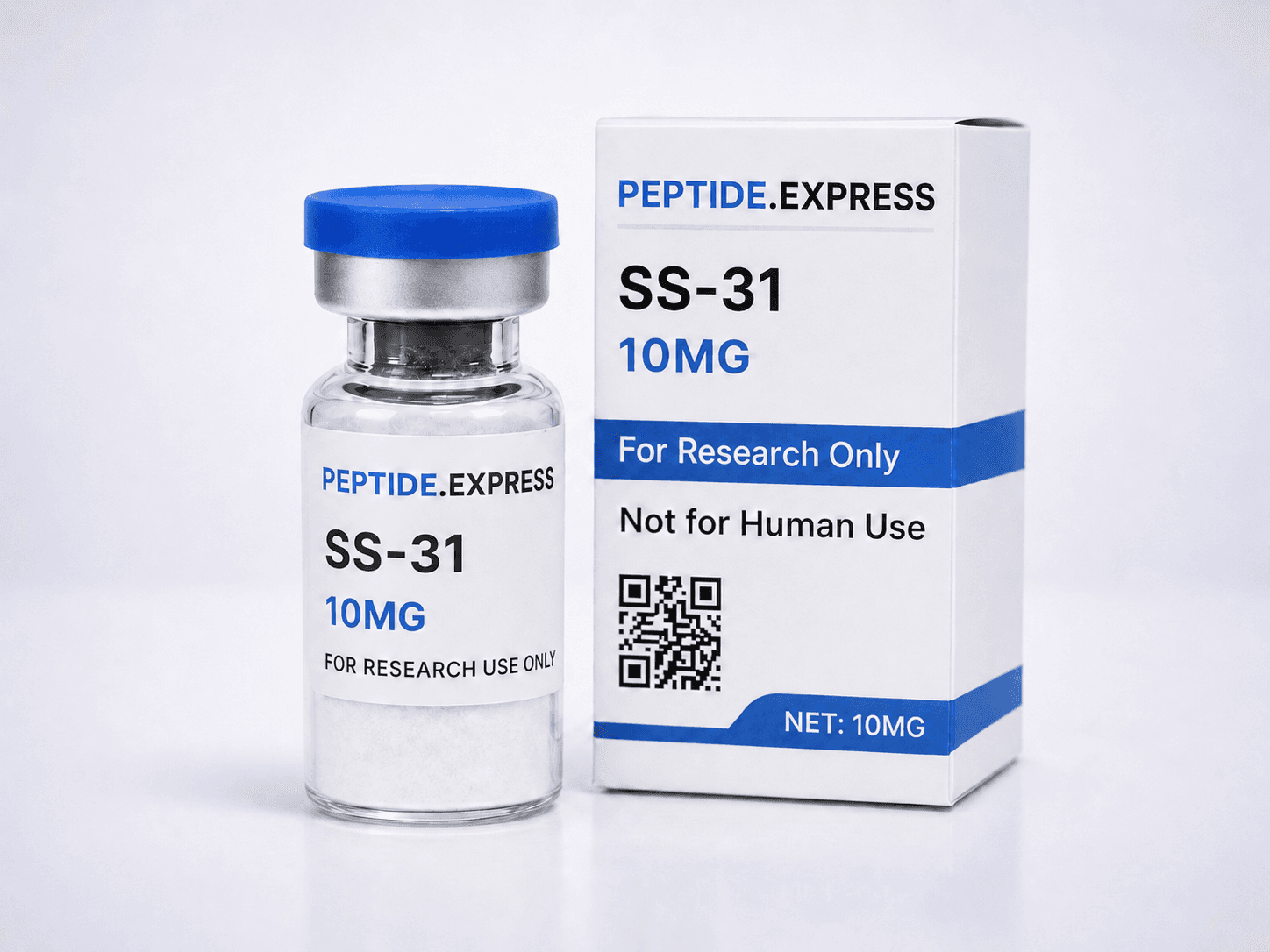
SS-31 (Elamipretide) — Cardiolipin-Binding Mitochondrial Tetrapeptide | D-Arg-Dmt-Lys-Phe-NH2 Research Compound
Research-Grade Compound
SS-31 (elamipretide) is a synthetic, cell-permeable tetrapeptide that binds cardiolipin in the inner mitochondrial membrane. Sequence: D-Arg-2',6'-Dmt-Lys-Phe-NH2, where 2',6'-Dmt is 2',6'-dimethyltyrosine, a non-proteinogenic aromatic residue. Molecular formula C32H49N9O5, molecular weight 639.8 Da, CAS 736992-21-5. It belongs to the Szeto-Schiller (SS) peptide series developed by Hazel Szeto and Peter Schiller, and also appears in the literature under the development codes MTP-131 and Bendavia.
Purity standard: SS-31 is sourced to ≥99% by HPLC. That is the specification every batch must meet, not a measurement of any one vial — the measured figure for a batch is on that batch's Certificate of Analysis.
Select Size
This Certificate of Analysis was issued by an independent third-party laboratory. Peptide.Express does not conduct in-house testing. Results are provided as-is from the testing facility and confirm batch identity, purity, and analytical methodology. For questions about specific CoA results, contact support@peptide.express.
What is SS-31?
SS-31 (elamipretide) is a synthetic, cell-permeable tetrapeptide that binds cardiolipin in the inner mitochondrial membrane. Sequence: D-Arg-2',6'-Dmt-Lys-Phe-NH2, where 2',6'-Dmt is 2',6'-dimethyltyrosine, a non-proteinogenic aromatic residue. Molecular formula C32H49N9O5, molecular weight 639.8 Da, CAS 736992-21-5. It belongs to the Szeto-Schiller (SS) peptide series developed by Hazel Szeto and Peter Schiller, and also appears in the literature under the development codes MTP-131 and Bendavia.
Two structural features do most of the work. The alternating aromatic-cationic motif gives the molecule its mitochondrial affinity without depending on membrane potential, so it accumulates in mitochondria that are already depolarized — precisely the mitochondria that most mitochondria-targeted compounds cannot reach. And the D-configuration arginine at the N-terminus plus the C-terminal amide make it resistant to the aminopeptidases and carboxypeptidases that clear ordinary tetrapeptides in minutes.
Elamipretide has been through a longer clinical development programme than almost anything else in this catalog, with Phase 2 and Phase 3 trials in Barth syndrome and primary mitochondrial myopathy. It is not FDA-approved for any indication. That combination — years of trials, no approval — is itself information, and researchers reading the preclinical literature should hold it in mind: a mechanism that is clean in isolated mitochondria has repeatedly proven harder to convert into a clinical endpoint in patients.
How Does SS-31 Work? Mechanism of Action
Cardiolipin is the target, and cardiolipin is unusual. It is a dimeric phospholipid with four acyl chains and a conical shape, found almost exclusively in the inner mitochondrial membrane, where it makes up roughly a fifth of the phospholipid content. Its job is structural and organizational: cardiolipin curves the membrane into cristae and holds the electron transport chain complexes together into supercomplexes — the respirasomes that let electrons pass between Complex I, III and IV without escaping into the matrix.
SS-31 binds cardiolipin through electrostatic contact between its cationic D-Arg and Lys residues and the phosphate headgroups, with the dimethyltyrosine inserting into the hydrophobic region. The functional consequence is protection of cardiolipin from peroxidation. Oxidized cardiolipin no longer organizes supercomplexes properly; electron leak rises, reactive oxygen species production rises with it, and the process becomes self-reinforcing because the ROS oxidize more cardiolipin. Binding interrupts that loop rather than scavenging the ROS after the fact, which is the distinction between SS-31 and a conventional antioxidant.
Downstream, preclinical work reports maintained mitochondrial membrane potential, preserved ATP synthesis capacity, stabilized cristae ultrastructure on electron microscopy, and reduced release of cytochrome c — which matters because cytochrome c leaving the intermembrane space is an apoptotic trigger. Cardiolipin also anchors cytochrome c to the membrane in the first place, so a compound that protects cardiolipin is acting on both the structural and the apoptotic arm through one interaction.
What the evidence does not settle is the gap between organelle and organism. Isolated-mitochondria and cell-culture results for SS-31 are consistent and mechanistically legible. Translation has been harder: clinical programmes in primary mitochondrial myopathy and Barth syndrome have run for years without producing an approval, and published trial outcomes have been mixed on their primary endpoints. Whatever the reason — effect size, endpoint selection, patient heterogeneity in mitochondrial disease — a research design should not treat the bioenergetic mechanism as a proxy for a functional outcome.
Research Applications of SS-31
Mitochondrial Bioenergetics Research
- Oxygen consumption rate assays: Seahorse extracellular flux measurement of basal respiration, maximal respiration and spare respiratory capacity in treated cell populations.
- Membrane potential quantification: TMRM or JC-1 fluorescence in models where depolarization is induced chemically or by substrate deprivation.
- Supercomplex assembly: blue native PAGE of digitonin-solubilized mitochondria, which shows whether respirasome organization is preserved rather than inferring it from function.
Oxidative Stress and Cardiolipin Chemistry
- Cardiolipin peroxidation profiling: mass spectrometric lipidomics distinguishing native from oxidized cardiolipin species, which is the most direct readout of the proposed mechanism.
- Mitochondrial ROS measurement: MitoSOX and related probes, reported alongside cytosolic ROS so that compartment specificity can be demonstrated rather than assumed.
- Cristae ultrastructure: transmission electron microscopy scoring of cristae density and organization in tissue from injury models.
Ischemia-Reperfusion and Mitochondrial Disease Models
- Cardiac ischemia-reperfusion preparations: infarct size and post-ischemic contractile recovery in isolated perfused hearts, the setting where the SS peptide series was first characterized.
- Renal and neuronal injury models: mitochondrial dysfunction as the shared upstream event across otherwise unrelated tissue injuries.
- Genetic mitochondrial disease models: Barth syndrome cell lines carry a tafazzin defect that leaves cardiolipin remodeling incomplete, making them the mechanistically tightest system for testing a cardiolipin-binding compound.
SS-31 vs NAD+ for Mitochondrial Research
| Feature | SS-31 (Elamipretide) | NAD+ |
|---|---|---|
| Molecular class | Synthetic tetrapeptide | Dinucleotide coenzyme (not a peptide) |
| Molecular formula | C32H49N9O5 | C21H27N7O14P2 |
| Molecular weight | 639.8 Da | 663.4 Da |
| CAS number | 736992-21-5 | 53-84-9 |
| Molecular target | Cardiolipin, inner mitochondrial membrane | Complex I, sirtuins (SIRT1-7), PARPs, CD38 |
| Type of intervention | Structural protection of an existing membrane | Replacement of a consumed substrate |
| Primary readout | ROS production, membrane potential, cristae structure | NAD+/NADH ratio, sirtuin deacylase activity |
| Endogenous? | No — fully synthetic | Yes — present in every living cell |
| Solution stability | Typical peptide: 14–28 days at 2–8°C | Short: use within 24–48 hours |
| Clinical development | Phase 2/3 trials completed; no FDA approval | No approval as an injectable drug product |
These are complementary rather than competing tools, and the difference is worth being precise about. SS-31 protects the structure that the electron transport chain is built on. NAD+ replenishes the substrate that runs through it. A mitochondrion with intact cristae and no NAD+ produces nothing; so does one with abundant NAD+ and disorganized supercomplexes. Which compound belongs in a given study depends on whether the model damages the membrane or depletes the pool.
SS-31 Technical Specifications
| Compound Name | SS-31 (elamipretide) |
|---|---|
| Common Synonyms | Elamipretide, MTP-131, Bendavia, SS31, Szeto-Schiller 31 |
| Classification | Szeto-Schiller aromatic-cationic tetrapeptide |
| Amino Acid Sequence | D-Arg-2',6'-Dmt-Lys-Phe-NH2 |
| Amino Acid Count | 4, including the non-proteinogenic residue 2',6'-dimethyltyrosine |
| CAS Number | 736992-21-5 |
| Molecular Formula | C32H49N9O5 |
| Molecular Weight | 639.8 Da |
| Molecular Target | Cardiolipin, inner mitochondrial membrane |
| Mitochondrial Uptake | Independent of membrane potential — accumulates in depolarized mitochondria |
| Clinical Status | Phase 2/3 clinical development (Barth syndrome, primary mitochondrial myopathy); not FDA-approved |
| Purity | ≥99% by HPLC |
| Purity Confirmation | LC-MS/MS molecular weight verification |
| Endotoxin Testing | LAL (Limulus Amebocyte Lysate) method |
| Physical Form | Lyophilized powder |
| Appearance | White to off-white powder |
| Reconstitution | Bacteriostatic water or sterile 0.9% sodium chloride |
| Storage (lyophilized) | -20°C, desiccated, protected from light |
| Storage (reconstituted) | 2–8°C, use within 14–28 days |
| Shelf Life | 24 months from manufacture (lyophilized) |
| Testing Methods | HPLC, LC-MS/MS, LAL Endotoxin |
| Documentation | Certificate of Analysis (CoA) per batch |
| FDA Status | Not approved for human use; investigational |
| Intended Use | In-vitro laboratory research only |
How to Reconstitute SS-31 for Research
SS-31 is a small, highly cationic peptide and it dissolves readily. The practical caution is adsorption rather than solubility: cationic peptides at low concentration stick to glass and to some plastics, and a dilute working solution can lose material to the container wall before it ever reaches the assay. Prepare a concentrated stock, dilute immediately before use, and keep low-binding tubes on hand if the assay runs in the micromolar range or below.
- Allow the vial to reach room temperature before opening.
- Draw the calculated volume of bacteriostatic water. For a 10 mg vial, 2 mL yields 5 mg/mL; for the 50 mg vial, 5 mL yields 10 mg/mL. At 639.8 Da, 5 mg/mL corresponds to approximately 7.8 mM.
- Swab the septum with 70% isopropyl alcohol and allow 30 seconds to dry.
- Inject the diluent slowly against the inner vial wall. Do not spray it onto the lyophilized cake.
- Swirl for 30–60 seconds. This peptide dissolves quickly; extended agitation gains nothing and risks foaming.
- Verify a clear, colorless solution with no particulate. Discard if cloudy or discolored.
- Label with the reconstitution date, concentration in mg/mL, and the molar concentration if the assay works in molar terms — converting later from memory is where errors enter.
- Store at 2–8°C and use within 14–28 days. Avoid repeated freeze-thaw cycles.
Diluent: bacteriostatic water for peptide reconstitution. Full protocol: step-by-step peptide reconstitution guide. Concentration maths: peptide reconstitution calculator.
Frequently Asked Questions — SS-31
What is SS-31 peptide?
Is SS-31 the same as elamipretide?
What is cardiolipin and why does SS-31 bind it?
How does SS-31 reach mitochondria?
Is SS-31 FDA-approved?
Is SS-31 in clinical trials?
What is the difference between SS-31 and NAD+ for mitochondrial research?
What is the Szeto-Schiller peptide family?
Can SS-31 protect against ischemia-reperfusion injury in research models?
Why does SS-31 contain a D-amino acid?
What purity standard does Peptide.Express use for SS-31?
How should SS-31 be stored?
Where is the Certificate of Analysis for SS-31?
Research References
- Birk AV, Liu S, Soong Y, Mills W, Singh P, Warren JD, Seshan SV, Pardee JD, Szeto HH. "The Mitochondrial-Targeted Compound SS-31 Re-Energizes Ischemic Mitochondria by Interacting with Cardiolipin." Journal of the American Society of Nephrology. 2013. Read the Birk 2013 SS-31 cardiolipin binding mechanism study
- Paradies G, Paradies V, De Benedictis V, Ruggiero FM, Petrosillo G. "Functional Role of Cardiolipin in Mitochondrial Bioenergetics." Biochimica et Biophysica Acta (Bioenergetics). 2014. Read the Paradies 2014 cardiolipin bioenergetics review
- FDA drug approvals and databases. Elamipretide does not appear as an approved drug product, which is the primary source for the regulatory statement on this page. Search the FDA drug approval databases
All products are sold for in-vitro laboratory research use only. Not intended for human consumption, clinical use, or veterinary use. Peptide.Express makes no medical claims. Consult the published literature for research application guidance.