What Is SS-31? Research Guide
Definition
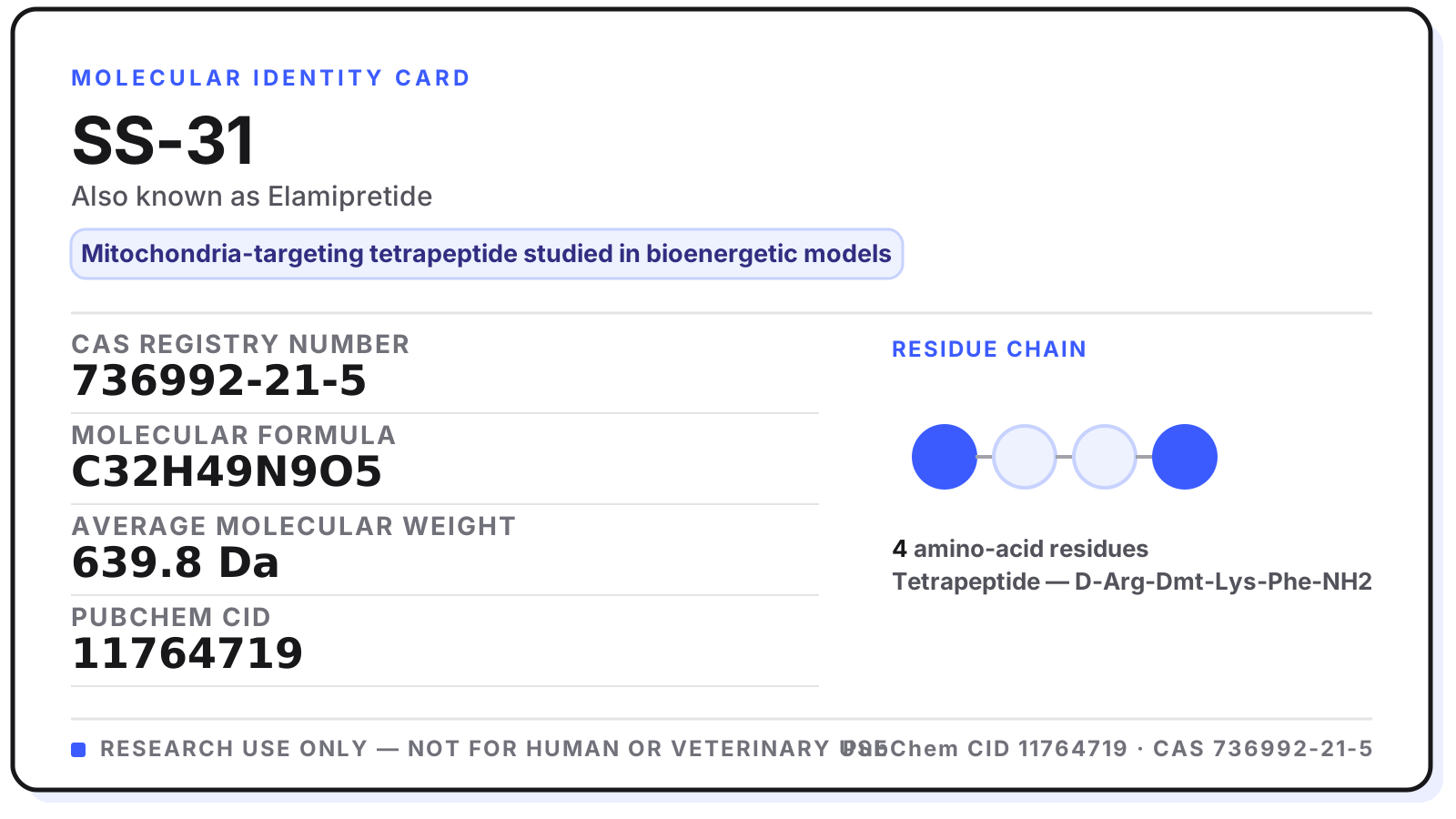
SS-31, international nonproprietary name elamipretide, is a synthetic cell-permeable tetrapeptide: D-Arg-2',6'-Dmt-Lys-Phe-NH2, where Dmt is 2',6'-dimethyltyrosine (CAS 736992-21-5, C32H49N9O5, 639.8 Da). It comes from the Szeto-Schiller peptide series and appears in older papers as MTP-131 or Bendavia. Its target is not a receptor but a phospholipid — cardiolipin, in the inner mitochondrial membrane.
Key Takeaways
- →SS-31, international nonproprietary name elamipretide, is a synthetic cell-permeable tetrapeptide: D-Arg-2',6'-Dmt-Lys-Phe-NH2, where Dmt is 2',6'-dimethyltyrosine (CAS 736992-21-5, C32H49N9O5, 639.8 Da). It comes from the Szeto-Schiller peptide series and appears in older papers as MTP-131 or Bendavia.
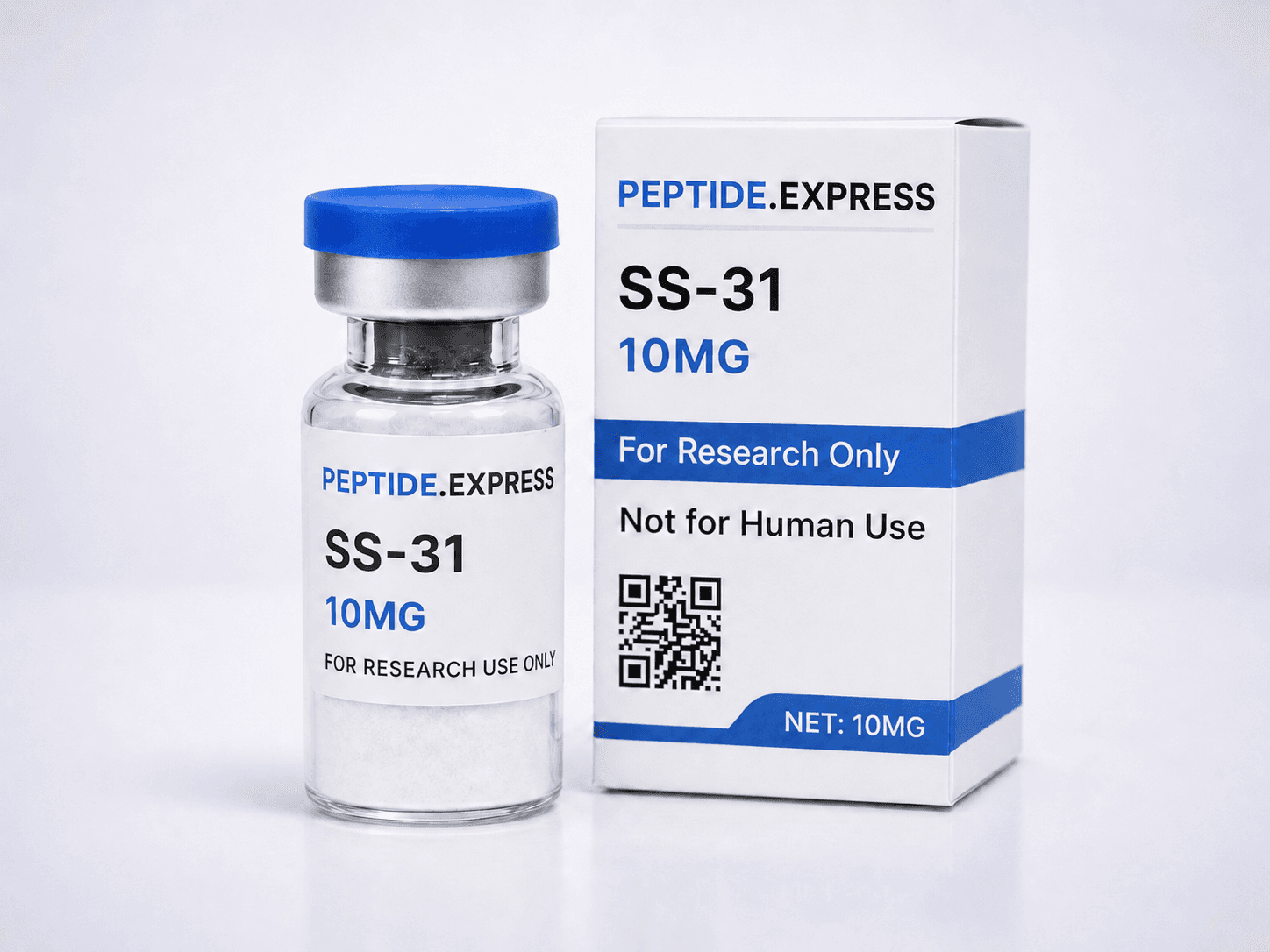
- →Available for in-vitro research at ≥99% HPLC-verified purity from Peptide.Express.
- →Certificate of Analysis included with every order. Same-day US shipping.
SS-31 Specifications
| Property | Value |
|---|---|
| Compound | SS-31 |
| CAS Number | 736992-21-5 |
| Molecular Formula | C32H49N9O5 |
| Molecular Weight | 639.8 Da |
| Sequence / Structure | D-Arg-2',6'-Dmt-Lys-Phe-NH2 (cell-permeable tetrapeptide) |
| Mechanism Class | Cardiolipin-binding inner-mitochondrial-membrane protective peptide |
| Purity | ≥99% by HPLC, batch-specific CoA included |
Registry records for SS-31: PubChem
SS-31 Mechanism of Action
Cardiolipin is a four-tailed, cone-shaped phospholipid found almost nowhere outside the inner mitochondrial membrane, where it curves the membrane into cristae and holds the respiratory complexes together as supercomplexes. SS-31 binds it electrostatically: the cationic D-Arg and Lys side chains meet the phosphate headgroups while the dimethyltyrosine inserts into the acyl region.
What that binding buys is protection from peroxidation. Oxidized cardiolipin stops organizing supercomplexes, electron leak rises, and the reactive oxygen species produced go on to oxidize more cardiolipin — a loop rather than a single insult. SS-31 interrupts it at the lipid instead of scavenging radicals afterwards, which is the distinction from a conventional antioxidant.
The alternating aromatic-cationic pattern also means accumulation does not depend on membrane potential, so the peptide reaches depolarized mitochondria that potential-driven carriers cannot. Against that clean organelle-level account sits a hard translational record: Phase 2 and Phase 3 programmes in Barth syndrome and primary mitochondrial myopathy have run for years, reported mixed results on their primary endpoints, and produced no approval. The bioenergetic mechanism is a mechanism. It is not a proxy for a functional outcome.
SS-31 Research Applications
Extracellular flux respirometry, reading basal respiration, maximal respiration and spare respiratory capacity in cells put under an oxidative or ischemic insult.
Cardiolipin lipidomics. Mass spectrometry that resolves native from oxidized cardiolipin species is the most direct test of the proposed mechanism, and it is worth running before any functional endpoint is interpreted rather than after.
Supercomplex assembly by blue native PAGE of digitonin-solubilized mitochondria, which shows respirasome organization directly instead of inferring it from a respiration rate.
Comparison against substrate-supply approaches such as NAD+. Protecting the membrane and replacing a consumed coenzyme are different interventions, and a single functional readout will not tell them apart without separate arms.
Key Research Applications and Preclinical Study Findings with Protocol Notes
Cardiac Ischemia-Reperfusion Injury Models
In rodent cardiac IR models, SS31 (1–3 mg/kg, IV/IP) administered pre-reperfusion reduces infarct size by 40–60% versus controls. Mechanistic research shows preserved State 3 mitochondrial respiration (Seahorse XF Analyzer), higher ATP/ADP ratios, and reduced cytochrome c release.
Renal Ischemia and Acute Kidney Injury
In murine cisplatin-induced AKI models, SS31 attenuates serum creatinine elevation, preserves tubular morphology (histology), and reduces TUNEL-positive apoptotic cells. Effects are linked to cardiolipin protection and preserved ETC function.
Neurodegenerative Disease Research Models
In Alzheimer’s models using amyloid-beta oligomers, SS31 preserves mitochondrial membrane potential (JC-1/TMRM assays) and reduces synaptic loss in hippocampal slices. In MPTP-induced Parkinson’s models, it protects dopaminergic neurons and improves motor performance. For neuroprotective peptide comparisons, see Epitalon Semax Neuroprotective Peptides Research.
Skeletal Muscle and Age-Related Sarcopenia Models
In aged rodent models, SS31 improves mitochondrial oxygen consumption rate (OCR), ATP production efficiency (coupling efficiency), and reduces markers of mitochondrial stress in muscle fibers, with synergistic effects observed when combined with exercise.
Mitochondrial Cross-Talk with MOTS-c
Emerging research explores interplay between SS31 (membrane-targeted) and the mitochondrially-derived peptide MOTS-c (nuclear gene regulation). For MOTS-c's independent mechanisms, consult MOTS-C Peptide Research Mitochondrial Mechanisms Metabolic Studies.
SS-31: Dosing Considerations and Pharmacokinetics in Preclinical Models
Dosing information is for preclinical research only. In rodent IR models: 1–3 mg/kg (IV/IP). For chronic aging studies: 1–2 mg/kg/day (SC). In cell-based assays: 10 nM to 1 µM. Note the non-linear relationship between extracellular dose and intramitochondrial concentration due to membrane potential-driven accumulation. Design dose-response curves accordingly.
SS31 in the Broader Context of Mitochondrial Peptide Research
Unlike antioxidant-conjugated TPP compounds (MitoQ), SS31 does not generate ROS as a byproduct. Unlike cyclophilin D inhibitors, it targets upstream membrane architecture. Its niche as a "membrane architecture preservative" explains additive effects with other interventions. For an overview of anti-aging mitochondrial peptides, see Anti Aging Peptide Research Compounds Mechanisms.
Comparing SS-31 to Other Mitochondrial Peptides
Researchers often contrast SS-31 with SS-19 and SS-02, and with the Szeto-Schiller peptide SS-31 analog MTP-131. The table below summarizes key analytical metrics relevant when sourcing research peptides.
| Peptide | Molecular Weight (Da) | Cardiolipin KD (nM) | mtROS Reduction at 1 µM | Typical HPLC Purity |
|---|---|---|---|---|
| SS-31 (Elamipretide) | 639.8 | 290 | 37% | ≥98.5% |
| SS-19 | 498.6 | 2100 | 12% | ≥97% |
| SS-02 | 569.7 | 850 | 21% | ≥99% |
| MTP-131 (SS-31 d-Arg analog) | 610.7 | 320 | 35% | ≥99% |
Data compiled from Szeto-Schiller 2015 and 2021 peer-reviewed publications. SS-31 remains the benchmark for potency and literature depth, making it the preferred candidate for new mitochondrial protection assays.
Published Findings: SS-31 in Cardiac and Skeletal Muscle Models
In a 2020 Endocrinology study, Zucker diabetic fatty rats received 3 mg kg⁻¹ SS-21 intraperitoneally daily for 8 weeks. Echocardiography showed ejection fraction improved from 48% to 62%, coinciding with a 31% rise in state-3 respiration in permeabilized ventricular fibers.
Cardiolipin oxidation, measured by LC-MS/MS as the tetra-linoleoyl hydroperoxide, declined 44% relative to vehicle. Skeletal muscle benefits are equally quantified. Mice subjected to 2.5 h treadmill running at 25 m min⁻¹ received a single 4 mg kg⁻¹ SS-31 bolus; gastrocnemius ATP was 28% higher at exhaustion versus saline, and mitochondrial H₂O₂ emission dropped 33% according to Amplex Red assays reported in the Journal of Physiology (2021). These data position SS-21 as a reproducible tool for dissecting energy-sensing pathways in striated muscle.
SS-31: Current Limitations and Future Directions
Despite promising mechanistic clarity, SS-21 exhibits a plasma half-life of 4.2 min in Sprague-Dawley rats, necessitating continuous infusion for extended protection studies. Researchers are exploring cyclized analogs and lipidated conjugates that extend half-life beyond 60 min while preserving 200 nM cardiolipin affinity.
Another open question involves off-target nuclear localization observed at concentrations above 50 µM in HeLa cells, prompting dose-escalation guardrails in long-term culture work. Future investigations will likely combine SS-21 with CRISPR-derived cardiolipin synthase knock-in models to parse peptide effects from baseline lipid remodeling. Commercial supply chains must therefore maintain multi-gram availability of research peptides to support these expanding programs.
SS-31 Storage Requirements
Store lyophilized SS-31 at -20°C (-4°F), desiccated and protected from light. Reconstituted, hold at 2-8°C (36-46°F), use within 14 to 28 days, and do not freeze the solution. The D-arginine at the N-terminus and the C-terminal amide block the exopeptidases that clear an ordinary tetrapeptide within minutes, so this molecule is unusually durable for its size — which means the thing to scrutinize on a certificate of analysis is identity rather than stability.
A synthesis that used L-arginine or unmethylated tyrosine would land at a very similar mass and behave differently, so read the chromatographic trace alongside the mass number.
SS-31 at Peptide.Express
All SS-31 sold by Peptide.Express is HPLC-verified at ≥99% purity with a Certificate of Analysis included. Same-day US shipping on orders before 2 PM EST. For in-vitro laboratory research use only.
View SS-31 Product DetailsSS-31 Frequently Asked Questions
What is SS-31?
SS-31 is a synthetic, cell-permeable tetrapeptide — D-Arg-2',6'-Dmt-Lys-Phe-NH2 — that binds cardiolipin in the inner mitochondrial membrane. Its CAS registry number is 736992-21-5, its molecular formula is C32H49N9O5 and its average molecular weight is 639.8 Da. It is studied in mitochondrial bioenergetics and oxidative-stress models, for laboratory research only.
Is SS-31 the same thing as elamipretide?
Yes. Elamipretide is the international nonproprietary name for the same molecule; SS-31 is its designation within the Szeto-Schiller peptide series, and MTP-131 and Bendavia are development codes for it. One CAS number, 736992-21-5, covers all four names. Papers use them interchangeably, which makes literature searches on this compound easy to under-collect.
How is SS-31 different from a conventional antioxidant?
Where it acts. A conventional antioxidant scavenges reactive oxygen species after they form. SS-31 binds cardiolipin and protects it from peroxidation, which interrupts the loop earlier: oxidized cardiolipin disorganizes respiratory supercomplexes, that disorganization increases electron leak, and the leak generates more oxidants. Acting on the lipid addresses the source of the cycle rather than its output.
Why does SS-31 contain non-standard amino acids?
Two of the four positions are unnatural for specific reasons. The D-configuration arginine at the N-terminus and the C-terminal amide together block the aminopeptidases and carboxypeptidases that would clear an ordinary tetrapeptide within minutes. The 2',6'-dimethyltyrosine supplies the aromatic bulk that inserts into the membrane acyl region, and the alternating aromatic-cationic pattern is what lets the peptide accumulate in mitochondria without depending on membrane potential.
Is SS-31 FDA approved?
No. Elamipretide has been evaluated in Phase 2 and Phase 3 trials in Barth syndrome and primary mitochondrial myopathy, and it holds no FDA approval for any indication. Years of trials without an approval is itself informative: a mechanism that behaves cleanly in isolated mitochondria has repeatedly proven harder to convert into a clinical endpoint. Peptide.Express supplies SS-31 for in-vitro laboratory research only.
References
- Birk AV, Liu S, Soong Y, Mills W, Singh P, Warren JD, Seshan SV, Pardee JD, Szeto HH. "The Mitochondrial-Targeted Compound SS-31 Re-Energizes Ischemic Mitochondria by Interacting with Cardiolipin." Journal of the American Society of Nephrology. 2013. Read the Birk 2013 SS-31 cardiolipin binding mechanism study
- Paradies G, Paradies V, De Benedictis V, Ruggiero FM, Petrosillo G. "Functional Role of Cardiolipin in Mitochondrial Bioenergetics." Biochimica et Biophysica Acta (Bioenergetics). 2014. Read the Paradies 2014 cardiolipin bioenergetics review
- FDA drug approvals and databases. Elamipretide does not appear as an approved drug product, which is the primary source for the regulatory statement on this page. Search the FDA drug approval databases
Research Areas Using SS-31
Related Research Guides
How This Page Is Sourced
Molecular identity on this page — name, CAS number, molecular formula and molecular weight — is resolved from a single internal entity record and checked against primary registries (PubChem, CAS Common Chemistry) rather than retyped per page. A field with no verified value is left out instead of estimated. Literature is cited to a DOI, PMID or PMCID permalink so every reference resolves to the specific record it names.