What Is PT-141? Research Guide
Definition
PT-141 (bremelanotide) is a cyclic seven-residue melanocortin receptor agonist, Ac-Nle-cyclo(Asp-His-D-Phe-Arg-Trp-Lys)-OH, with CAS number 189691-06-3, formula C50H68N14O10 and an average molecular weight of 1025.2 Da. It is the free-acid metabolite of melanotan II and is studied in melanocortin receptor and neuroendocrine signaling research.
Key Takeaways
- →PT-141 (bremelanotide) is a cyclic seven-residue melanocortin receptor agonist, Ac-Nle-cyclo(Asp-His-D-Phe-Arg-Trp-Lys)-OH, with CAS number 189691-06-3, formula C50H68N14O10 and an average molecular weight of 1025.2 Da. It is the free-acid metabolite of melanotan II and is studied in melanocortin receptor and neuroendocrine signaling research..
- →Available for in-vitro research at ≥99% HPLC-verified purity from Peptide.Express.
- →Certificate of Analysis included with every order. Same-day US shipping.

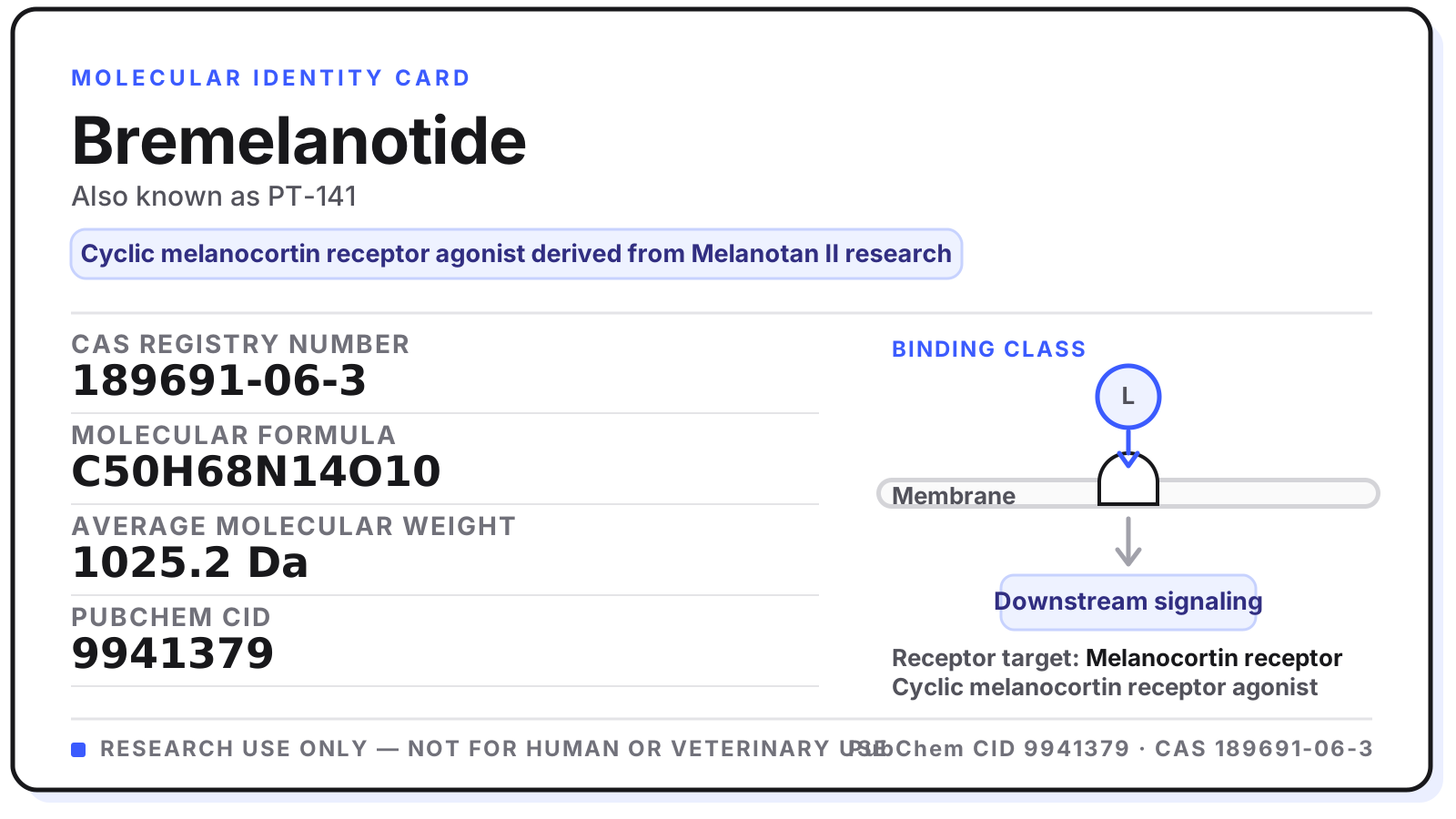
PT-141 Specifications
| Property | Value |
|---|---|
| Compound | PT-141 |
| CAS Number | 189691-06-3 |
| Molecular Formula | C50H68N14O10 |
| Molecular Weight | 1025.2 Da |
| Sequence / Structure | Ac-Nle-cyclo(Asp-His-D-Phe-Arg-Trp-Lys)-OH (melanocortin agonist) |
| Mechanism Class | Melanocortin receptor agonist |
| Purity | ≥99% by HPLC, batch-specific CoA included |
Registry records for PT-141: PubChem
PT-141 Mechanism of Action
PT-141 is an agonist across the melanocortin receptor family, with hypothalamic MC4R and MC3R the subtypes of research interest and Gs/cAMP the transduction route. One structural change separates it from melanotan II: the C-terminal amide is replaced by a free carboxylic acid, which is what hydrolysis of melanotan II produces, and it shifts receptor preference away from the MC1R-driven melanogenesis that dominates melanotan II pharmacology.
The pharmacologically important point is the site of action rather than the potency — melanocortin agonism here is central, not vascular, which is why this class is studied on an entirely different axis from PDE5 inhibitors.
PT-141 Research Applications
MC3R and MC4R receptor pharmacology, resolving subtype selectivity through cAMP accumulation in cells expressing individual melanocortin receptors.
Central neuroendocrine signaling models, where the hypothalamic rather than peripheral site of action is the property under test.
Structure-activity comparison with melanotan II, in which an amide-to-acid change at a single terminus produces a measurable shift in subtype preference.
Cyclic peptide chemistry, since the Asp-Lys lactam bridge is a standard method of locking a peptide into its active conformation and blocking exopeptidases.
Published Research Contexts and Study Parameters
PT-141 has been the subject of peer-reviewed investigation across multiple research domains. Early foundational work by researchers at Palatin Technologies, published in indexed journals including the International Journal of Impotence Research and Peptides, characterized the compound's receptor selectivity profile and central mechanism. Subsequent studies expanded into areas including neuroendocrine regulation and energy homeostasis, as well as immune modulation, all conducted in animal or in vitro models.
As Dr. Robert Hadley and colleagues noted in preclinical pharmacology contexts, "melanocortin receptor agonists with central selectivity represent a distinct mechanistic class from peripherally acting agents, and PT-141 serves as the reference compound for central MC4R activation studies in rodent behavioral paradigms." This mechanistic distinction is the basis for PT-141's continued utility as a research tool peptide.
Key published study parameters for preclinical PT-141 research have included:
- Subcutaneous doses ranging from 0.01 mg/kg to 1.0 mg/kg in rodent models
- Sample sizes of 6 to 24 animals per treatment group in behavioral pharmacology studies
- Observation windows of 30 to 240 minutes post-administration in time-course experiments
- Receptor binding assays using radioligand displacement with IC50 values reported in the 5-20 nM range for MC4R
- HPLC verification of compound purity exceeding 98% as a standard inclusion criterion in published methodology sections
What Research Domains Have Studied PT-141?
PT-141 has appeared in peer-reviewed literature across several distinct preclinical research areas, each exploiting different aspects of its melanocortin receptor pharmacology.
- Neuroendocrine signaling research: Studies examining how MC3R and MC4R modulate hypothalamic-pituitary axis communication and downstream hormonal dynamics in animal models
- Energy homeostasis investigations: Preclinical work assessing melanocortin system involvement in appetite regulation circuits, with PT-141 used as a pharmacological probe
- Behavioral pharmacology: Rodent behavioral paradigms using PT-141 to interrogate the role of central melanocortin signaling in motivated behaviors and autonomic responses
- Receptor subtype characterization: Competitive binding and functional assays establishing PT-141's selectivity profile across the five melanocortin receptor subtypes
- Immune and inflammatory pathway research: Emerging in vitro work examining MC1R and MC3R activity in immune cell populations using PT-141 as a selective pharmacological tool
Comparison: PT-141 vs. Melanotan II in Preclinical Research Contexts
PT-141 and Melanotan II (MT-II) are structurally related melanocortin peptide analogs, but they differ in important ways that affect their use as research tools.
MT-II is a linear analog of alpha-MSH that also binds MC4R but additionally targets MC2R, making its receptor selectivity profile broader and less precise for studies focused specifically on MC3R/MC4R-mediated signaling. PT-141 was developed in part to eliminate tanning activity associated with MC1R agonism, making it a more targeted probe for central melanocortin research.
| Parameter | PT-141 (Bremelanotide) | Melanotan II |
|---|---|---|
| Structure | Cyclic heptapeptide | Linear heptapeptide analog |
| Molecular Weight | 1025.2 g/mol | 1024.2 g/mol |
| Primary Receptor Targets | MC1R, MC3R, MC4R, MC5R | MC1R, MC2R, MC3R, MC4R, MC5R |
| Central vs. Peripheral Action | Predominantly central (hypothalamic) | Both central and peripheral |
| Pigmentation Activity | Reduced relative to MT-II | Significant MC1R-driven pigmentation |
| Research Application Focus | Central melanocortin signaling, neuroendocrine studies | Broader melanocortin system, pigmentation research |
| Typical HPLC Purity (research grade) | ≥98% | ≥98% |
The structural distinction between these two compounds highlights why researchers must specify the exact analog required when sourcing research peptides. Substituting one for the other in a receptor selectivity study would invalidate results.
Both compounds are available as high-purity research compounds from qualified peptide suppliers with batch-specific CoA documentation.
Regulatory and Compliance Considerations for PT-141 Research
PT-141 is classified as a research chemical and is available for purchase by qualified researchers, institutions and laboratories for non-clinical, non-human research purposes. Researchers in the United States should note that PT-141 is not approved for human use under any indication outside of specific regulatory frameworks, and all procurement must comply with applicable institutional and federal guidelines governing research chemical acquisition and use.
Peptide.Express supplies PT-141 strictly for in vitro and preclinical research use only, in compliance with all applicable regulations. Laboratory procurement officers should verify that institutional review board (IRB) or institutional animal care and use committee (IACUC) protocols are in place before initiating animal studies involving PT-141. Documentation of research intent and institutional affiliation is standard practice for responsible peptide supplier relationships.
Research Use Disclaimer: PT-141 (Bremelanotide) offered by Peptide.Express is intended exclusively for laboratory research purposes. It is not approved for human consumption or self-administration, and not for any therapeutic application. Researchers are responsible for ensuring compliance with all local, national and institutional regulations governing research chemical use.
PT-141 Storage Requirements
Store lyophilized PT-141 at -20°C (-4°F) and protect it from light: the tryptophan residue is photo-oxidizable, so an amber or foil-wrapped vial is the correct default rather than an optional precaution. Reconstituted, keep at 2-8°C (36-46°F) and use within 30 days. The lactam bridge makes the cyclic core resistant to exopeptidases, so oxidation rather than proteolysis is the degradation route to expect in solution.
PT-141 at Peptide.Express
All PT-141 sold by Peptide.Express is HPLC-verified at ≥99% purity with a Certificate of Analysis included. Same-day US shipping on orders before 2 PM EST. For in-vitro laboratory research use only.
View PT-141 Product DetailsPT-141 Frequently Asked Questions
What is PT-141 (Bremelanotide)?
PT-141, generic name bremelanotide, is a cyclic seven-residue melanocortin receptor agonist with CAS number 189691-06-3, molecular formula C50H68N14O10 and an average molecular weight of 1025.2 Da. It is the free-acid metabolite of melanotan II and is studied in MC3R/MC4R receptor pharmacology and central neuroendocrine signaling.
What is the difference between PT-141 and Melanotan II?
One functional group at the C-terminus. Melanotan II ends in an amide (C50H69N15O9, 1024.2 Da); PT-141 ends in a free carboxylic acid (C50H68N14O10, 1025.2 Da) and is the product of hydrolyzing that amide. Melanotan II is the stronger MC1R agonist and drives melanogenesis, while PT-141 is studied chiefly for MC3R and MC4R activity.
Is PT-141 FDA approved?
Bremelanotide is approved by the FDA as Vyleesi, an injectable product for acquired, generalized hypoactive sexual desire disorder in premenopausal women. The approval covers that finished product. Research-grade bremelanotide powder is not a medicine, has not been evaluated as one, and is supplied for in-vitro laboratory research only.
What is the structure of PT-141?
PT-141 is Ac-Nle-cyclo(Asp-His-D-Phe-Arg-Trp-Lys)-OH: an N-acetylated norleucine followed by a six-residue ring closed by a lactam bond between the aspartate and lysine side chains. Norleucine and D-phenylalanine are both non-standard residues, and the ring constrains the peptide into its receptor-active conformation.
References
- Molinoff PB, Shadiack AM, Earle D, Diamond LE, Quon CY. PT-141: a melanocortin agonist for the treatment of sexual dysfunction. Ann N Y Acad Sci. 2003. Read Molinoff et al. on PT-141 as an MC3R/MC4R melanocortin agonist
- Mountjoy KG, Mortrud MT, Low MJ, Simerly RB, Cone RD. Localization of the melanocortin-4 receptor (MC4-R) in neuroendocrine and autonomic control circuits in the brain. Mol Endocrinol. 1994. Read Mountjoy et al. on MC4R distribution in hypothalamic and autonomic circuits
- Vyleesi (bremelanotide) injection, FDA-approved prescribing information via DailyMed. Bremelanotide is approved for hypoactive sexual desire disorder in premenopausal women; the approval covers the finished drug product only. Read the Vyleesi (bremelanotide) FDA prescribing information
Research Areas Using PT-141
Related Research Guides
How This Page Is Sourced
Molecular identity on this page — name, CAS number, molecular formula and molecular weight — is resolved from a single internal entity record and checked against primary registries (PubChem, CAS Common Chemistry) rather than retyped per page. A field with no verified value is left out instead of estimated. Literature is cited to a DOI, PMID or PMCID permalink so every reference resolves to the specific record it names.