Classification
- Ipamorelin
- GHRP — growth hormone releasing peptide
- Sermorelin
- GHRH analog
Compound comparison
Two receptors, two scales. Ipamorelin is a five-residue GHSR-1a agonist signalling through calcium; sermorelin is the unmodified 29-residue GHRH(1-29) fragment acting at GHRH-R through cAMP-PKA and cleared within ten to twenty minutes. Sermorelin was approved as Geref and withdrawn; ipamorelin stopped at phase 2. Cortisol-sensitive designs favour ipamorelin’s selectivity; GHRH-arm designs use sermorelin.
Quick Answer
Five residues against twenty-nine, and two different receptors. Ipamorelin is a 711.9 Da pentapeptide (CAS 170851-70-4) that agonises GHSR-1a, the ghrelin receptor, through calcium mobilisation. Sermorelin is the native GHRH(1-29) fragment at 3,357.9 Da (CAS 86168-78-7), acting at GHRH-R through cAMP-PKA. They converge on the same somatotroph by separate routes, which is why combination designs outnumber head-to-head ones. No trial has compared them directly.


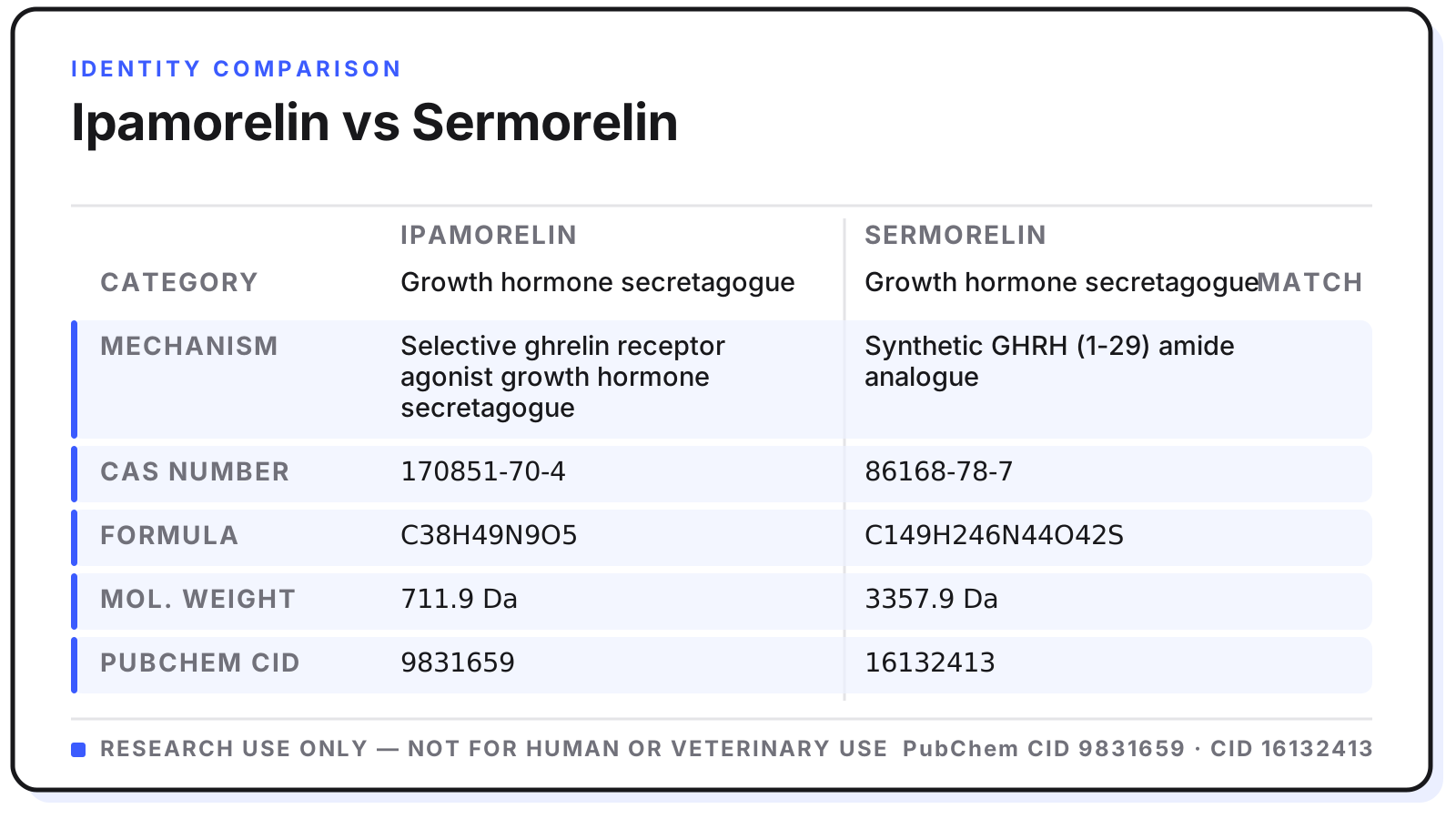
Classification
Receptor target
Amino acid count
Sequence / structure
CAS number
Molecular formula
Molecular weight
Signalling cascade
Cortisol and prolactin release
Non-natural residues
Reported plasma half-life
Highest published human trial stage
Age of the main literature
Commonly combined with
Purity (Peptide.Express)
Ipamorelin compared with Sermorelin across mechanism, structure and research attributes. Research reference only.
The most common mistake in comparing these two is treating them as alternatives. They act on different receptors on the same cell, and the physiological response to activating both simultaneously exceeds what either produces alone. In practice that means most research designs featuring one of them feature something from the other class as well.
Ipamorelin is the more chemically unusual of the two. At 711.9 Da it is tiny for a receptor-active peptide, and three of its five residues are non-natural: alpha-aminoisobutyric acid, D-2-naphthylalanine and D-phenylalanine. Those substitutions do two jobs — they resist proteolytic degradation, and they confer the receptor selectivity that separates ipamorelin from earlier GHRPs. GHRP-2 and GHRP-6 stimulate cortisol and prolactin alongside growth hormone; ipamorelin largely does not, which makes it a cleaner tool when cortisol is a confounder in the experimental design.
Sermorelin is the more conventional molecule: the N-terminal 29 residues of endogenous GHRH, unmodified, at 3,357.9 Da. The C-terminal 15 residues of the full 44-amino-acid hormone turn out to be unnecessary for receptor binding, which is why the truncated fragment retains activity. Being unmodified is also its limitation — with no N-terminal protection it is cleared quickly, on the order of ten to twenty minutes in Geref-era pharmacokinetic reports, against stabilised analogs like tesamorelin that carry modifications specifically to slow that degradation.
The evidence bases are asymmetric in an awkward way, and the asymmetry does not run cleanly in either direction. Sermorelin has a real approval history — it was marketed as Geref and has since been withdrawn, generally described as a commercial rather than a safety decision — but most of its literature predates 2000 and reflects assay methods and trial conventions of that era.
Ipamorelin has cleaner selectivity data and more modern receptor pharmacology, but a narrower body of work, a discontinued phase 2 programme and no approval anywhere. Neither has published human pharmacokinetics of the quality you would want before quoting a number, and no trial has compared the two against each other at any point.
The receptor. Ipamorelin is a 5-amino-acid pentapeptide agonising GHSR-1a, the ghrelin receptor, through a calcium-mediated pathway. Sermorelin is a 29-amino-acid GHRH(1-29) analog acting at the GHRH receptor through the cAMP-PKA cascade. Both increase GH secretion; they arrive by different routes.
No. Ipamorelin is a GHRP — a growth hormone releasing peptide that mimics ghrelin. Sermorelin, CJC-1295 and tesamorelin are the GHRH analogs.
Because unlike earlier GHRPs such as GHRP-2 and GHRP-6, it produces minimal cortisol and prolactin release at research concentrations. That selectivity comes from the non-natural residues in its sequence, and it matters in any design where cortisol would confound the readout. It is concentration-dependent rather than absolute.
They can, and the rationale is the same as for the more common CJC-1295 plus ipamorelin pairing — two convergent pathways onto the same somatotroph. In practice CJC-1295 (No DAC) is used more often than sermorelin for the GHRH arm because of its improved stability.
Only one side has a usable published figure, so the honest answer is that this cannot be settled. Sermorelin is an unmodified native GHRH fragment cleared on the order of ten to twenty minutes in Geref-era reports. Ipamorelin's human plasma half-life is not established in peer-reviewed pharmacokinetic literature, and its non-natural residues predict proteolytic resistance without measuring it.
Neither convincingly. Sermorelin has the larger clinical footprint because it was an approved product, but most of that work predates 2000. Ipamorelin has more modern receptor pharmacology and a discontinued phase 2 programme. Both are thin by the standards of a compound with a current approval, and no head-to-head study exists.
Geref was the brand name under which sermorelin held FDA approval. That approval has since been withdrawn from market, generally described as a commercial rather than a safety decision. Research-market sermorelin is not the approved pharmaceutical product.
Length and stability. Sermorelin is the unmodified 29-residue GHRH fragment at 3,357.9 Da. Tesamorelin is the full 44-residue GHRH sequence at 5,136 Da with a trans-3-hexenoyl group at the N-terminus that slows metabolic degradation. Tesamorelin holds a current FDA approval as Egrifta; sermorelin's approval as Geref has been withdrawn.
Yes. Both are verified at ≥99% purity by reverse-phase HPLC with LC-MS/MS identity confirmation, and ship with a batch-specific Certificate of Analysis. For in-vitro laboratory research use only.
Compiled by the Peptide.Express Research Team. Written and reviewed by Peptide.Express Editorial Team. Molecular identity on this page (name, CAS number, molecular formula and molecular weight) is resolved from a single internal entity record and checked against primary registries (PubChem, CAS Common Chemistry) rather than retyped per page. A field with no verified value is left out instead of estimated. Literature is cited to a DOI, PMID or PMCID permalink so every reference resolves to the specific record it names.