Tesamorelin vs CJC-1295 (No DAC)
Both engage the GHRH receptor through the same cAMP-PKA cascade; tesamorelin is the full 44-residue sequence, CJC-1295 (No DAC) the 29-residue fragment. Tesamorelin completed phase 3 and holds an FDA approval; CJC-1295 (No DAC) has no published human phase trial. Designs needing published human pharmacokinetics use tesamorelin; minimal-fragment GHRH-R work uses CJC-1295 (No DAC).
Quick Answer
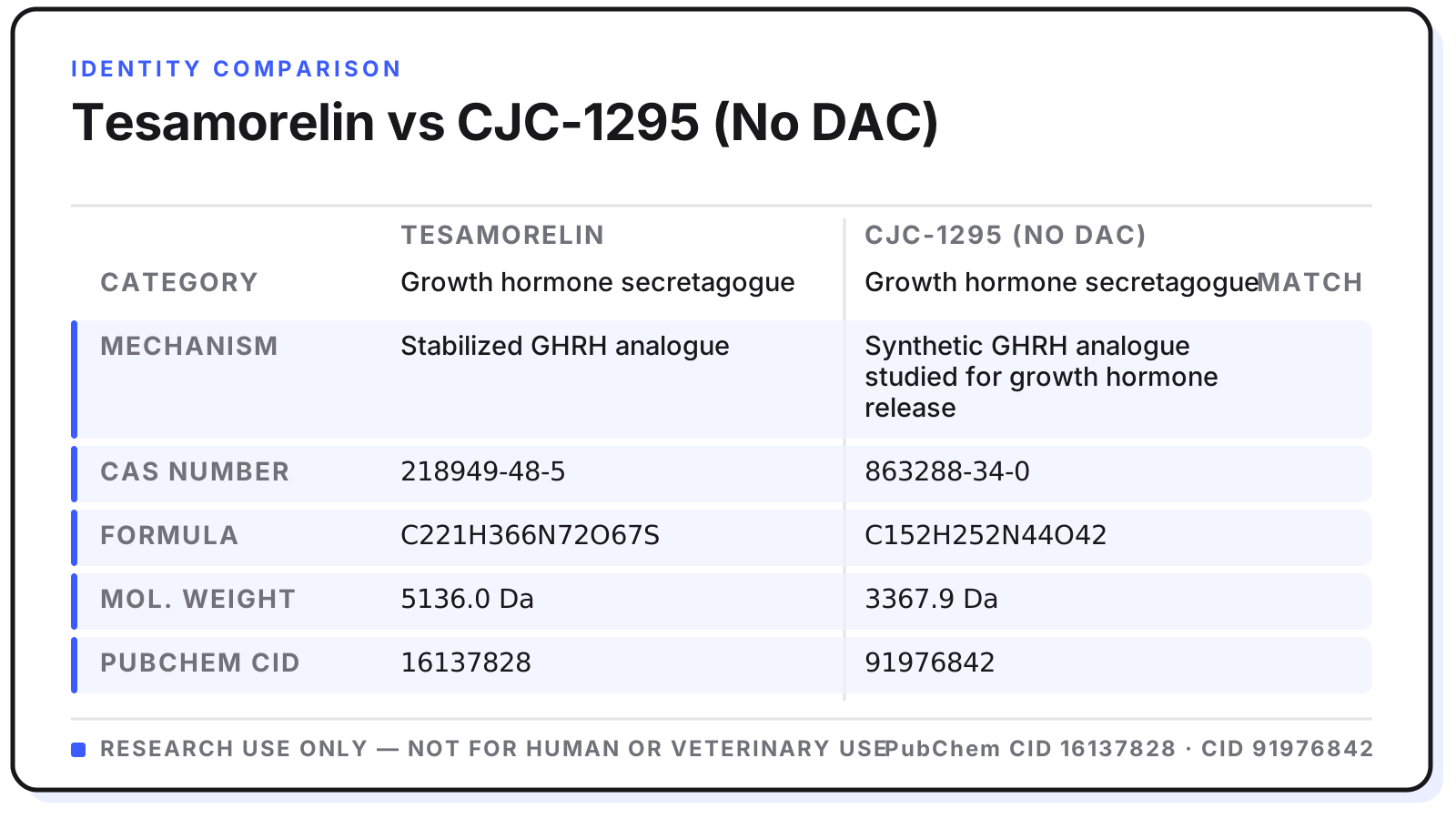
Sequence length and evidence depth separate these two, not duration. Tesamorelin is the complete 44-residue GHRH sequence carrying a trans-3-hexenoyl cap at the N-terminus (CAS 218949-48-5, 5,136 Da) and holds an FDA approval built on phase 3 trials. CJC-1295 (No DAC), also called Modified GRF (1-29), is the 29-residue receptor-binding fragment with four substitutions (CAS 863288-34-0, 3,367.9 Da) and has no published phase trial behind it. Neither is long-acting; that is CJC-1295 With DAC, a different molecule.
Compound Reference Pages
Tesamorelin vs CJC-1295 (No DAC): At a Glance
| Attribute | Tesamorelin | CJC-1295 (No DAC) |
|---|---|---|
| Mechanism class | Full-length stabilized GHRH analog | Truncated stabilized GHRH analog (Mod GRF 1-29) |
| Receptor target | GHRH receptor (GHRH-R) | GHRH receptor (GHRH-R) |
| Peptide length | 44 amino acids | 29 amino acids |
| Stabilizing modification | Trans-3-hexenoyl group on the N-terminal tyrosine | Substitutions at positions 2, 8, 15 and 27 |
| Development code | TH9507 (Theratechnologies) | None — no sponsor development programme |
| CAS number | 218949-48-5 | 863288-34-0 |
| Molecular formula | C221H366N72O67S | C152H252N44O42 |
| Molecular weight | 5,136 Da (PubChem CID 16137828) | 3,367.9 Da |
| Reported plasma half-life | Tens of minutes after intravenous dosing, per the Egrifta prescribing information | Not established in peer-reviewed pharmacokinetic literature; roughly 30 minutes is repeated in secondary sources without a primary citation |
| Highest published human trial stage | Phase 3 completed | No published human phase trial |
| Regulatory status | FDA-approved as Egrifta for HIV-associated lipodystrophy; research-grade material is not that product | Not approved in any jurisdiction for any indication |
| Purity (Peptide.Express) | ≥99% by reverse-phase HPLC, batch CoA | ≥99% by reverse-phase HPLC, batch CoA |
How Tesamorelin and CJC-1295 (No DAC) Differ in Research
Both molecules bind the same receptor and run the same cAMP-PKA cascade inside the somatotroph. Tesamorelin presents the complete 44-residue GHRH sequence with a trans-3-hexenoyl group attached to the N-terminal tyrosine. CJC-1295 (No DAC) is the 1-29 fragment — the minimal region that still activates GHRH-R — with four substitutions layered on. The position-2 substitution is the one doing most of the work, because it removes the dipeptidyl peptidase IV cleavage site that destroys native GHRH within minutes.
The duration story is widely mangled online, so state it plainly: neither of these is long-acting. Both modifications defend the same N-terminal vulnerability, and both molecules clear in well under an hour. The compound in this family that genuinely circulates for days is CJC-1295 With DAC, which carries a maleimidopropionyl group that binds serum albumin covalently.
Registry records make this easy to confuse — the PubChem record indexed under the bare name "CJC-1295" (CID 91971820, CAS 446262-90-4) reports C165H269N47O46 and 3,647.2 Da, a mass that reflects the DAC-bearing form rather than the 3,367.9 Da No-DAC material.
Reading the mass on a Certificate of Analysis is the practical way to tell which one is in the vial.
The asymmetry that actually matters is evidentiary, and it is large. Tesamorelin completed phase 3 trials and holds an FDA approval; there is a published clinical pharmacology package for it, including the plasma half-life figure quoted above. CJC-1295 (No DAC) has no equivalent.
Its half-life, its receptor affinity relative to native GHRH, and its dose-response behaviour are described in vendor literature and secondary reviews far more often than in primary papers. Setting the two side by side is not setting two comparable datasets side by side, and no head-to-head study of tesamorelin against Mod GRF (1-29) has been published.
Peptide.Express supplies both at ≥99% purity by reverse-phase HPLC with LC-MS/MS mass confirmation and a batch-specific Certificate of Analysis. Research-grade tesamorelin is not Egrifta and carries none of that product's regulatory review. All material is for in-vitro laboratory research and educational use only.
Tesamorelin vs CJC-1295 (No DAC): Frequently Asked Questions
What is the main difference between Tesamorelin and CJC-1295?
Length, and the depth of evidence behind each. Tesamorelin is the full 44-residue GHRH sequence protected by a trans-3-hexenoyl group; CJC-1295 (No DAC) is the 29-residue Modified GRF (1-29) fragment carrying four substitutions. Tesamorelin has completed phase 3 trials and holds an FDA approval as Egrifta. CJC-1295 (No DAC) has no published human phase trial at all.
Which has the longer half-life, Tesamorelin or CJC-1295 (No DAC)?
Neither is long-acting, and the honest answer is that only one of them has a published figure. The Egrifta prescribing information reports a tesamorelin plasma half-life measured in tens of minutes after intravenous dosing. For CJC-1295 (No DAC), the roughly 30-minute figure circulating online has no primary pharmacokinetic paper behind it. The days-long half-life belongs to CJC-1295 With DAC.
Which has more published research behind it?
Tesamorelin, by a wide margin. It has a completed phase 3 programme, a published clinical pharmacology package and an FDA-approved product built on that data. CJC-1295 (No DAC) is documented mainly through preclinical work on GRF(1-29) analogs and secondary reviews. Any comparison of the two is comparing unequal evidence standards.
Can Tesamorelin and CJC-1295 be studied together?
There is no published rationale for combining them, because they agonise the same receptor through the same cascade — the combination adds a variable without adding a pathway. Research designs that pair compounds in this space almost always pair a GHRH analog with a ghrelin-receptor agonist such as ipamorelin instead.
Which is studied with Ipamorelin — Tesamorelin or CJC-1295?
CJC-1295 (No DAC). It is the GHRH-arm analog most often paired with ipamorelin, because a GHRH-R analog plus a GHSR-1a agonist engages two separate secretion pathways onto the same cell. Peptide.Express supplies that pairing as a single pre-blended vial.
Are Tesamorelin and CJC-1295 the same purity at Peptide.Express?
Yes. Both are verified at ≥99% purity by reverse-phase HPLC with LC-MS/MS mass confirmation, performed by an independent laboratory, and ship with a batch-specific Certificate of Analysis.
References
- Falutz J, et al. "Long-term safety and effects of tesamorelin, a growth hormone-releasing factor analogue, in HIV-infected patients with abdominal fat accumulation." AIDS, 2008. Read the tesamorelin long-term safety study on PubMed
- Falutz J, et al. "Tesamorelin Improves Fat Quality Independent of Changes in Fat Quantity." AIDS, 2021. Read the tesamorelin fat quality analysis on PMC
- LiverTox: Clinical and Research Information on Drug-Induced Liver Injury — Tesamorelin. National Institute of Diabetes and Digestive and Kidney Diseases, NIH Bookshelf. Read the LiverTox tesamorelin monograph on NCBI Bookshelf
- Egrifta (tesamorelin for injection) FDA prescribing information, 2024. The authoritative source for the approved indication, pharmacokinetic parameters and monitored laboratory values. Read the Egrifta FDA prescribing information (PDF)
- Teichman SL, Neale A, Lawrence B, Gagnon C, Castaigne JP, Frohman LA. "Prolonged Stimulation of Growth Hormone (GH) and Insulin-Like Growth Factor I Secretion by CJC-1295, a Long-Acting Analog of GH-Releasing Hormone, in Healthy Adults." Journal of Clinical Endocrinology & Metabolism, 2006. Read the CJC-1295 (DAC) human dosing study on PubMed
- Raun K, et al. "Ipamorelin, the First Selective Growth Hormone Secretagogue." European Journal of Endocrinology, 1998. Read the Raun ipamorelin selectivity study on PubMed
- Bowers CY, Reynolds GA, Durham D, Barrera CM, Pezzoli SS, Thorner MO. "Growth Hormone (GH)-Releasing Peptide Stimulates GH Release in Normal Men and Acts Synergistically with GH-Releasing Hormone." Journal of Clinical Endocrinology & Metabolism, 1990. Read the GHRP and GHRH co-administration synergy study on PubMed
Related Comparisons
Explore More
How This Page Is Sourced
Compiled by the Peptide.Express Research Team. Reviewed by Ben Laythee, Lead Chemist. Molecular identity on this page — name, CAS number, molecular formula and molecular weight — is resolved from a single internal entity record and checked against primary registries (PubChem, CAS Common Chemistry) rather than retyped per page. A field with no verified value is left out instead of estimated. Literature is cited to a DOI, PMID or PMCID permalink so every reference resolves to the specific record it names.