What Is Tesamorelin? Research Guide
Definition
Tesamorelin (development code TH9507) is a synthetic analog of the complete 44-amino-acid human growth hormone-releasing hormone, carrying a trans-3-hexenoyl group on the N-terminal tyrosine (CAS 218949-48-5, C221H366N72O67S, 5135.9 Da). That acylation blocks DPP-4 cleavage. It is the only GHRH analog in this library that reproduces the whole hormone rather than its 1-29 fragment.
Key Takeaways
- →Tesamorelin (development code TH9507) is a synthetic analog of the complete 44-amino-acid human growth hormone-releasing hormone, carrying a trans-3-hexenoyl group on the N-terminal tyrosine (CAS 218949-48-5, C221H366N72O67S, 5135.9 Da). That acylation blocks DPP-4 cleavage.
- →Available for in-vitro research at ≥99% HPLC-verified purity from Peptide.Express.
- →Certificate of Analysis included with every order. Same-day US shipping.

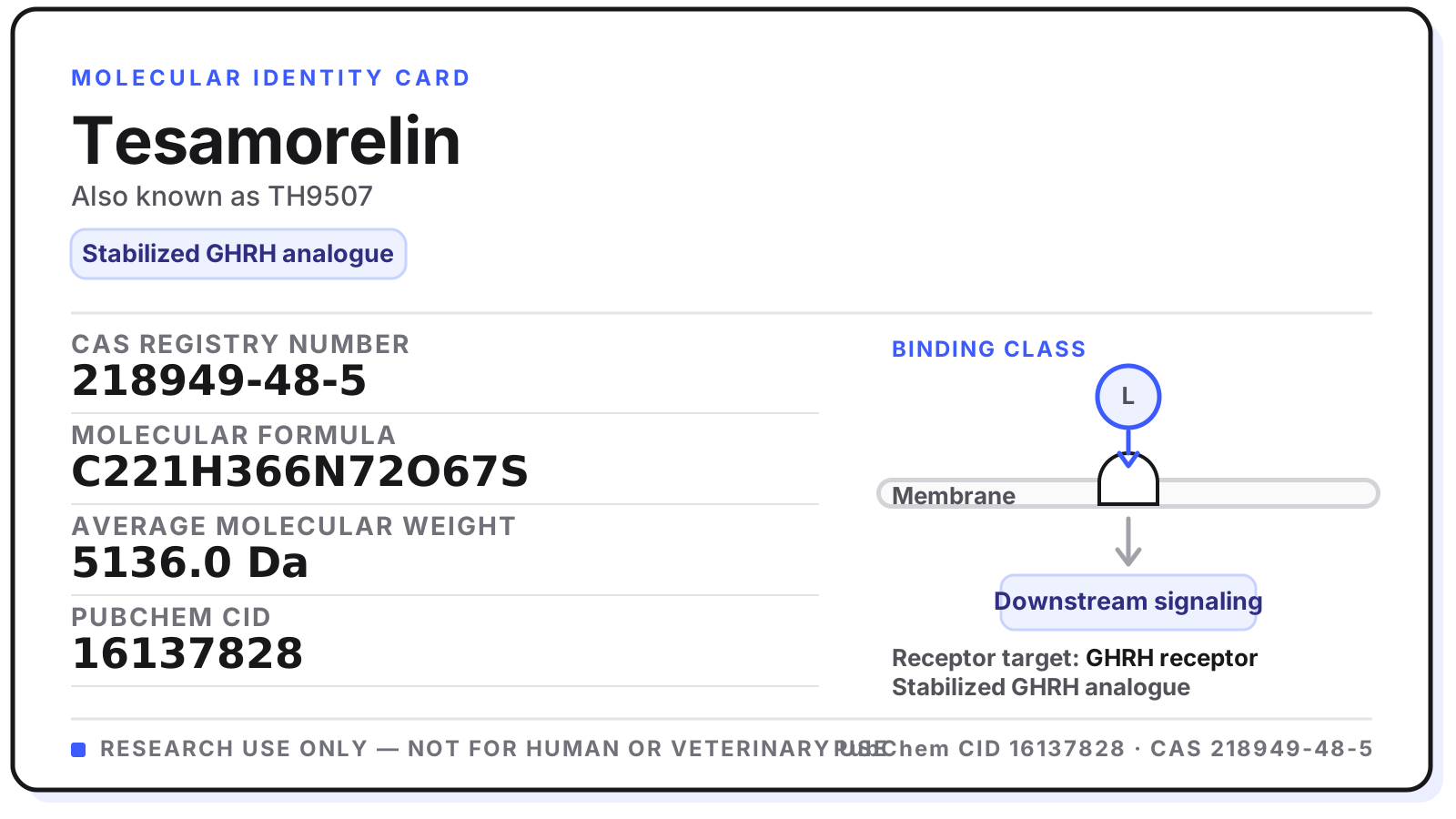
Tesamorelin Specifications
| Property | Value |
|---|---|
| Compound | Tesamorelin |
| CAS Number | 218949-48-5 |
| Molecular Formula | C221H366N72O67S |
| Molecular Weight | 5136 Da |
| Sequence / Structure | Stabilized 44-amino-acid GHRH analog (trans-3-hexenoyl-modified) |
| Mechanism Class | Long-acting GHRH analog |
| Purity | ≥99% by HPLC, batch-specific CoA included |
Registry records for Tesamorelin: PubChem
Tesamorelin Mechanism of Action
Tesamorelin engages the same GHRH receptor as sermorelin and CJC-1295 and drives the same Gs/cAMP cascade in somatotrophs; the difference is the molecule presented to that receptor. It reproduces all 44 residues instead of the truncated 1-29 fragment, and the trans-3-hexenoyl group on Tyr1 sterically obstructs dipeptidyl peptidase-4 at the N-terminus.
Published work reports increased IGF-1 with the pulsatile pattern of GH release preserved, which follows from acting upstream at the hypothalamic-pituitary interface rather than supplying exogenous growth hormone. Among the compounds here it is unusual in having a licensed drug product behind it, and its pharmacology is correspondingly better documented.
Tesamorelin Research Applications
GHRH receptor research, where a full-length 44-residue ligand allows direct comparison against the 1-29 fragment analogs on the same assay.
Visceral adipose tissue and lipid-metabolism models — the area with the deepest published tesamorelin record, and the one its approved product addresses.
IGF-1 axis studies, since GHRH-receptor agonism raises IGF-1 indirectly through endogenous GH rather than by administering it.
Acylation chemistry, where tesamorelin and semaglutide represent two different structural answers to the same DPP-4 and clearance problem.
Tesamorelin Has an FDA Approval — Here Is Exactly What It Covers
Almost nothing in the research peptide catalog has a current FDA approval. Tesamorelin does. It was approved as EGRIFTA (now marketed as EGRIFTA SV) for the reduction of excess abdominal fat in HIV-infected adult patients with lipodystrophy, and the phase 3 program behind that approval produced published human safety and pharmacodynamic data that no other growth hormone secretagogue in common research use can point to.
The precision matters. The approval attaches to a manufactured pharmaceutical product, made under pharmaceutical GMP, formulated and labelled for one indication in one patient population. It does not attach to the molecule in the abstract, and it does not extend to research-market tesamorelin. A vial of research-grade tesamorelin is not Egrifta, is not a drug product, and is not sold as one.
What the approval does give a researcher is something genuinely useful: a public, regulator-reviewed dataset covering pharmacokinetics, IGF-1 response, monitored laboratory values and adverse event profile. The FDA prescribing information is the authoritative source for those parameters, and it is a better reference for pharmacokinetic design than any secondary summary. Reading it is the single highest-yield hour available to anyone designing a tesamorelin protocol.
The record is narrow, though. Trials enrolled a specific population with a specific metabolic phenotype. The visceral fat effect reverses when administration stops. Reading across from those results to other models is extrapolation, and should be labelled as such in any protocol that does it.
Pulsatile Release, and Why It Is Different From Giving GH
Because tesamorelin enters the axis at the pituitary rather than the periphery, the counter-regulation stays intact. Rising GH stimulates hypothalamic somatostatin release. Somatostatin suppresses further somatotroph firing. Output arrives in pulses that track the endogenous rhythm rather than as a flat elevation.
Exogenous recombinant human growth hormone bypasses that loop entirely. It raises circulating GH directly, flattens the pulse architecture, and suppresses endogenous somatotroph output through negative feedback. For a research question about total GH exposure, that difference may be irrelevant. For a question about physiological GH signaling — pulse frequency, pulse amplitude, downstream receptor desensitisation, or anything where the pattern rather than the level is the variable — it is the entire point.
This is the single most-cited reason investigators select a GHRH analog over recombinant GH. It also constrains what the compound can do: a GHRH analog cannot raise GH in a model with no functioning somatotroph reserve, and the ceiling on the response is set by the pituitary rather than by how much peptide is introduced. Both properties are useful in study design and both are frequently ignored.
Hepatic IGF-1 and the Visceral Fat Question
Growth hormone acts on hepatocytes through the JAK2-STAT5 pathway to drive transcription of insulin-like growth factor 1. Circulating IGF-1 is the downstream mediator most closely tracked in tesamorelin research, and it rises reliably in the published human dataset — it is the most reproducible signal the compound produces and the standard endpoint for confirming axis engagement.
IGF-1 and GH together raise lipolytic tone in adipose tissue. The reported effect in the clinical trials was preferential for visceral rather than subcutaneous depots, and that depot selectivity is the property that made tesamorelin clinically interesting in the first place.
It is also not fully explained. Visceral adipocytes differ from subcutaneous adipocytes in lipolytic responsiveness, in receptor density, and in portal drainage, which puts them in a different metabolic position relative to the liver. All three probably contribute. None of them, individually or in obvious combination, accounts for the size of the depot difference reported. Anyone who tells you the mechanism is settled is overstating the literature.
A 2021 analysis by Lake and colleagues in AIDS approached the question sideways and made it more interesting rather than less. It reported changes in fat quality — the composition and character of the tissue — that were independent of changes in fat quantity. Something is happening to adipose tissue beyond volume reduction, and the depot selectivity may be a symptom of that rather than the whole story. Treat it as an open question with a partial mechanistic account.
One more variable belongs in any metabolic protocol using this compound. Growth hormone is counter-regulatory to insulin, and the EGRIFTA SV prescribing information directs that glucose status be evaluated before treatment starts and monitored periodically thereafter. A design that raises GH and does not measure glycemic response is leaving an interacting variable unobserved.
Tesamorelin: Where the Evidence Runs Out
Two gaps are worth naming plainly, because both get papered over in most secondary coverage of this compound.
The first is mechanistic. Visceral-over-subcutaneous depot selectivity is a documented observation without a complete explanation. Receptor density, lipolytic responsiveness and portal drainage each contribute plausibly and none accounts for the effect size. Research designs that assume a known mechanism and build inference on top of it are building on an observation, not a pathway.
The second is about population. Essentially the entire high-quality human evidence base for tesamorelin comes from trials in HIV-infected patients with lipodystrophy — a population with a specific and unusual metabolic phenotype, often on antiretroviral therapy, with a fat distribution pattern that is not typical of metabolic disease generally. That is a narrow base from which to generalise, and the compound has not been characterised at comparable quality in other populations or models.
A smaller third gap: the effect is not durable. Visceral fat returns when administration stops, which was observed in the trial program and appears in the labelling. Any research design treating the effect as a state change rather than a maintained perturbation is misreading the data.
None of this makes tesamorelin a weak research tool. It has the best-characterised human dataset of any GHRH analog available, an FDA-reviewed pharmacokinetic profile, and a clean receptor mechanism. It means the confident claims should stay attached to what was measured — GH pulsatility, IGF-1 response, depot-selective lipolysis in one clinical population — and the extrapolations should be labelled as extrapolations.
Tesamorelin Storage Requirements
Store lyophilized tesamorelin at -20°C (-4°F) with the vial sealed. Reconstituted, hold at 2-8°C (36-46°F) and use within 30 days. Its single methionine is an oxidation site, and at 44 residues with an N-terminal acyl chain it adsorbs onto plastic more readily than the short peptides in this group, so prepare working dilutions in low-binding tubes if concentration accuracy matters.
Tesamorelin at Peptide.Express
All Tesamorelin sold by Peptide.Express is HPLC-verified at ≥99% purity with a Certificate of Analysis included. Same-day US shipping on orders before 2 PM EST. For in-vitro laboratory research use only.
View Tesamorelin Product DetailsTesamorelin Frequently Asked Questions
What is Tesamorelin?
Tesamorelin, development code TH9507, is a synthetic analog of the full 44-amino-acid human growth hormone-releasing hormone bearing a trans-3-hexenoyl group on the N-terminal tyrosine. Its CAS number is 218949-48-5, its molecular formula is C221H366N72O67S and its average molecular weight is 5135.9 Da. It is studied in GHRH-receptor and lipid-metabolism research.
Is Tesamorelin FDA approved?
A tesamorelin drug product is approved: Egrifta, cleared by the FDA to reduce excess visceral abdominal fat in patients with HIV-associated lipodystrophy. That approval covers the finished, labeled product only. Research-grade tesamorelin powder is not a drug, has not been evaluated as one, and is supplied for in-vitro laboratory research.
What is the difference between Tesamorelin and Sermorelin?
Length and stability. Sermorelin is GRF (1-29), the shortest GHRH fragment retaining full activity, unmodified and cleaved by DPP-4 within minutes. Tesamorelin reproduces all 44 residues and adds a trans-3-hexenoyl group at Tyr1 that blocks that cleavage. At 5135.9 Da it is roughly one and a half times the mass of sermorelin at 3357.9 Da.
What is the molecular weight of Tesamorelin?
Tesamorelin has an average molecular weight of 5135.9 Da, molecular formula C221H366N72O67S and CAS registry number 218949-48-5. Its PubChem CID is 16137828. It is the largest GHRH analog in this research library.
References
- Falutz J, et al. "Long-term safety and effects of tesamorelin, a growth hormone-releasing factor analogue, in HIV-infected patients with abdominal fat accumulation." AIDS, 2008. Read the tesamorelin long-term safety study on PubMed
- Falutz J, et al. "Tesamorelin Improves Fat Quality Independent of Changes in Fat Quantity." AIDS, 2021. Read the tesamorelin fat quality analysis on PMC
- LiverTox: Clinical and Research Information on Drug-Induced Liver Injury — Tesamorelin. National Institute of Diabetes and Digestive and Kidney Diseases, NIH Bookshelf. Read the LiverTox tesamorelin monograph on NCBI Bookshelf
- Egrifta (tesamorelin for injection) FDA prescribing information, 2024. The authoritative source for the approved indication, pharmacokinetic parameters and monitored laboratory values. Read the Egrifta FDA prescribing information (PDF)
Tesamorelin Compared
Related Research Guides
How This Page Is Sourced
Molecular identity on this page — name, CAS number, molecular formula and molecular weight — is resolved from a single internal entity record and checked against primary registries (PubChem, CAS Common Chemistry) rather than retyped per page. A field with no verified value is left out instead of estimated. Literature is cited to a DOI, PMID or PMCID permalink so every reference resolves to the specific record it names.