What Is DSIP? Research Guide
Definition
DSIP — delta sleep-inducing peptide — is a nine-residue peptide, Trp-Ala-Gly-Gly-Asp-Ala-Ser-Gly-Glu (CAS 62568-57-4, C35H48N10O15, 848.8 Da). Schoenenberger and Monnier isolated it in 1977 from cerebral venous blood drawn from rabbits held in induced slow-wave sleep, and the name records that assay rather than a mechanism. Nearly fifty years later, no DSIP receptor has been cloned.
Key Takeaways
- →DSIP — delta sleep-inducing peptide — is a nine-residue peptide, Trp-Ala-Gly-Gly-Asp-Ala-Ser-Gly-Glu (CAS 62568-57-4, C35H48N10O15, 848.8 Da). Schoenenberger and Monnier isolated it in 1977 from cerebral venous blood drawn from rabbits held in induced slow-wave sleep, and the name records that assay rather than a mechanism.
- →Available for in-vitro research at ≥99% HPLC-verified purity from Peptide.Express.
- →Certificate of Analysis included with every order. Same-day US shipping.

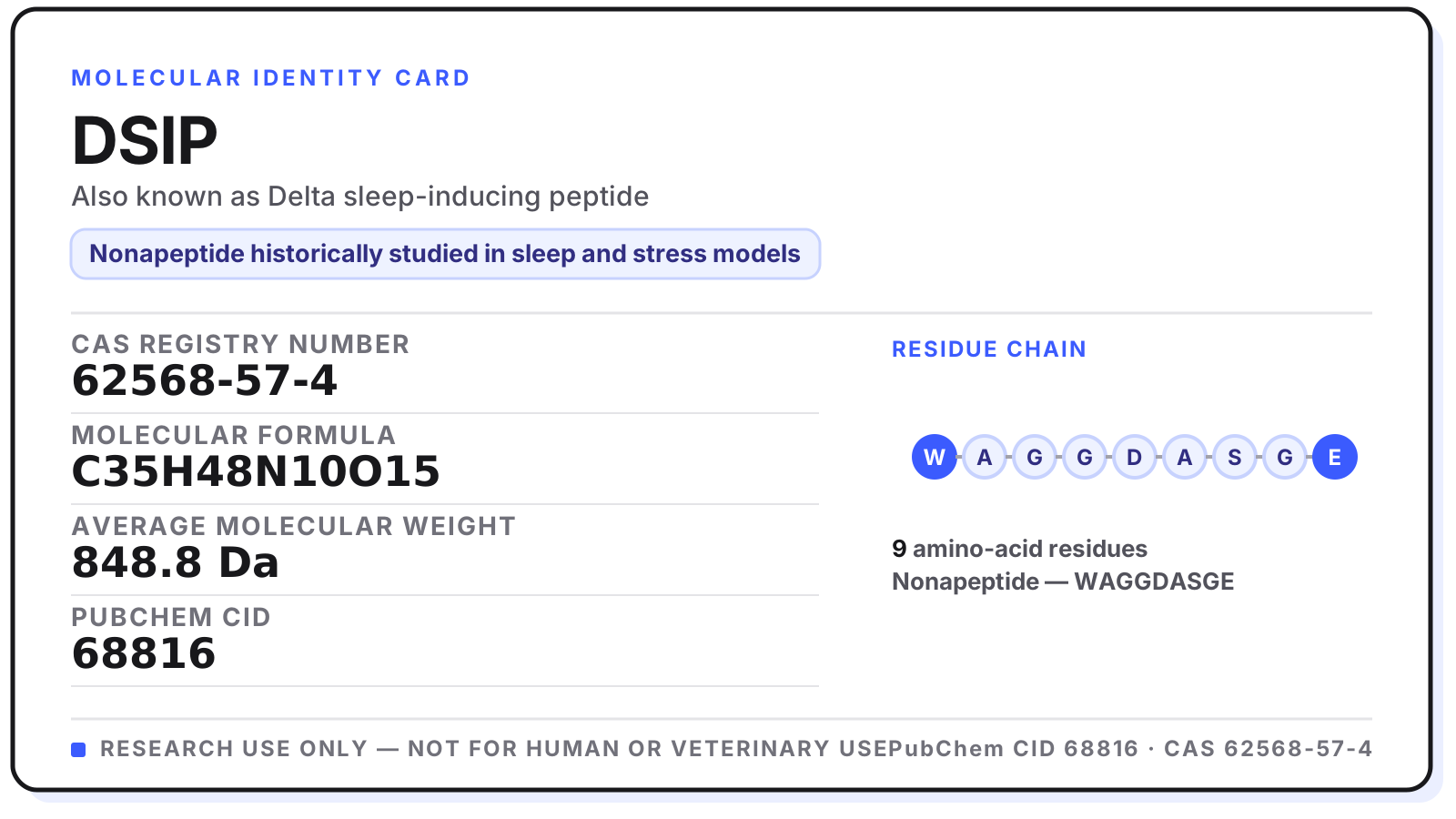
DSIP Specifications
| Property | Value |
|---|---|
| Compound | DSIP |
| CAS Number | 62568-57-4 |
| Molecular Formula | C35H48N10O15 |
| Molecular Weight | 848.8 Da |
| Sequence / Structure | Trp-Ala-Gly-Gly-Asp-Ala-Ser-Gly-Glu (WAGGDASGE, nonapeptide) |
| Mechanism Class | Endogenous nonapeptide studied in slow-wave sleep regulation |
| Purity | ≥99% by HPLC, batch-specific CoA included |
Registry records for DSIP: PubChem
DSIP Mechanism of Action
The most consequential fact about DSIP is a negative one. No receptor has been identified for it, no consensus binding site exists, and every reported effect is therefore an observation made after administration rather than a step in a described pathway.
The widely repeated claim that DSIP is a GABA-A agonist has nothing behind it: the compound does not produce the pharmacological signature of benzodiazepines or barbiturates in standard assays, so whatever it modulates sits upstream of the classical sedative targets.
Replication is the other long-running problem. Some groups reproduced the 1977 delta-EEG result and others did not, and differences in species, administration route and EEG scoring criteria account for part of that spread but not all of it. Two findings outside the sleep work have held up better, largely because they were narrower to begin with.
Banks, Kastin and Coy (Brain Research, 1984) characterised transport of a labelled DSIP analog across the blood-brain barrier by a non-competitive route. Graf and colleagues (Neuroendocrinology, 1985) reported that DSIP reduces CRF-induced corticosterone release while leaving the ACTH-induced response alone. Circulating peptidases clear the peptide quickly, which constrains any systemic design built on it.
DSIP Research Applications
Delta-power spectral analysis in rodent and rabbit EEG preparations — the endpoint the compound was named for, and the place where between-laboratory disagreement is widest. A protocol that states its scoring criteria explicitly is the difference between a replicable design here and one nobody can check.
Sedative-mechanism exclusion. Running DSIP against a GABA-A agonist arm asks directly whether a change in sleep architecture belongs to general sedation or to something else, and DSIP is unusually well suited to that question precisely because its target is unknown.
Blood-brain barrier transport research, where DSIP serves as a reference substrate: its passage into the central nervous system was characterised early and has been measured repeatedly since, which is more than can be said for its sleep pharmacology.
Stress-axis models built on CRF-induced corticosterone release. This is the best-described non-sleep effect in the record, and it too rests on a small number of studies with no receptor connecting them.
DSIP Storage Requirements
Store lyophilized DSIP at -20°C (-4°F), desiccated. Reconstituted, keep at 2-8°C (36-46°F) and use within 14 to 28 days. Two notes are specific to this sequence. The tryptophan at position 1 is photo-oxidizable, so the vial belongs under cover rather than parked beneath bench lighting.
And DSIP goes into solution faster than most peptides in this library — a gentle swirl finishes it, and agitation it does not need only risks the air-liquid interface. The poor plasma stability described in the literature is a property of blood, not of a refrigerated vial, and should not be read as a shorter shelf life.
DSIP at Peptide.Express
All DSIP sold by Peptide.Express is HPLC-verified at ≥99% purity with a Certificate of Analysis included. Same-day US shipping on orders before 2 PM EST. For in-vitro laboratory research use only.
View DSIP Product DetailsDSIP Frequently Asked Questions
What is DSIP?
DSIP is delta sleep-inducing peptide, a nonapeptide with the sequence Trp-Ala-Gly-Gly-Asp-Ala-Ser-Gly-Glu (WAGGDASGE). Its CAS registry number is 62568-57-4, its molecular formula is C35H48N10O15 and its average molecular weight is 848.8 Da. Schoenenberger and Monnier isolated it in 1977 from the cerebral venous blood of rabbits in induced slow-wave sleep. Supplied for in-vitro laboratory research only.
What is the mechanism of action of DSIP?
Not established, and that is the accurate answer rather than a cautious one. No DSIP receptor has been cloned or characterised in nearly fifty years, so there is no binding-site account to give. What exists is a set of downstream observations from administration studies — a categorically weaker form of evidence than a receptor-linked pathway. Any source that describes DSIP mechanism with the confidence used for a GPCR ligand is asserting more than the literature supports.
Is DSIP a GABA-A agonist or a sedative?
No on both counts. The GABA-A claim circulates widely and has no support behind it: DSIP does not produce the pharmacological profile of benzodiazepines or barbiturates in standard assays. Whatever it modulates in sleep-regulatory circuitry operates through something other than the classical sedative targets, which is a large part of why the compound stayed interesting after its sleep data proved inconsistent.
How well replicated is the original DSIP sleep finding?
Unevenly. The 1977 result was an increase in delta-frequency EEG power in animal preparations, and subsequent attempts split — some groups reproduced an effect on slow-wave activity, others found none. Species, administration route and EEG scoring criteria explain part of the divergence but not all of it. A research design built on this compound should treat the replication problem as a first-order variable rather than a footnote.
Does DSIP cross the blood-brain barrier?
Yes, and it is the best-supported finding attached to the compound. Banks, Kastin and Coy reported in Brain Research in 1984 that a labelled DSIP analog crosses by a non-competitive mechanism. DSIP is used as a reference substrate in peptide transport research for that reason. Crossing the barrier is a pharmacokinetic property, not evidence of any central effect.
References
- Schoenenberger GA, Monnier M. Characterization of a delta-electroencephalogram(-sleep)-inducing peptide. Proc Natl Acad Sci U S A. 1977. Read Schoenenberger and Monnier's 1977 isolation and characterization of DSIP
- Banks WA, Kastin AJ, Coy DH. Evidence that [125I]N-Tyr-delta sleep-inducing peptide crosses the blood-brain barrier by a non-competitive mechanism. Brain Res. 1984. Read Banks, Kastin and Coy on DSIP blood-brain barrier transport
- Graf MV, Kastin AJ, Coy DH, Fischman AJ. Delta-sleep-inducing peptide reduces CRF-induced corticosterone release. Neuroendocrinology. 1985. Read Graf et al. on DSIP's effect on CRF-induced corticosterone release
Research Areas Using DSIP
Related Research Guides
How This Page Is Sourced
Molecular identity on this page — name, CAS number, molecular formula and molecular weight — is resolved from a single internal entity record and checked against primary registries (PubChem, CAS Common Chemistry) rather than retyped per page. A field with no verified value is left out instead of estimated. Literature is cited to a DOI, PMID or PMCID permalink so every reference resolves to the specific record it names.