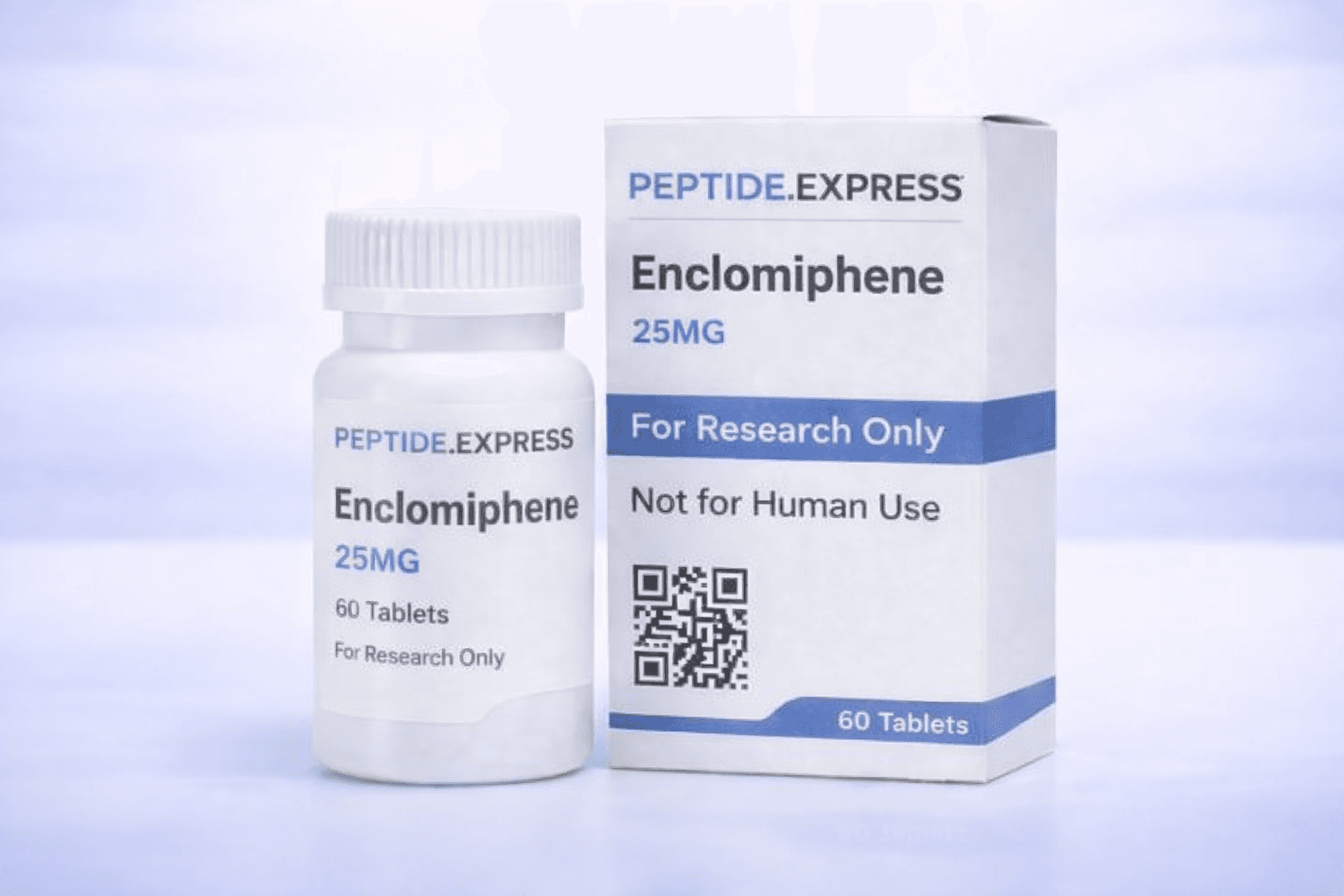
Enclomiphene Oral Tablets — Selective Estrogen Receptor Modulator (SERM), Trans-Isomer of Clomiphene
Research-Grade Compound
Enclomiphene is a small-molecule selective estrogen receptor modulator (SERM) and the trans-isomer of clomiphene. It is not a peptide — it contains no amino acids and no peptide bonds, and it belongs to the triphenylethylene chemical class alongside compounds such as tamoxifen. Molecular formula C26H28ClNO, molecular weight 405.96 Da, CAS 15690-57-0.
No reviews yet. Be the first to review this product.
What is Enclomiphene?
Enclomiphene is a small-molecule selective estrogen receptor modulator (SERM) and the trans-isomer of clomiphene. It is not a peptide — it contains no amino acids and no peptide bonds, and it belongs to the triphenylethylene chemical class alongside compounds such as tamoxifen. Molecular formula C26H28ClNO, molecular weight 405.96 Da, CAS 15690-57-0.
Clomiphene as normally supplied is a mixture of two geometric isomers: zuclomiphene, the cis form, and enclomiphene, the trans form. They are not pharmacologically equivalent. Enclomiphene behaves predominantly as an estrogen receptor antagonist at hypothalamic and pituitary receptors with minimal agonist character, while zuclomiphene carries partial agonist activity and a much longer elimination half-life — enclomiphene is reported to clear in a matter of hours, zuclomiphene over days to weeks. Isolating the trans-isomer therefore changes both the pharmacodynamic profile and the duration of exposure, which is the entire rationale for studying it separately from the racemate.
This product is supplied as oral tablets rather than as a lyophilized powder, so there is no reconstitution step and no diluent to select. Handling is a matter of keeping tablets dry, sealed and away from light. Peptide.Express supplies enclomiphene for laboratory research use only; it is not an approved medicine, not a testosterone therapy, and not offered as an alternative to one.
How Does Enclomiphene Work? Mechanism of Action
Enclomiphene competes with estradiol for estrogen receptors — principally ERα — in the hypothalamus and anterior pituitary. Estradiol at those sites exerts negative feedback on the hypothalamic-pituitary-gonadal axis, damping GnRH pulse frequency and, downstream of that, gonadotropin output. Occupying the receptor without activating it removes the feedback signal.
The consequence follows the axis: GnRH pulse frequency rises, pituitary gonadotrophs increase secretion of luteinising hormone and follicle-stimulating hormone, and the gonads receive more stimulation for steroidogenesis and gametogenesis. What makes this pharmacologically interesting as a research model is the direction of action. Exogenous androgen administration produces gonadal steroid output while suppressing the axis that would otherwise generate it; enclomiphene works by driving the axis rather than bypassing it. Studies that need to distinguish axis-preserving from axis-suppressing manipulations use exactly that contrast.
Calling any SERM simply an antagonist compresses the pharmacology too far. Estrogen receptor ligands recruit different coactivator and corepressor complexes depending on the conformation they impose on the receptor and on which regulatory proteins a given tissue expresses. The same molecule can therefore read as antagonist in one tissue and partial agonist in another. Enclomiphene is antagonist-dominant at the hypothalamic-pituitary sites that matter for HPG feedback, which is not the same as being an antagonist everywhere.
A real limit on the evidence base: most published pharmacology for this chemistry comes from studies of racemic clomiphene, where the two isomers were administered together and their effects cannot be separated after the fact. Attributing a finding specifically to the trans-isomer requires a design using the separated isomer, and those studies are much less common. Anyone building a research protocol on enclomiphene should check whether the source literature actually isolated the isomer or is being read as though it did.
Research Applications of Enclomiphene
HPG Axis Feedback Research
- Negative-feedback modelling: blocking hypothalamic and pituitary estrogen receptors provides a pharmacological method of removing the feedback arm without removing the gonads.
- Gonadotropin response characterisation: LH and FSH output following receptor blockade is the standard endpoint linking receptor occupancy to axis behaviour.
- Axis-preserving versus axis-suppressing comparison: running an exogenous androgen arm alongside a SERM arm separates the two manipulations that both raise gonadal steroid signalling.
Estrogen Receptor Pharmacology
- Competitive binding assays: relative affinity for ERα and ERβ places enclomiphene against reference SERMs in the same panel.
- Tissue-selective coregulator recruitment: the coactivator and corepressor complexes recruited at each tissue explain why a single SERM shows different functional behaviour by site.
- Isomer-resolved pharmacology: enclomiphene against zuclomiphene in the same assay is the design that racemic clomiphene studies structurally cannot deliver.
Comparative Endocrine Pharmacology
- SERM class comparison: enclomiphene and tamoxifen share the triphenylethylene scaffold, while raloxifene is a benzothiophene — a structural axis worth controlling for in class-wide studies.
- Cross-axis contrast: pairing a SERM arm with a GHRH-analog arm separates HPG-axis manipulation from somatotropic-axis manipulation in the same experimental design.
- Upstream and downstream pairing: kisspeptin acts on GPR54 upstream of GnRH, enclomiphene acts on the feedback signal reaching the same neurons, and running both isolates which layer of the circuit a readout reflects.
Enclomiphene vs Zuclomiphene
| Feature | Enclomiphene (trans-isomer) | Zuclomiphene (cis-isomer) |
|---|---|---|
| Isomeric form | Trans (E) isomer of clomiphene | Cis (Z) isomer of clomiphene |
| Compound class | Small-molecule SERM, triphenylethylene | Small-molecule SERM, triphenylethylene |
| Molecular formula | C26H28ClNO | C26H28ClNO (same formula, different geometry) |
| Molecular weight | 405.96 Da | 405.96 Da |
| CAS number | 15690-57-0 | Distinct CAS registry — verify against supplier documentation |
| Estrogen receptor behaviour | Antagonist-dominant at hypothalamic and pituitary sites | Partial agonist character |
| Reported elimination | Hours | Days to weeks |
| Effect on HPG feedback | Removes estradiol negative feedback, raising LH and FSH | Mixed — agonist activity can oppose the antagonist effect |
| Peptide or small molecule | Small molecule — not a peptide | Small molecule — not a peptide |
Racemic clomiphene, the form used in most published studies and in the prescription product, contains both isomers together. That matters more than it first appears: the long-persisting partial-agonist isomer accumulates across repeated administration while the short-acting antagonist isomer does not, so the pharmacological character of the mixture shifts over time in a way neither isomer shows alone. Reading racemic clomiphene data as though it describes enclomiphene is one of the more common errors in this literature, and the separated-isomer studies needed to correct it are comparatively rare.
Enclomiphene Technical Specifications
| Compound Name | Enclomiphene (trans-clomiphene) |
|---|---|
| Common Synonyms | Enclomifene, enclomiphene citrate, trans-clomiphene |
| Classification | Small-molecule selective estrogen receptor modulator (SERM) — not a peptide |
| Chemical Class | Triphenylethylene |
| Isomeric Form | Trans-isomer of clomiphene |
| Paired Isomer | Zuclomiphene (cis-isomer, partial agonist, long elimination) |
| CAS Number | 15690-57-0 |
| Molecular Formula | C26H28ClNO |
| Molecular Weight | 405.96 Da |
| Amino Acid Sequence | Not applicable — enclomiphene contains no amino acids |
| Primary Target | Estrogen receptor (principally ERα) in hypothalamus and anterior pituitary |
| Axis Studied | Hypothalamic-pituitary-gonadal (HPG) axis |
| Physical Form | Oral tablets |
| Reconstitution | Not applicable — supplied as tablets, no diluent required |
| Purity (active ingredient) | ≥99% enclomiphene by HPLC, assayed on the active ingredient rather than the finished tablet |
| Identity Confirmation | LC-MS/MS mass confirmation against 405.96 Da |
| Storage | Room temperature in the sealed original container, dry and protected from light |
| Humidity Control | Keep desiccated; do not transfer to unsealed containers |
| Testing Methods | HPLC, LC-MS/MS |
| Documentation | Certificate of Analysis (CoA) per batch |
| FDA Status | Not approved as a single-isomer product for any indication |
| WADA Status | Anti-estrogenic agents including clomifene are prohibited at all times under class S4 |
| Intended Use | Laboratory research only |
How to Reconstitute Enclomiphene for Research
Enclomiphene ships as oral tablets, so there is nothing to reconstitute — no diluent selection, no concentration arithmetic, no 14-to-28-day post-reconstitution window. What replaces all of that is moisture control. Tablets pick up atmospheric humidity through any container that is not properly sealed, and a tablet that has absorbed moisture is no longer a reliable unit of anything. The steps below cover handling and storage, not reconstitution.
- Keep tablets in the original sealed container. Do not decant into weighing boats, vials or unsealed secondary containers for storage.
- Store at controlled room temperature, dry and protected from light. Refrigeration is unnecessary and introduces condensation risk each time the container is opened.
- Retain any desiccant packet supplied with the container, and reseal fully after every access.
- Open the container in a low-humidity environment and close it promptly. Repeated exposure to ambient humidity is the main degradation route for an oral solid dosage form.
- Inspect tablets before use. Discard the batch if you observe softening, discoloration, mottling, chipping or any change from the appearance recorded on the Certificate of Analysis.
- Record the batch number against every experiment. With no reconstitution date to track, the batch identifier is the only chain of custody the material carries.
- For assays requiring a solution, prepare it fresh from tablet material using a solvent appropriate to the assay and document the preparation method — the tablet excipient matrix is not inert and will appear in the analysis.
- Observe the manufacture and expiry dates printed on the container rather than applying peptide storage windows, which do not apply to a small-molecule oral solid.
Diluent: bacteriostatic water for peptide reconstitution. Full protocol: step-by-step peptide reconstitution guide. Concentration maths: peptide reconstitution calculator.
Frequently Asked Questions — Enclomiphene
What is enclomiphene?
Is enclomiphene a peptide?
What is a SERM and how does enclomiphene work as one?
What is the difference between enclomiphene and zuclomiphene?
What is the difference between enclomiphene and clomiphene (Clomid)?
How does enclomiphene affect LH and FSH in research models?
How does enclomiphene differ mechanistically from exogenous testosterone administration?
Is enclomiphene FDA approved?
Is enclomiphene prohibited in competitive sport?
How should enclomiphene tablets be stored?
Does enclomiphene need to be reconstituted?
What purity standard and testing does Peptide.Express apply to enclomiphene?
Where is the Certificate of Analysis for enclomiphene?
Research References
- Wiehle RD, Cunningham GR, Pitteloud N, Wike J, Hsu K, Fontenot GK, Rosner M, Dwyer A, Podolski J. Testosterone restoration by enclomiphene citrate in men with secondary hypogonadism: pharmacodynamics and pharmacokinetics. BJU Int. 2013. Read Wiehle et al.'s trial of enclomiphene citrate in secondary hypogonadism
- Mikkelson TJ, Kroboth PD, Cameron WJ, Dittert LW, Chungi V, Manberg PJ. Single-dose pharmacokinetics of clomiphene citrate in normal volunteers. Fertil Steril. 1986. Read Mikkelson et al.'s isomer-resolved clomiphene citrate pharmacokinetics
- Clomiphene citrate tablets, FDA-approved prescribing information via DailyMed. Racemic clomiphene citrate holds approval with its own labelling; enclomiphene as a single isomer does not. Read the clomiphene citrate FDA prescribing information
All products are sold for in-vitro laboratory research use only. Not intended for human consumption, clinical use, or veterinary use. Peptide.Express makes no medical claims. Consult the published literature for research application guidance.