Tirzepatide (GLP-TIRZ) — Dual GLP-1/GIP Receptor Agonist | LY3298176 Incretin Research Compound
Research-Grade Compound
Tirzepatide (development code LY3298176, commonly shortened to "tirz") is a synthetic 39-amino-acid peptide that agonizes both GLP-1R (the glucagon-like peptide-1 receptor) and GIPR (the glucose-dependent insulinotropic polypeptide receptor). Molecular formula C225H348N48O68, molecular weight 4,813.5 Da, CAS 2023788-19-2. A C20 fatty diacid is attached at Lys20; that acyl chain binds serum albumin reversibly, which is what stretches the plasma half-life to roughly five days in published clinical pharmacokinetics and makes once-weekly administration workable in trials.
Purity standard: GLP2-TIRZ is sourced to ≥99% by HPLC. That is the specification every batch must meet, not a measurement of any one vial — the measured figure for a batch is on that batch's Certificate of Analysis.
Select Size
No reviews yet. Be the first to review this product.
What is Tirzepatide (GLP-TIRZ)?
Tirzepatide (development code LY3298176, commonly shortened to "tirz") is a synthetic 39-amino-acid peptide that agonizes both GLP-1R (the glucagon-like peptide-1 receptor) and GIPR (the glucose-dependent insulinotropic polypeptide receptor). Molecular formula C225H348N48O68, molecular weight 4,813.5 Da, CAS 2023788-19-2. A C20 fatty diacid is attached at Lys20; that acyl chain binds serum albumin reversibly, which is what stretches the plasma half-life to roughly five days in published clinical pharmacokinetics and makes once-weekly administration workable in trials.
Tirzepatide is one of the few compounds in the research-peptide catalog with a real approval record behind it. The FDA approved it as Mounjaro for type 2 diabetes in 2022 and as Zepbound for obesity in 2023. That matters for research framing in a specific way: the pharmacology of this molecule has been characterized in registrational trials with published endpoints, so it functions as a reference standard for dual incretin receptor work rather than as a compound whose behavior has to be inferred from preclinical data.
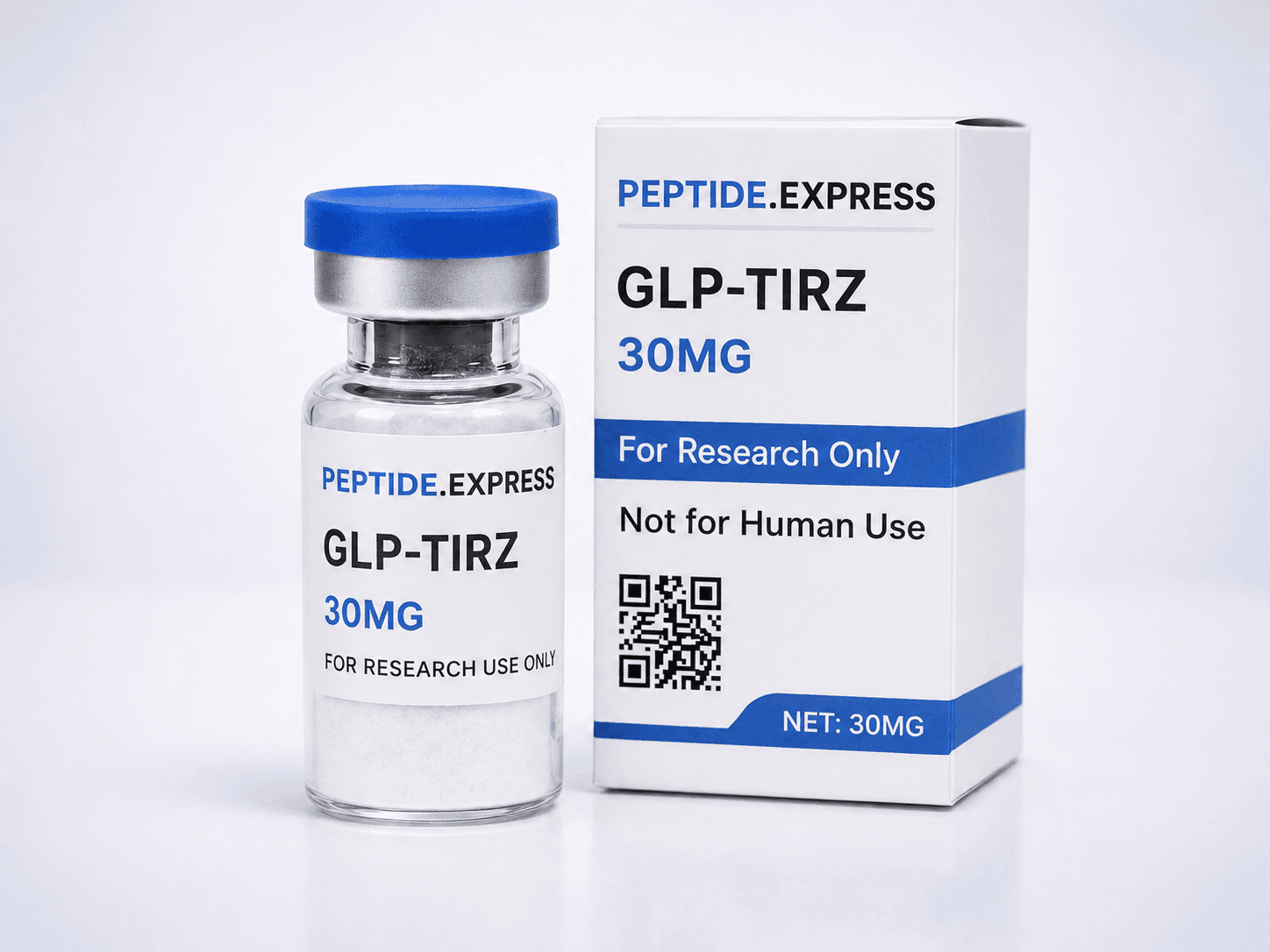
The GLP-TIRZ designation is the internal Peptide.Express SKU name — the compound is tirzepatide, and that is the name used throughout the literature, in the CAS registry, and on the Certificate of Analysis. Research-grade material is not the approved pharmaceutical product: it is not Mounjaro, it is not Zepbound, it is not manufactured under pharmaceutical GMP, and it carries no approved indication. What ships is lyophilized powder verified at ≥99% purity by HPLC with LC-MS/MS mass confirmation against 4,813.5 Da, for in-vitro laboratory research use only.
How Does Tirzepatide (GLP-TIRZ) Work? Mechanism of Action
Tirzepatide engages two incretin receptors with a single molecule. The two receptors are structurally related class B GPCRs and both couple through Gs to raise intracellular cAMP, but they are expressed on overlapping-yet-distinct tissue populations, and the reason the combination behaves differently from either alone lies in that distribution rather than in the signaling chemistry.
GLP-1R — Intake Suppression and Glucose-Dependent Insulin Secretion
On pancreatic beta cells, GLP-1R agonism amplifies insulin secretion only when glucose is elevated — the incretin effect is glucose-dependent by construction, which is why this receptor arm carries a low intrinsic hypoglycemia signal. It simultaneously suppresses glucagon secretion from alpha cells under hyperglycemic conditions.
The central arm runs through GLP-1R expression in the hypothalamic arcuate nucleus and the area postrema, reducing food intake and slowing gastric emptying. Gastrointestinal adverse effects across the incretin class track this arm more than any other, which becomes relevant to the design argument for adding GIPR.
GIPR — Adipocyte Nutrient Handling and the Second Insulinotropic Input
GIPR is expressed on beta cells, on adipocytes, and in CNS regions that partly overlap GLP-1R territory. Beta-cell GIPR agonism supplies a second glucose-dependent insulinotropic signal. Adipocyte GIPR signaling influences lipid buffering and nutrient partitioning — a lever on adiposity that operates through storage and handling rather than through appetite.
GIPR is genuinely contested territory in the literature, and any honest description of tirzepatide has to say so. Both GIPR agonists and GIPR antagonists reduce body weight in preclinical models, and the field has not settled why. Receptor desensitization under sustained agonism is one proposed reconciliation; opposing central and peripheral GIPR populations is another. Tirzepatide is an agonist at this receptor, and it works — but the mechanistic account of why agonism at GIPR helps is not closed.
What the Dual-Agonist Trials Established
SURMOUNT-1, published by Jastreboff and colleagues in the New England Journal of Medicine in 2022, is the registrational obesity trial. Across dose arms it reported mean body-weight reductions of roughly 15% at 5 mg and about 21% at 15 mg at week 72. Those are published Phase 3 clinical findings in trial participants receiving the approved pharmaceutical product under medical supervision, cited here as pharmacological reference data — not as a claim about research-market material and not as a claim about any purchaser outcome.
SURPASS-2 ran the direct head-to-head against semaglutide in type 2 diabetes and reported greater HbA1c and body-weight reduction on tirzepatide. That trial is named here without a specific citation because no verified identifier for it was available at the time of writing; the receptor-pharmacology reference in the references section covers the underlying dual-agonist biology, not the SURPASS-2 trial data itself. Anyone building on the comparison should read the primary SURPASS-2 paper rather than a summary of it.
What the trials do not establish is anything about a research-grade vial. Registrational data attaches to the drug product that was studied — a specific manufacturing process, a specific formulation, a specific supply chain under FDA oversight. Research material shares the molecule, not the regulatory pedigree. Mass confirmation against 4,813.5 Da and HPLC purity are what a research buyer can actually verify, and that is the appropriate basis for evaluating a vial.
Research Applications of Tirzepatide (GLP-TIRZ)
Dual Incretin Receptor Pharmacology
- Reference-standard comparisons: tirzepatide is the established dual GLP-1R/GIPR agonist against which triple agonists and GLP-1R-selective compounds are benchmarked in receptor assays.
- cAMP accumulation profiling: measuring relative potency at GLP-1R versus GIPR in cell lines expressing one receptor at a time is how the imbalanced agonism of this molecule is quantified.
- GIPR direction-of-effect studies: running tirzepatide against GIPR antagonists in the same model is the design that addresses the agonist-versus-antagonist question directly.
Metabolic Signaling Models
- Isolated islet preparations: glucose-dependent insulin secretion under combined GLP-1R and GIPR stimulation, separated from the CNS intake effects that dominate whole-animal readouts.
- Adipocyte nutrient partitioning: GIPR-driven lipid handling in cultured adipocytes, which is the arm that distinguishes dual agonism from GLP-1R-only pharmacology.
- Gastric emptying and CNS satiety circuits: hindbrain and hypothalamic GLP-1R activation measured against the tolerability signal it generates.
Analytical Method Development
- Acylated peptide separation: the C20 fatty diacid at Lys20 gives tirzepatide distinctive reverse-phase retention behavior, making it a useful test article for HPLC method development on lipidated analogs.
- Mass confirmation workflows: LC-MS/MS against 4,813.5 Da with the C225H348N48O68 formula as the theoretical check.
- Albumin-binding characterization: the reversible albumin interaction that drives the extended half-life is measurable in vitro and is the mechanism behind the acylation strategy across this compound class.
Tirzepatide vs Semaglutide
| Feature | Tirzepatide | Semaglutide |
|---|---|---|
| Receptor targets | GLP-1R and GIPR (dual agonist) | GLP-1R only (single agonist) |
| Glucose-dependent insulinotropic arms | Two — GLP-1R and GIPR | One — GLP-1R |
| Adipocyte GIPR signaling | Yes | None |
| Structure | 39 amino acids, 4,813.5 Da, C20 fatty diacid at Lys20 | Acylated GLP-1 analog; molecular data not carried in the Peptide.Express entity record |
| CAS number | 2023788-19-2 | Not carried in the Peptide.Express entity record |
| Originator | Eli Lilly (LY3298176) | Novo Nordisk |
| US brand names | Mounjaro (T2DM), Zepbound (obesity) | Ozempic (T2DM), Wegovy (obesity) |
| Registrational obesity trial | SURMOUNT-1 (NEJM 2022) | STEP program |
| Direct head-to-head evidence | SURPASS-2 in type 2 diabetes | SURPASS-2 in type 2 diabetes |
| FDA status | Approved for T2DM and obesity | Approved for T2DM and obesity |
The GIP receptor arm is the whole pharmacological difference, and SURPASS-2 is the only direct comparison between the two in type 2 diabetes. Weight-change figures quoted from separate trial programs are not comparable to each other — different populations, durations and endpoints — so the receptor-level difference is the more defensible thing to reason from. Semaglutide molecular values are deliberately not asserted here: they are absent from the Peptide.Express canonical entity record, and this site does not quote molecular data it has not verified.
Tirzepatide (GLP-TIRZ) Technical Specifications
| Compound Name | Tirzepatide |
|---|---|
| Product SKU Name | GLP-TIRZ |
| Development Code | LY3298176 (Eli Lilly) |
| Brand Names (approved product) | Mounjaro (type 2 diabetes), Zepbound (obesity) |
| Common Synonyms | tirz, tirzepatide acetate, tirzepatide peptide, LY3298176 |
| Mechanism Class | Dual GLP-1 / GIP receptor agonist |
| Receptor Targets | GLP-1R, GIPR |
| Amino Acid Count | 39 |
| Structure Note | 39-amino-acid dual GIP/GLP-1 agonist with C20 fatty diacid at Lys20 |
| Molecular Formula | C225H348N48O68 |
| Molecular Weight | 4,813.5 Da |
| CAS Number | 2023788-19-2 |
| Plasma Half-Life | Approximately 5 days (published clinical pharmacokinetics) |
| FDA Status | Approved as Mounjaro (T2DM) and Zepbound (obesity); research-grade material is not the approved product |
| Purity | ≥99% by HPLC |
| Purity Confirmation | LC-MS/MS mass confirmation against 4,813.5 Da |
| Endotoxin Testing | LAL (Limulus Amebocyte Lysate) method |
| Manufacturing Standard | Research-grade synthesis; not pharmaceutical GMP |
| Physical Form | Lyophilized powder |
| Appearance | White to off-white powder |
| Reconstitution | Bacteriostatic water |
| Storage (lyophilized) | -20°C, desiccated, protected from light |
| Storage (reconstituted) | 2–8°C, use within 14–28 days |
| Shelf Life | 24 months from manufacture (lyophilized) |
| Testing Methods | HPLC, LC-MS/MS, LAL Endotoxin |
| Documentation | Certificate of Analysis (CoA) per batch |
| Intended Use | In-vitro laboratory research only |
How to Reconstitute Tirzepatide (GLP-TIRZ) for Research
The C20 fatty diacid at Lys20 is the reason tirzepatide handles the way it does in solution. Acylated peptides adsorb to glass and plastic surfaces more readily than unmodified ones, which matters when preparing dilute working solutions — losses to the container wall are real at low microgram-per-millilitre concentrations. Preparing a concentrated stock and diluting into the assay buffer immediately before use is the usual way around it.
- Let the vial reach room temperature before opening.
- Calculate diluent volume for the target concentration. For the 30 mg vial, 3 mL of bacteriostatic water yields 10 mg/mL and 6 mL yields 5 mg/mL.
- Swab the septum with alcohol and give it 30 seconds to dry.
- Angle the needle and run the diluent down the inner vial wall rather than onto the lyophilized cake. Foaming an acylated peptide is a straightforward way to lose material.
- Swirl for 60–90 seconds. No shaking, no vortexing.
- Check the solution against a light background — clear and colorless, no particulate, no persistent haze.
- Label with reconstitution date, batch number and resulting concentration in mg/mL.
- Store at 2–8°C, use within 14–28 days, and do not freeze the reconstituted solution.
Diluent: bacteriostatic water for peptide reconstitution. Full protocol: step-by-step peptide reconstitution guide. Concentration maths: peptide reconstitution calculator.
Frequently Asked Questions — Tirzepatide (GLP-TIRZ)
What is tirzepatide?
What does GLP-TIRZ mean?
Is "tirz" the same as tirzepatide?
Is tirzepatide FDA approved?
What is the difference between Mounjaro and Zepbound?
How does tirzepatide differ from semaglutide?
What is the GIP receptor and why does tirzepatide target it?
Is tirzepatide stronger than semaglutide?
What is the difference between tirzepatide and retatrutide?
What does "tirzepatide peptide" mean for research use?
What is the C20 fatty diacid at Lys20 for?
What is tirzepatide's molecular formula and weight?
What purity standard does Peptide.Express use for tirzepatide?
What testing does tirzepatide undergo before shipping?
How should tirzepatide be stored before and after reconstitution?
How do I reconstitute tirzepatide for research use?
Where is the Certificate of Analysis for tirzepatide?
Research References
- Jastreboff AM, Aronne LJ, Ahmad NN, et al. "Tirzepatide Once Weekly for the Treatment of Obesity." New England Journal of Medicine, 2022. (SURMOUNT-1) Read the SURMOUNT-1 tirzepatide obesity trial in NEJM
- Coskun T, Sloop KW, Loghin C, et al. "LY3298176, a Novel Dual GIP and GLP-1 Receptor Agonist for the Treatment of Type 2 Diabetes Mellitus: From Discovery to Clinical Proof of Concept." Molecular Metabolism. 2018. Read the Coskun 2018 tirzepatide discovery and receptor pharmacology paper in Molecular Metabolism
- "Retatrutide — A Game Changer in Obesity Pharmacotherapy." Included here because it sets the dual-agonist pharmacology of tirzepatide against the triple-agonist case, which is the comparison most often asked about. Read the triple-agonist review that contextualizes dual GLP-1/GIP pharmacology on PMC
- Jastreboff AM, Kaplan LM, Frías JP, et al. "Triple-Hormone-Receptor Agonist Retatrutide for Obesity — A Phase 2 Trial." New England Journal of Medicine, 2023. The reference point for what adding GCGR agonism to the dual-agonist template does. Read the retatrutide Phase 2 trial in NEJM
All products are sold for in-vitro laboratory research use only. Not intended for human consumption, clinical use, or veterinary use. Peptide.Express makes no medical claims. Consult the published literature for research application guidance.