CagriSema and retatrutide represent two mechanistically distinct approaches to incretin-based metabolic research, and the CagriSema retatrutide comparison has become one of the most discussed topics among obesity peptide researchers ahead of and following ADA 2026 presentations. CagriSema combines semaglutide (a GLP-1 receptor agonist) with cagrilintide (an amylin analogue), while retatrutide acts as a triple agonist targeting GLP-1, GIP, and glucagon receptors simultaneously. Understanding the pharmacological divergence between these two compounds is essential for researchers designing studies in cardiometabolic, appetite-regulation or adipose tissue biology.
Definition: CagriSema is a fixed-ratio co-formulation of cagrilintide (4.5 mg, an amylin/calcitonin receptor agonist) and semaglutide (2.4 mg, a GLP-1 receptor agonist), developed by Novo Nordisk. Retatrutide (LY3437943) is an acylated peptide triagonist developed by Eli Lilly, acting at GLP-1, GIP and glucagon receptors with approximate molecular weight of 4,860 Da.
Both compounds emerged from the next generation of incretin research following the clinical validation of GLP-1 monotherapy. Their divergent receptor engagement profiles produce overlapping but non-identical metabolic effects, making side-by-side mechanistic analysis a productive area for preclinical and translational researchers. All compounds discussed here are intended strictly for in vitro and in vivo research use only and are not approved for human therapeutic administration.
Receptor Engagement Profiles: How CagriSema and Retatrutide Differ
The most fundamental distinction in any CagriSema retatrutide comparison lies at the receptor level. CagriSema achieves dual engagement through two separate molecular entities co-administered at fixed doses, while retatrutide achieves triple receptor engagement through a single acylated molecule with engineered affinities across three receptor classes.
CagriSema Receptor Mechanism
Cagrilintide binds selectively to the amylin receptor (AMY1, AMY2, AMY3) and the calcitonin receptor, with its pharmacological profile engineered from pramlintide but extended to a half-life of approximately 7 days, enabling once-weekly dosing. Semaglutide, the GLP-1 component, binds with high affinity to the GLP-1 receptor (GLP-1R), achieving receptor occupancy sufficient for appetite suppression and gastric motility modulation.
According to data published in The Lancet (REDEFINE 1, 2024), the combination achieved mean body weight reductions of approximately 22.7% over 68 weeks in adults with obesity in the dose-escalation arm studied.
The amylin receptor pathway engages central satiety circuits distinct from GLP-1 signaling, primarily through area postrema and nucleus tractus solitarius projections.
This mechanistic complementarity is what drives research interest in the combination: additive or potentially synergistic effects on energy intake regulation compared to GLP-1 monotherapy alone.
Retatrutide Receptor Mechanism
Retatrutide engages three receptor targets within a single molecular scaffold: GLP-1R, GIPR (glucose-dependent insulinotropic polypeptide receptor), and GCGR (glucagon receptor). The glucagon receptor component is a notable differentiator from tirzepatide, which targets only GLP-1R and GIPR. Glucagon receptor agonism increases hepatic glucose output and thermogenesis via brown adipose tissue activation, potentially contributing to energy expenditure increases beyond appetite suppression alone.
According to a Phase 2 dose-ranging trial published in The New England Journal of Medicine (Jastreboff et al., 2023), retatrutide at 12 mg produced mean weight reductions of 24.2% over 48 weeks in adults with obesity (BMI 30-50), representing one of the largest weight reductions observed in a Phase 2 peptide obesity trial at that point in time. The study enrolled 338 participants across five dose cohorts.
Comparative Pharmacokinetics and Structural Properties
Pharmacokinetic divergence between these two research compounds affects experimental design in meaningful ways, particularly regarding dosing interval and tissue distribution studies, as well as washout periods in animal models.
| Parameter | CagriSema (Cagrilintide component) | CagriSema (Semaglutide component) | Retatrutide |
|---|---|---|---|
| Receptor Targets | AMY1/2/3, Calcitonin R | GLP-1R | GLP-1R, GIPR, GCGR |
| Approximate Half-Life | ~7 days | ~7 days | ~6 days |
| Molecular Weight | ~3,900 Da | ~4,114 Da | ~4,860 Da |
| Dosing Interval (clinical) | Once weekly | Once weekly | Once weekly |
| Phase at ADA 2026 | Phase 3 (REDEFINE program) | Phase 3 (REDEFINE program) | Phase 3 (TRIUMPH program) |
| Acylation Strategy | C18 fatty diacid linker | C18 fatty acid linker | C20 fatty diacid linker |
| Administration Route | Subcutaneous injection | Subcutaneous injection | Subcutaneous injection |
Both compounds rely on fatty acid acylation for albumin binding and extended half-life.
Retatrutide employs a C20 fatty diacid chain, which provides slightly tighter albumin binding compared to the C18 chains used in both cagrilintide and semaglutide. In research models, this translates to a mean terminal half-life of approximately 6 days for retatrutide versus approximately 7 days for each component of CagriSema, a difference that matters in wash-in/washout study designs.
Retatrutide: ADA 2026 Data Highlights: What the Research Community Is Tracking
The American Diabetes Association 2026 Scientific Sessions served as a major data disclosure event for both development programs. Researchers following incretin pharmacology had several key datasets to analyze across both compounds.
REDEFINE Program Updates (CagriSema)
The REDEFINE 1 and REDEFINE 2 trials represent the key Phase 3 program for CagriSema. Data presented at ADA 2026 extended earlier readouts with additional cardiovascular and metabolic endpoint data. The REDEFINE 1 trial reported 68-week results in approximately 3,400 adults without type 2 diabetes, with the highest dose arm achieving mean body weight reduction of 22.7%.
Secondary endpoints included waist circumference reduction and fasting plasma glucose changes, plus blood pressure modulation. Of particular mechanistic interest to researchers: the amylin component of CagriSema appears to produce additive effects on gastric emptying delay beyond what semaglutide achieves alone, as measured by acetaminophen absorption studies in a subset of REDEFINE participants.
This gastric motility data is relevant for researchers modeling gastrointestinal pharmacodynamics in rodent or primate models.
TRIUMPH Program Updates (Retatrutide)
Eli Lilly's TRIUMPH Phase 3 program for retatrutide generated substantial discussion at ADA 2026, particularly given the Phase 2 benchmark of 24.2% weight reduction at 48 weeks. The Phase 3 data extended the observation window and included a larger population with concurrent type 2 diabetes.
The glucagon receptor component of retatrutide produces measurable increases in resting energy expenditure in metabolic chamber studies, a mechanism not present in GLP-1/amylin combinations. According to research presentations at ADA 2026, retatrutide's glucagon receptor agonism also produces hepatic effects relevant for non-alcoholic fatty liver disease (NAFLD/MASLD) models, including reductions in liver fat fraction measured by MRI-PDFF.
Researchers studying hepatic lipid metabolism have noted this as a differentiating endpoint not typically observed with GLP-1 monotherapy at equivalent doses.
Mechanistic Comparison: Amylin Pathway vs. Glucagon Receptor Engagement
The core mechanistic divergence between these two research paradigms is the choice of third receptor target. CagriSema adds amylin receptor signaling to GLP-1R engagement, while retatrutide adds glucagon receptor signaling to GLP-1R and GIPR engagement. These represent different biological hypotheses about optimal metabolic intervention points.
Why Amylin Receptor Addition Matters for CagriSema Research
Amylin, co-secreted with insulin from pancreatic beta cells, acts centrally to reduce food intake and peripherally to slow gastric emptying and suppress glucagon secretion. The amylin receptor system is expressed in hypothalamic circuits partially distinct from GLP-1R-expressing neurons, which is the theoretical basis for additive appetite suppression.
Preclinical research in diet-induced obese rodent models demonstrated that cagrilintide plus semaglutide produced greater fat mass reduction than either compound alone at matched doses, supporting the combination hypothesis. For researchers using CagriSema-related peptides in preclinical models, the amylin receptor component requires attention to species differences: rodent amylin receptors show meaningful pharmacological differences from human receptors, and receptor occupancy data from murine models does not translate directly to primate predictions without cross-species pharmacokinetic adjustment.
Why Glucagon Receptor Addition Matters for Retatrutide Research
Glucagon receptor agonism introduces a thermogenic dimension absent from pure incretin combinations.
Brown adipose tissue (BAT) activation via GCGR signaling increases uncoupled respiration and energy expenditure, which in theory addresses the metabolic adaptation (compensatory reduction in resting energy expenditure) that limits long-term weight loss with appetite-suppression-only approaches. Researchers studying energy expenditure phenotypes in mouse models with BAT ablation or uncoupling protein 1 (UCP1) knockout have used retatrutide analogues to probe the glucagon-thermogenesis axis specifically.
The GCGR component also raises hepatic glucose output, which creates a physiological counterbalance to the insulin-sensitizing effects of GLP-1R and GIPR co-agonism.
This net glycemic neutrality is a design feature rather than a side effect, and it is relevant for researchers studying glucose homeostasis models where isolated glucagon receptor stimulation would be confounded by hypoglycemia risk.
Research Applications: Selecting the Right Compound for Your Study Design
Choosing between CagriSema-related peptides and retatrutide analogues depends on the specific biological question under investigation. Neither compound is universally superior; each is better suited to particular experimental designs.
- Central appetite circuit research: CagriSema's dual GLP-1R + amylin receptor engagement makes it preferable for studies mapping hypothalamic satiety neuron activation, particularly when distinguishing amylinergic from GLP-1-mediated satiety signals is important.
- Hepatic lipid metabolism studies: Retatrutide's glucagon receptor component produces measurable hepatic effects (lipophagy induction, beta-oxidation upregulation) that are better matched to NAFLD/MASLD research models.
- Energy expenditure phenotyping: Retatrutide's thermogenic GCGR signal makes it the preferred tool for studies using indirect calorimetry or BAT activation endpoints.
- Gastric motility research: The combined gastric emptying delay from both GLP-1R and amylin receptor engagement in CagriSema provides a stronger and more mechanistically layered tool for gastrointestinal motility studies.
- Combination pharmacology studies: CagriSema, by virtue of being a defined mixture of two separately characterizable peptides, allows researchers to modulate the ratio of components, which is not possible with the single-molecule retatrutide scaffold.
- Cardiovascular endpoint studies: Both programs have active cardiovascular outcome data streams. Researchers should align compound selection with the specific cardiovascular endpoint (heart rate, blood pressure, cardiac remodeling) most relevant to their model.
Purity and Research-Grade Quality Considerations
Research integrity in dual agonist peptide studies depends directly on compound purity and structural integrity.
Both CagriSema components and retatrutide are acylated peptides with fatty acid chains that introduce specific analytical challenges: the hydrophobic acyl tail increases aggregation potential during storage and reconstitution, and degradation products (deacylated forms, oxidized methionine variants) can produce pharmacologically distinct or inactive species that confound results.
Researchers sourcing these compounds should verify the following quality benchmarks before use:
- HPLC purity of greater than or equal to 99% by area, with a full chromatogram provided in the Certificate of Analysis (CoA)
- Mass spectrometry confirmation of correct molecular weight within 0.1 Da of theoretical
- Endotoxin testing below 1 EU/mg for in vivo applications
- Lyophilized storage format to prevent hydrolysis and acyl chain migration during long-term holding
- Reconstitution guidance specific to acylated peptides (typically dilute acetic acid or DMSO co-solvent for initial dissolution)
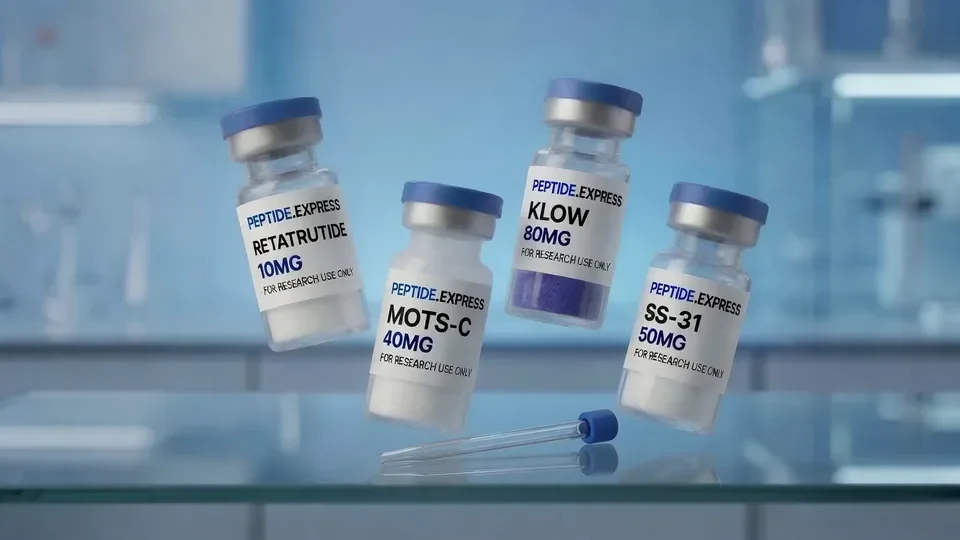
Peptide.Express supplies research peptides including incretin-related compounds with HPLC purity verification, third-party tested quality assurance, and full CoA documentation for each production lot. All compounds are provided as lyophilized powders for research use only, with batch-specific mass spec data available on request.
Researchers requiring documentation for institutional compliance or grant reporting can access CoA records directly through the product portal. As with all high-purity research compounds in this structural class, storage at -20 degrees Celsius in lyophilized form is recommended, with reconstituted solutions used within 24-48 hours or aliquoted and stored at -80 degrees Celsius to preserve receptor binding competence.
Translational Research Considerations for 2026 and Beyond
The ADA 2026 data reinforced a broader trend in obesity peptide research: multi-receptor engagement consistently outperforms single-target approaches in weight reduction magnitude, but the mechanistic basis for this superiority differs meaningfully between competing architectures. CagriSema's amylin pathway engagement and retatrutide's glucagon receptor thermogenesis represent two non-overlapping biological hypotheses that may ultimately prove complementary rather than competitive at the research level.
As published in Nature Metabolism (2024), researchers analyzing incretin receptor synergism noted that GLP-1R and GIPR co-agonism achieves greater beta cell preservation in type 2 diabetes models than GLP-1R monotherapy, a finding that has direct implications for how researchers design islet biology studies using retatrutide versus semaglutide comparators.
The addition of GCGR agonism in retatrutide introduces a further variable that must be controlled in any study where glycemic balance is a primary endpoint.
For the dual agonist peptides field more broadly, the mechanistic divergence between these two programs is scientifically productive: it creates natural comparison arms that can illuminate which receptor engagement pattern drives which downstream phenotype.
Researchers designing 2026 and 2027 studies are well-positioned to use both compound classes as pharmacological probes rather than treating them as interchangeable obesity research tools.
References
- Jastreboff AM, Kaplan LM, Frías JP, et al. "Triple-Hormone-Receptor Agonist Retatrutide for Obesity — A Phase 2 Trial." New England Journal of Medicine, 2023. Read the retatrutide Phase 2 trial in NEJM
- "Retatrutide — A Game Changer in Obesity Pharmacotherapy." Review of the triple GLP-1/GIP/glucagon receptor agonist pharmacology and the trial evidence available prior to Phase 3 readout. Read the retatrutide obesity pharmacotherapy review on PMC
- "Efficacy and safety of retatrutide, a novel GLP-1, GIP, and glucagon receptor agonist." Systematic review of the published retatrutide efficacy and adverse-event data. Read the retatrutide efficacy and safety review on PMC
- Coskun T, Urva S, Roell WC, et al. "LY3437943, a Novel Triple Glucagon, GIP, and GLP-1 Receptor Agonist for Glycemic Control and Weight Loss: From Discovery to Clinical Proof of Concept." Cell Metabolism. 2022. Read the Coskun 2022 retatrutide discovery and receptor pharmacology paper in Cell Metabolism