Key Takeaways
- GHKcu+KPV Blend is an investigational dual-tripeptide formulation combining copper-chelated glycyl-L-histidyl-L-lysine (GHK-Cu) with the alpha-melanocyte-stimulating hormone C-terminal fragment KPV, studied in preclinical models for NF-kB inhibition and extracellular matrix synthesis. Supplied strictly for laboratory research use only, the combination is not FDA approved for human therapeutic applications.
- Sourcing specification: ≥99% purity by HPLC. Measured purity is reported on the lot's Certificate of Analysis where one is on file.
- Third-party Certificates of Analysis are published where on file. Same-day US shipping.
GHKcu+KPV Blend Specifications
GHKcu+KPV Blend is studied in in-vitro and animal models via Copper delivery and extracellular matrix remodeling via GHK-Cu. This section covers molecular identity and specification data. Analytical standard: not stated in this reference profile. Stocked material is for laboratory research use only. Identity, structure, and handling values come from the existing profile.
- Compound Classification
- Dual Bioactive Tripeptide Blend
- Active Component 1
- GHK-Cu (Copper(II)-complexed tripeptide)
- Active Component 2
- KPV (Alpha-MSH C-terminal tripeptide fragment)
- Peptide Chain Length
- Two distinct tripeptides (3 amino acid residues each)
- Physical Appearance
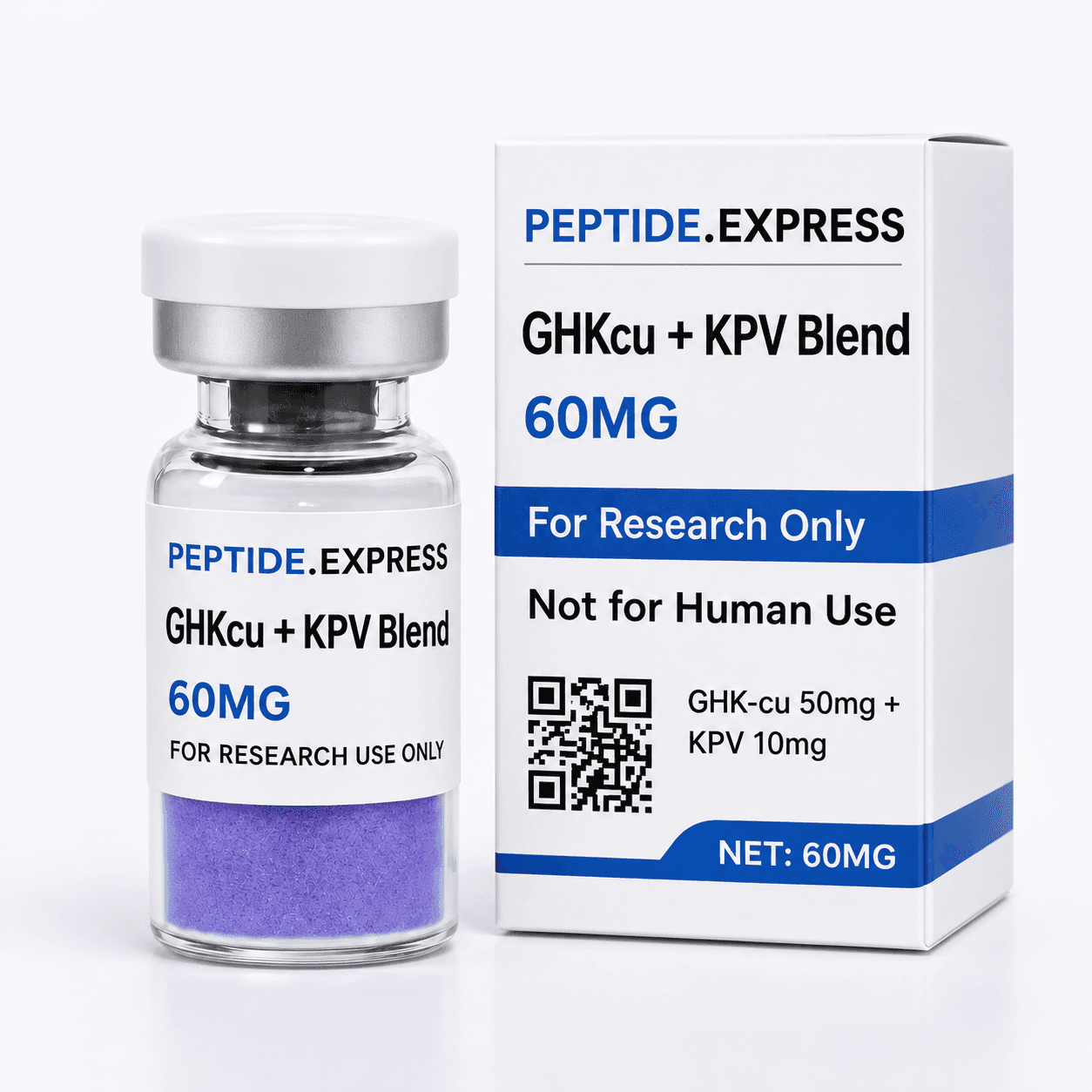
- Blue to violet-blue lyophilized cake or powder
- Purity Standard
- >=99% per individual peptide component by RP-HPLC
- Identity Verification
- Electrospray Ionization Mass Spectrometry (ESI-MS) for both components
- Blend Ratio Verification
- Dual-peak chromatographic integration per batch CoA
- Counterion Profile
- Acetate or trifluoroacetate salt as specified on lot CoA
- Solubility
- Freely soluble in sterile purified water and bacteriostatic water
- Aqueous Solution Color
- Clear royal blue to light blue (concentration dependent)
- Recommended Reconstitution pH
- pH 5.5 to 7.0 (avoid strong acids and metal chelators)
- Incompatible Reagents
- EDTA, EGTA, strong reducing agents (dithiothreitol, TCEP), and alkaline buffers above pH 8.0
- Lyophilized Storage
- -20 degrees C in a desiccated, light-protected freezer
- Short-Term Transit Stability
- Stable at ambient temperature during standard sealed domestic shipping
- Reconstituted Storage
- 2 degrees C to 8 degrees C for short-term bench use; aliquot at -80 degrees C for extended storage
- Container Closure
- Type I borosilicate glass vial with bromobutyl stopper and crimp seal
- Documentation Provided
- Batch-specific third-party Certificate of Analysis (HPLC + MS)
- Regulatory Posture
- Unapproved investigational research reagent; not FDA approved
- Intended Use
- In vitro laboratory research and preclinical animal models only
GHKcu+KPV Blend molecular identity and purity specifications
GHKcu+KPV Blend Mechanism of Action
GHKcu+KPV Blend is studied in in-vitro and animal models via Copper delivery and extracellular matrix remodeling via GHK-Cu. This section covers the reported mechanism and its evidence limits. Analytical standard: not stated in this reference profile. Stocked material is for laboratory research use only. Identity, structure, and handling values come from the existing profile.
Copper delivery and extracellular matrix remodeling via GHK-Cu. Published preclinical research indicates that GHK-Cu functions as a high-affinity copper(II) carrier that exchanges divalent copper ions directly with cellular transport proteins and copper-dependent metalloenzymes. Inside dermal fibroblast cultures and rodent excisional wound models, this copper delivery upregulates lysyl oxidase activity, an enzyme required for cross-linking nascent collagen and elastin fibrils into mechanically stable matrices.
Gene expression profiling in human cell lines demonstrates broad transcriptional modulation following GHK-Cu exposure, shifting transcripts involved in glycosaminoglycan synthesis, metalloproteinase balance, and antioxidant defense such as superoxide dismutase. Preclinical angiogenesis assays also document increased vascular endothelial growth factor expression and capillary sprout formation in treated tissue beds.
Whether these transcriptional shifts require an unidentified cell-surface receptor or stem entirely from localized copper ion flux and direct DNA-binding interactions remains contested in the literature. Systemic human receptor pharmacology for exogenous GHK-Cu has not been established. PepT1-mediated uptake and NF-kB pathway suppression via KPV.
KPV exerts its primary preclinical activity by dampening intracellular pro-inflammatory cascades rather than stimulating matrix deposition. In human intestinal epithelial cell lines and murine colitis models, published preclinical research indicates that KPV enters cells directly via the oligopeptide transporter PepT1, which is upregulated on inflamed mucosal and epidermal surfaces.
Once inside the cytoplasm, KPV interacts with importin-alpha proteins to block the nuclear translocation of the p65 (RelA) subunit of nuclear factor kappa B (NF-kB), preventing transcription of tumor necrosis factor-alpha and interleukin-6. A persistent open question in melanocortin biology is the exact partition between PepT1 transporter uptake and classical melanocortin receptor binding across different tissues.
While KPV shows weak affinity for MC1R and MC3R in competitive binding assays compared to full-length alpha-MSH, anti-inflammatory effects persist in MC1R-deficient mouse macrophages, pointing toward a non-receptor-mediated intracellular mechanism that has not been validated in human clinical trials. Hypothesized stage-specific coupling and evidence gaps.
Wound healing and tissue repair models divide recovery into overlapping phases where unresolved inflammation stalls fibroblast proliferation and degrades newly synthesized collagen via excess matrix metalloproteinases. The rationale for studying a GHKcu+KPV Blend in laboratory protocols rests on stage-specific complementarity: KPV is introduced to attenuate acute NF-kB-driven cytokine release, while GHK-Cu supplies copper cofactors to drive collagen synthesis and neovascularization during the proliferative phase.
No head-to-head comparative studies or formal synergy analyses have been published comparing the co-administered blend against single-agent GHK-Cu or single-agent KPV in matched animal cohorts. Pharmacokinetic interactions, potential copper-ion competition between the histidine-containing GHK scaffold and the lysine-containing KPV chain in concentrated aqueous solution, and intracellular signaling crosstalk when both tripeptides occupy the same microenvironment remain uncharacterized.
GHKcu+KPV Blend Research Applications
GHKcu+KPV Blend is studied in in-vitro and animal models via Copper delivery and extracellular matrix remodeling via GHK-Cu. This section covers the model systems and analytical readouts. Analytical standard: not stated in this reference profile. Stocked material is for laboratory research use only. Identity, structure, and handling values come from the existing profile.
Dermal fibroblast co-culture models: evaluating collagen type I, decorin, and TIMP-1 secretion when LPS-stimulated human fibroblasts are exposed simultaneously to copper-chelated GHK and KPV.
Rodent excisional and burn wound assays: measuring granulation tissue thickness, neutrophil infiltration counts, and tensile recovery timelines in murine full-thickness skin defect protocols.
Endothelial tube formation studies: quantifying microvascular sprouting in Matrigel assays under pro-inflammatory cytokine challenge to test whether NF-kB blockade preserves copper-driven angiogenesis.
PepT1 transport kinetics in Caco-2 monolayers: assessing trans-epithelial electrical resistance (TEER) and tight-junction protein localization alongside copper-dependent epithelial restitution.
Macrophage polarization and p65 translocation assays: tracking nuclear versus cytoplasmic RelA ratios by immunofluorescence in THP-1 or murine RAW 264.7 macrophages exposed to dual-peptide media.
Oxidative stress and metalloproteinase balance: measuring reactive oxygen species generation and MMP-2/MMP-9 zymography in UV-irradiated keratinocyte cultures.
GHKcu+KPV Blend Storage Requirements
GHKcu+KPV Blend is studied in in-vitro and animal models via Copper delivery and extracellular matrix remodeling via GHK-Cu. This section covers the material's structure-specific handling requirements. Analytical standard: not stated in this reference profile. Stocked material is for laboratory research use only. Identity, structure, and handling values come from the existing profile.
Because GHK-Cu relies on non-covalent coordination between divalent copper and its histidine-glycine nitrogen donors, ghk cu kpv blend reconstitution requires strict avoidance of chelating buffers such as EDTA-containing PBS or strongly acidic diluents below pH 5.0, either of which can strip copper ions from the tripeptide complex and alter assay reproducibility.
Reconstitution and handling guidance: Remove the sealed GHKcu+KPV Blend vial from -20 degrees C storage and allow it to equilibrate to ambient room temperature (20 to 25 degrees C) for 15 to 20 minutes inside a desiccator so atmospheric moisture does not condense onto the hygroscopic copper-peptide cake upon unsealing.
Inspect the lyophilized plug visually to confirm its characteristic blue tint, then flip off the protective cap and swab the exposed elastomeric septum with 70% isopropyl alcohol, allowing the surface to air-dry completely before needle entry. Select an unbuffered, chelator-free aqueous vehicle suited to your assay design, typically sterile purified water for cell culture media dilution or 0.9% benzyl alcohol bacteriostatic water when multi-withdrawal bench aliquots are required; never use standard laboratory TE buffer or EDTA-supplemented saline.
Draw the calculated volume of room-temperature diluent into a sterile graduated syringe and insert the needle through the center of the septum, angling the bevel so the liquid streams slowly down the inner glass wall rather than jetting directly onto the lyophilized powder.
Vent any excess headspace pressure if using a closed vacuum vial, then gently swirl or roll the vial between gloved palms for 60 to 90 seconds until both tripeptides dissolve into a uniform, particle-free blue solution; do not vortex or sonicate, as aggressive aeration promotes oxidative side reactions.
Verify complete dissolution against a light background, checking specifically that no pale bluish-white copper hydroxide precipitate has formed, which can occur if an alkaline buffer above pH 8.0 was inadvertently introduced. Filter through a low-protein-binding 0.22-micron PES or PVDF syringe membrane only if downstream sterile cell culture protocols demand an extra bioburden barrier, accounting for dead-volume retention during concentration calculations.
Divide the stock solution immediately into single-experiment polypropylene microcentrifuge tubes (low-bind grade preferred), label each with lot number, mass concentration of each peptide, and preparation date, and store working aliquots at 2 to 8 degrees C or frozen stocks at -80 degrees C without repeated freeze-thaw cycling.
GHKcu+KPV Blend at Peptide.Express
GHKcu+KPV Blend is sourced against a ≥99% HPLC purity specification. Third-party Certificates of Analysis are listed by batch where on file. Same-day US shipping on orders before 2 PM EST. For laboratory research use only. Not for human or veterinary use.
GHKcu+KPV Blend Frequently Asked Questions
What is GHKcu+KPV Blend used for in laboratory research?
GHKcu+KPV Blend is used in preclinical in vitro and animal studies to investigate how simultaneous NF-kB pathway inhibition and copper-dependent extracellular matrix synthesis affect tissue remodeling and epithelial barrier repair. Researchers pair KPV, which suppresses pro-inflammatory cytokines via PepT1 uptake, with GHK-Cu, which supplies copper cofactors to dermal fibroblasts, to examine dual-pathway signaling in cell culture and rodent injury assays.
Are anecdotal ghk cu kpv blend reddit protocols backed by peer-reviewed studies?
Informal discussions searching for a ghk cu kpv blend reddit summary or a ghk cu+kpv blend protocol do not reflect peer-reviewed clinical science. Published biomedical literature contains no validated human dosing schedules, systemic safety profiles, or optimal blend ratios for co-administered GHK-Cu and KPV; legitimate laboratory protocols are restricted strictly to controlled in vitro concentrations and approved animal models.
Is GHKcu+KPV Blend approved by the FDA?
No, GHKcu+KPV Blend is not approved by the FDA for any human therapeutic, diagnostic, or preventative indication. While topical GHK-Cu appears as a cosmetic ingredient in over-the-counter skin formulations, the FDA removed injectable GHK-Cu from Category 2 of the bulk drug substances compounding list in April 2026, and neither KPV nor the combined blend holds regulatory approval for clinical use.
Does the GHKcu+KPV Blend have human clinical trial data?
Zero registered human clinical trials evaluate the co-administered GHKcu+KPV Blend as of November 2026. All mechanistic data supporting this combination derive from isolated cell culture experiments, such as Caco-2 epithelial monolayers and human dermal fibroblasts, alongside rodent colitis and cutaneous wound models conducted largely on the individual tripeptides rather than the co-formulated mixture.
Why is the lyophilized GHKcu+KPV Blend powder blue?
The distinct blue to violet-blue color of GHKcu+KPV Blend comes directly from the copper(II) ion chelated within the GHK-Cu component. Uncomplexed KPV and copper-free GHK are white powders, whereas coordination of divalent copper to the nitrogen atoms of glycine and histidine creates a d-d electronic transition that absorbs red-orange visible light and reflects blue wavelengths.
What solvent is required for ghk cu kpv blend reconstitution?
Sterile purified water or bacteriostatic water (0.9% benzyl alcohol) at neutral to slightly acidic pH (5.5 to 7.0) is standard for ghk cu kpv blend reconstitution in laboratory workflows. Researchers must avoid buffers containing EDTA, EGTA, or strong reducing agents like DTT, because those reagents strip copper(II) ions out of the GHK chelate complex and invalidate copper-delivery assays.
How is batch quality verified on a blended two-peptide vial?
Every batch of GHKcu+KPV Blend is verified by an independent third-party analytical laboratory using both reversed-phase high-performance liquid chromatography (RP-HPLC) and electrospray ionization mass spectrometry (ESI-MS). Unlike single-peptide testing, dual-component CoAs confirm distinct retention peaks and molecular ion masses for both tripeptides, verifying individual purity at >=99% alongside the target mass ratio.
How does GHKcu+KPV Blend differ from KLOW Blend in preclinical designs?
GHKcu+KPV Blend isolates two three-residue peptides targeting copper-mediated matrix synthesis and PepT1/NF-kB cytokine suppression, whereas four-component formulations like KLOW Blend add larger sequences such as BPC-157 and TB-500 fragments. Using the two-peptide GHKcu+KPV Blend reduces confounding variables in cell culture assays when investigators want clean attribution without actin-sequestering or nitric-oxide-pathway cross-signaling.
How should GHKcu+KPV Blend be stored before and after dilution?
Unopened lyophilized GHKcu+KPV Blend vials should be stored at -20 degrees C in a dark, dry freezer environment. Once reconstituted into aqueous solution, working dilutions remain stable for short-term bench experiments at 2 to 8 degrees C, while divided single-use aliquots intended for multi-week study schedules should be frozen promptly at -80 degrees C without freeze-thaw cycling.
Does KPV bind melanocortin receptors in the same way as alpha-MSH?
Preclinical binding and knockout assays indicate KPV does not depend on classical pigmentary melanocortin receptor activation to suppress inflammation. Although KPV is the C-terminal tripeptide of alpha-MSH, published preclinical research indicates it enters epithelial and immune cells via the PepT1 oligopeptide transporter to block nuclear import of NF-kB p65, retaining activity even in MC1R-deficient mouse macrophages.
Related Research Guides
How This Page Is Sourced
Molecular identity on this page (name, CAS number, molecular formula and molecular weight) is resolved from a single internal entity record and checked against primary registries (PubChem, CAS Common Chemistry) rather than retyped per page. A field with no verified value is left out instead of estimated. Literature is cited to a DOI, PMID or PMCID permalink so every reference resolves to the specific record it names.