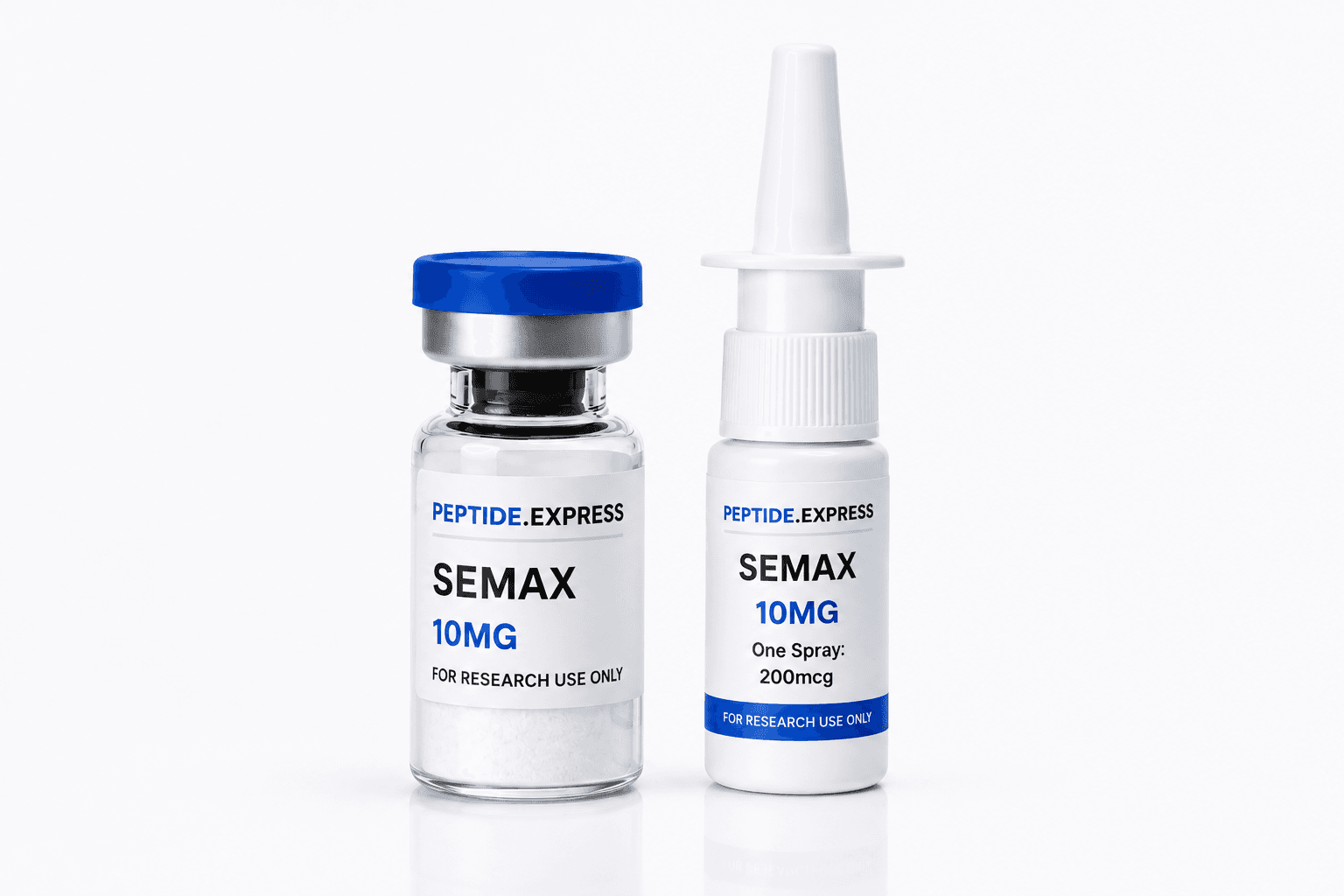
Semax Nasal Spray — Synthetic ACTH-Fragment Neuropeptide Analogue (Intranasal Research Formulation) | Intranasal research presentation of the peptide Semax
Research-Grade Compound
Semax Nasal Spray is an intranasal laboratory presentation of Semax, a short synthetic peptide analogue drawn from the adrenocorticotropic hormone (ACTH) fragment family and described in the peptide literature as a putative cognitive enhancing neuropeptide. It is supplied strictly for in-vitro and non-human laboratory research, either as a solution held in a spray actuator or as lyophilized material packaged alongside an unfilled actuator body.
This Certificate of Analysis was issued by an independent third-party laboratory. Peptide.Express does not conduct in-house testing. Results are provided as-is from the testing facility and confirm batch identity, purity, and analytical methodology. For questions about specific CoA results, contact [email protected].
What is Semax Nasal Spray?
Semax Nasal Spray is an intranasal laboratory presentation of Semax, a short synthetic peptide analogue drawn from the adrenocorticotropic hormone (ACTH) fragment family and described in the peptide literature as a putative cognitive enhancing neuropeptide. It is supplied strictly for in-vitro and non-human laboratory research, either as a solution held in a spray actuator or as lyophilized material packaged alongside an unfilled actuator body.
No verified molecular record is published for this specific preparation, so this profile states no molecular formula, mass, registry number or amino acid sequence. Identity is instead confirmed lot by lot using chromatographic and mass-spectrometric testing, and those results are what the accompanying documentation reports.
Interest in Semax comes largely from Russian-language pharmacology and from the wider nootropic peptide literature, where it is grouped with agents proposed to act on neurotrophin signalling. Very little of that work rises to the level of a controlled human mechanism study, and the intranasal route introduces a second uncharacterized variable, because nasal absorption for this peptide has not been quantified in the peer-reviewed record available here. Laboratories buying it typically use it as an analytical reference item, as a test article for delivery-device characterization, or as an input to cell-based neuropeptide assays.
How Does Semax Nasal Spray Work? Mechanism of Action
Structural lineage and what it does not tell you
Semax is described across the peptide literature as a synthetic analogue built on a fragment of the ACTH sequence family, modified so that the corticotropic activity of the parent hormone is absent while reported central nervous system activity is retained. That description is a structural claim from descriptive sources, not a functional result generated with this preparation.
Nothing about a structural relationship to ACTH establishes a receptor target. The melanocortin receptor pharmacology of Semax has not been characterized in a way that would let anyone predict activity at a specific receptor subtype, and this page makes no such prediction.
The neurotrophin hypothesis, and its evidence status
The most commonly repeated proposal attributes Semax activity to changes in brain-derived neurotrophic factor (BDNF) expression and downstream TrkB signalling. That proposal originates in rodent and cell-culture work rather than in controlled human studies, and it should be treated as an open hypothesis for assay design rather than as an established mechanism.
For a laboratory, the practical consequence is that BDNF and TrkB readouts are reasonable endpoints to measure, not results to assume. Any in-vitro study using this material is testing the hypothesis, not confirming it.
Monoamine and neuroinflammatory proposals
Secondary hypotheses in the descriptive literature involve monoamine turnover and inflammatory mediator expression in nervous tissue. None of these has been established for Semax in controlled human research, and the direction and magnitude of any such effect remain unresolved.
Where a study design depends on one of these pathways, the honest framing is exploratory.
Why the intranasal route is its own research variable
Nose-to-brain transport is an active formulation science field in its own right, and the actuator presentation makes Semax usable as a test article in that field. Quantitative nasal absorption parameters for this peptide, including the fraction reaching central compartments in any species, have not been established in the literature available here.
Two things are separable and worth separating in a protocol. The device performance question, meaning droplet size distribution and plume geometry and delivered mass per actuation, can be measured directly on a bench with no biological endpoint at all. The transport question, meaning what crosses a mucosal barrier model and in what quantity, requires a barrier model and generates data that does not transfer to any other formulation or actuator. Conflating the two produces numbers that look like pharmacokinetics but describe a pump.
Identity verification and why it matters for this class
Putative cognitive enhancing research peptides circulate in preparations of uncertain provenance. A 2020 analytical report in Drug Testing and Analysis documented such peptides recovered from seized pharmaceutical preparations and argued that controlling agencies should expect further encounters of the same kind, which is a direct argument for treating lot-level identity and purity data as part of the experimental record rather than as paperwork.
That is the reasoning behind reporting a purity standard and issuing chromatographic documentation per lot instead of relying on a label.
Research Applications of Semax Nasal Spray
Cell-based neuropeptide research
- Neurotrophin endpoint assays: cultured neuronal or glial models used to test the proposed BDNF and TrkB response, which remains an unconfirmed hypothesis for this compound rather than a documented effect.
- Cytotoxicity and tolerance screening: standard viability panels run before any signalling endpoint, since a short peptide dissolved in bacteriostatic water carries a preservative load that must be controlled for separately.
- Comparative peptide panels: Semax run alongside other short neuroactive peptides so that assay responses are interpreted against a within-plate reference rather than against literature values.
Intranasal delivery and formulation science
- Spray pattern and plume geometry measurement: the actuator assembly supports bench characterization of droplet distribution and delivered mass per actuation with no biological endpoint involved.
- Mucosal barrier transport models: excised epithelium or cell monolayer systems used to estimate transepithelial movement, a parameter that has not been quantified for this peptide in published human work.
- Formulation stability screening: solution held under defined temperature and light conditions and re-run by HPLC to track degradation of the peptide in an aqueous, preserved matrix.
Analytical and reference use
- LC-MS method development: characterized material used to build detection methods, an activity the 2020 Drug Testing and Analysis report on seized preparations depends on directly.
- Chromatographic identity checks: retention time and mass confirmation used to verify that a working solution still contains what the label claims after storage.
Semax Nasal Spray Technical Specifications
| Compound Class | Synthetic ACTH-fragment neuropeptide analogue |
|---|---|
| Common Synonyms | Semax, intranasal Semax, Semax spray research solution |
| Presentation | Intranasal actuator assembly, supplied either prefilled or with lyophilized material for reconstitution |
| Physical Form | White to off-white lyophilized powder, or clear colorless solution once reconstituted |
| Purity Standard | >=99% by HPLC (sourcing standard, not a batch measurement) |
| Identity Confirmation | Mass spectrometry performed per lot |
| Secondary Testing | Reverse-phase HPLC chromatogram issued with each lot |
| Molecular Identity Data | Described qualitatively only; no verified formula, mass, registry number or sequence is published for this preparation |
| Solubility | Readily soluble in bacteriostatic water and in sterile water for injection grade diluent |
| Recommended Diluent | Bacteriostatic water containing 0.9% benzyl alcohol for multi-draw laboratory work |
| Lyophilized Storage | -20 degrees Celsius, desiccated, protected from light |
| Reconstituted Storage | 2 to 8 degrees Celsius, protected from light, short working window |
| Freeze-Thaw Guidance | Aliquot before freezing; avoid repeated cycles on a single vial |
| Shipping Condition | Ambient shipment in insulated packaging; lyophilized material tolerates normal transit |
| Sterility | Supplied non-sterile for in-vitro laboratory use; not sterile-filled |
| Handling Precautions | Gloves and eye protection; avoid generating dust from lyophilized material |
| Documentation | Lot-specific Certificate of Analysis with HPLC and mass spectrometry data |
| Regulatory Status (US) | No FDA approval; not scheduled under the Controlled Substances Act as of writing |
| Intended Use | Laboratory research use only; not for human or veterinary application |
How to Reconstitute Semax Nasal Spray for Research
Presentation varies by lot. Some units ship as a prefilled solution and need no diluent at all, while others ship as lyophilized material with an empty actuator body. Read the lot label before opening anything, and treat the actuator as a non-sterile laboratory dispensing device rather than a clinical product.
- Bring the sealed vial and the diluent to room temperature before opening, because cold glass pulls condensation onto lyophilized peptide and ambient moisture is what degrades it fastest.
- Fix your working concentration before you touch a syringe, then calculate diluent volume from it; a nasal actuator delivers a near-fixed volume per actuation, so concentration is the only variable left under your control.
- Wipe the vial septum with 70% isopropyl alcohol and let it air dry rather than wiping the alcohol off.
- Draw bacteriostatic water into a sterile syringe and release it slowly down the inner wall of the vial, aiming the stream at glass instead of directly onto the peptide cake.
- Let the material dissolve undisturbed for a minute or two, then roll the vial gently between your palms; shaking a small peptide solution generates foam and shear that make later chromatographic and spectrophotometric reads noisier.
- Hold the vial against a dark background and confirm the solution is clear and free of particulates before any transfer, discarding anything cloudy or fibrous.
- Transfer to the actuator body in a clean work area, seat the pump firmly, then prime into waste until a full plume forms and record how many priming actuations that took, since that count matters to any spray-pattern data you collect afterwards.
- Label the assembled unit with compound name, concentration, diluent and date, then hold it at 2 to 8 degrees Celsius away from light.
- Split any leftover bulk solution into single-use aliquots and freeze those instead of re-entering one vial repeatedly.
Diluent: bacteriostatic water for peptide reconstitution. Full protocol: step-by-step peptide reconstitution guide. Concentration maths: peptide reconstitution calculator.
Frequently Asked Questions — Semax Nasal Spray
What is Semax Nasal Spray?
Why does this page not list a molecular formula, molecular weight or sequence?
What purity standard applies?
Is there evidence that Semax affects BDNF?
How much of an intranasal dose reaches central compartments?
Can this be used on humans?
What diluent should be used if the lot ships as lyophilized powder?
How should the material be stored?
How is Semax Nasal Spray different from injectable Semax preparations?
Is Semax the same thing as N-Acetyl Semax amidate?
What documentation ships with an order?
Is Semax a controlled substance?
What causes a cloudy solution after reconstitution?
Research References
- Vanhee C, Francotte A, Janvier S, et al. "The occurrence of putative cognitive enhancing research peptides in seized pharmaceutical preparations: An incentive for controlling agencies to prepare for future encounters of the kind." Drug testing and analysis, 2020. Read the Vanhee 2020 record on PubMed: The occurrence of putative cognitive enhancing research peptides in seized pharmaceutical preparations: An incentive for controlling agencies to prepare for future encounters of the kind
All products are sold for in-vitro laboratory research use only. Not intended for human consumption, clinical use, or veterinary use. Peptide.Express makes no medical claims. Consult the published literature for research application guidance.