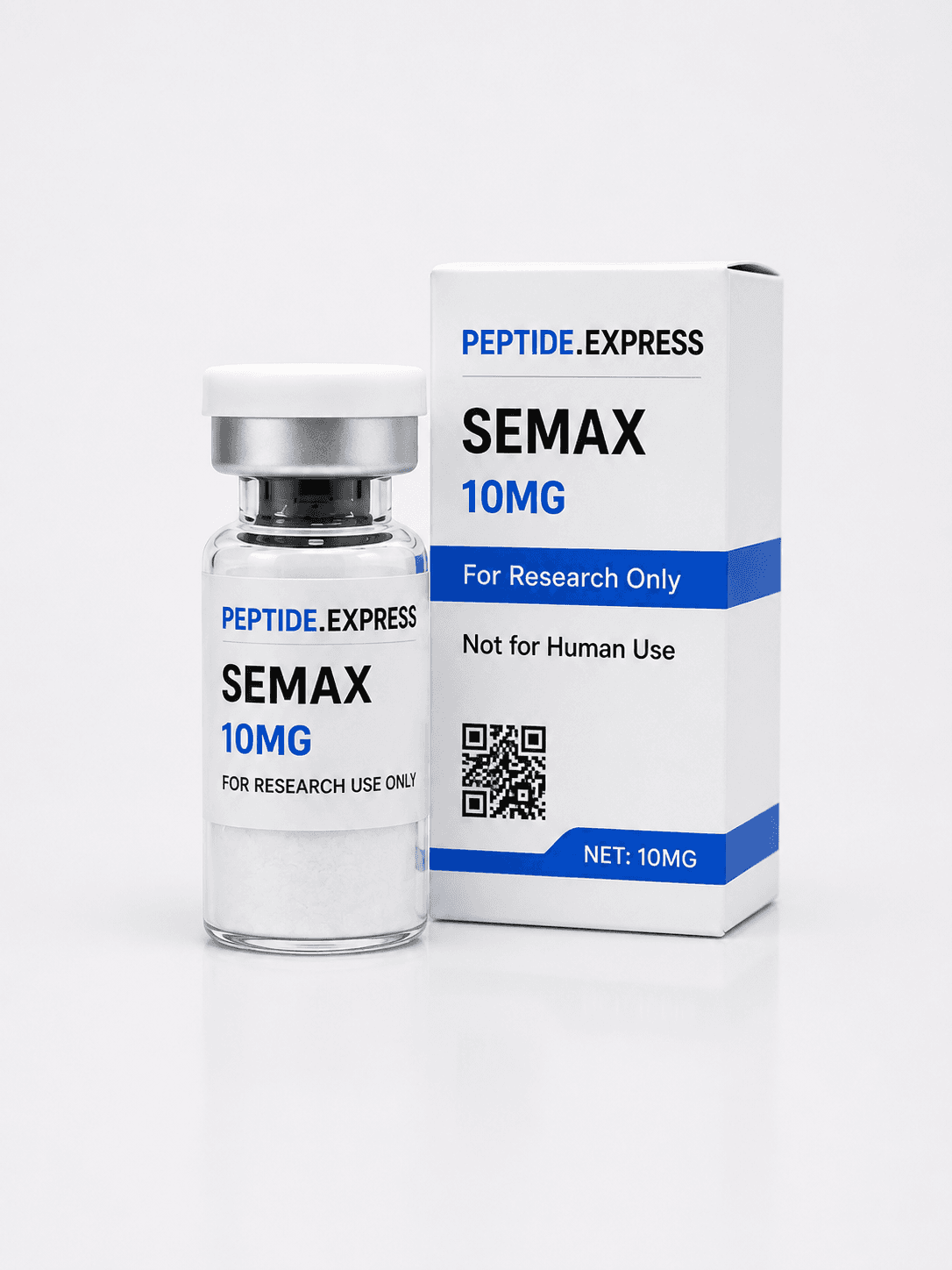
Semax — Synthetic ACTH(4-10) Analogue Heptapeptide | Met-Glu-His-Phe-Pro-Gly-Pro, 7 residues, CAS 80714-61-0
Research-Grade Compound
Semax is a synthetic heptapeptide with the sequence Met-Glu-His-Phe-Pro-Gly-Pro, formed by extending the ACTH(4-7) fragment of adrenocorticotropic hormone with a C-terminal Pro-Gly-Pro tripeptide. Its molecular formula is C37H51N9O10S, its molecular weight is approximately 813.9 Da, and its CAS number is 80714-61-0. It is supplied here solely as a research chemical for in-vitro and preclinical laboratory work.
Select Size
This Certificate of Analysis was issued by an independent third-party laboratory. Peptide.Express does not conduct in-house testing. Results are provided as-is from the testing facility and confirm batch identity, purity, and analytical methodology. For questions about specific CoA results, contact [email protected].
What is Semax?
Semax is a synthetic heptapeptide with the sequence Met-Glu-His-Phe-Pro-Gly-Pro, formed by extending the ACTH(4-7) fragment of adrenocorticotropic hormone with a C-terminal Pro-Gly-Pro tripeptide. Its molecular formula is C37H51N9O10S, its molecular weight is approximately 813.9 Da, and its CAS number is 80714-61-0. It is supplied here solely as a research chemical for in-vitro and preclinical laboratory work.
The design logic behind the molecule is structural rather than hormonal. The four-residue ACTH core is preserved while the appended Pro-Gly-Pro segment changes how the sequence behaves toward peptidases, and the resulting compound is described across the neurochemical literature as an ACTH(4-10) analogue with nootropic properties rather than as a corticotropic agent. Investigators have used it as a probe in three fairly distinct areas: neurotrophin gene and protein regulation, transcriptional responses to cerebral ischemia in rats, and the coordination chemistry of copper and zinc ions.
The bulk of published work on Semax is preclinical, carried out in rats and mice. A smaller human literature exists, including functional MRI work on resting-state network connectivity and Russian-language clinical reporting in ischemic stroke, and none of it establishes a mechanism at the receptor level.
How Does Semax Work? Mechanism of Action
Neurotrophin expression and specific brain binding
The most reproduced observation in the Semax literature is an effect on brain-derived neurotrophic factor. A 2006 study in the Journal of Neurochemistry reported that Semax bound specifically to membrane preparations from rat basal forebrain and raised BDNF protein levels in that region. A companion 2006 report in Brain Research described regulation of BDNF and trkB expression in the rat hippocampus.
In a rat model of cerebral ischemia, a 2010 report in Cellular and Molecular Neurobiology found that Semax and Pro-Gly-Pro activated transcription of neurotrophin genes and their receptor genes. All of this evidence is rodent evidence. Whether the same transcriptional coupling occurs in human tissue has not been characterized.
Monoaminergic activity in rodent brain
A 2005 study in Neurochemical Research reported that Semax activated dopaminergic and serotoninergic systems in rodent brain, which is the finding most often invoked to explain the behavioural readouts other groups measure. The size and direction of that activation in humans has not been established, and the papers describing it do not identify a single receptor as the entry point.
Transcriptional response after cerebral ischemia
Rather than a single target, several groups have profiled what the peptide does to whole transcriptomes under ischemic stress. A 2014 genome-wide analysis in BMC Genomics reported that Semax altered expression of immune system and vascular system gene sets in rat brain focal ischemia, and a 2017 paper in Molecular Genetics and Genomics narrowed that to immune response genes during ischemic brain injury in rats. A 2020 study in Genes examined the same question after ischemia-reperfusion and again described the effect at the transcriptome level.
These are descriptive expression studies in rats. They establish that transcriptional profiles shift, not that a named signalling cascade is responsible.
Copper and zinc coordination chemistry
A separate line of in-vitro work treats Semax as a metal-binding ligand rather than a neuropeptide. A 2015 study in the Journal of Inorganic Biochemistry reported high affinity for Cu(II) together with protection against metal-induced cell toxicity in culture, and a 2016 paper from the same journal showed that acetylating the N-terminus changes both Cu(II) and Zn(II) coordination and the associated biological behaviour, which makes the free amine of the methionine residue chemically load-bearing.
Two later reports extend this into amyloid biophysics. A 2022 study in ACS Chemical Neuroscience described effects on copper-induced amyloid beta aggregation in artificial membrane models, and a 2025 report in Bioinorganic Chemistry and Applications attributed reduced Cu(II)-catalysed ROS production to metal ion stripping and redox silencing. Both are cell-free or cell-culture systems. A 2025 paper in Acta Naturae examined Semax and a derivative in an animal model of Alzheimer's disease, which remains a single preclinical model rather than a body of confirmatory work.
An unresolved primary target
No canonical Semax receptor has been agreed on in the published literature, and papers on the compound generally treat its target as open. The most specific claim to date comes from a 2025 study in the British Journal of Pharmacology, which reported that Semax acts on the mu opioid receptor gene Oprm1 to promote deubiquitination and functional recovery after spinal cord injury in female mice. That is one preclinical study in one sex of one species, and it has not been independently replicated in the records available here.
Research Applications of Semax
Cerebral ischemia and neuroinflammation models
- Post-ischemic expression profiling: genome-wide analysis in rat focal ischemia reported shifts in immune and vascular gene sets.
- Ischemia-reperfusion transcriptomics: rat studies used the peptide to probe protective gene programmes after reperfusion.
- Neurotrophin transcription readouts: rat cerebral ischemia work measured neurotrophin and receptor gene activation.
Neurotrophic signalling and behavioural neuroscience
- BDNF protein assays: specific binding and raised BDNF reported in rat basal forebrain preparations.
- Hippocampal expression work: BDNF and trkB transcript regulation measured in rat hippocampus.
- Monoamine microdialysis and turnover studies: dopaminergic and serotoninergic activation described in rodents.
- Toxicant-exposure learning models: a 2016 rat study reported prevention of heavy metal induced learning and memory inhibition.
- Route-of-administration comparisons: a 2010 rodent study contrasted nootropic and analgesic readouts across delivery routes.
Metal ion biochemistry and amyloid biophysics
- Cu(II) affinity determination: potentiometric and spectroscopic work placed the peptide among high-affinity copper ligands.
- Redox silencing assays: Cu(II)-catalysed ROS output measured in cell-free and cell-culture systems.
- Membrane-model aggregation studies: copper-driven amyloid beta assembly tracked in artificial bilayers.
Semax Technical Specifications
| Molecular Formula | C37H51N9O10S |
|---|---|
| Molecular Weight | ~813.9 Da |
| CAS Number | 80714-61-0 |
| Amino Acid Sequence | Met-Glu-His-Phe-Pro-Gly-Pro |
| Residue Count | 7 |
| Peptide Class | Synthetic ACTH(4-10) analogue; ACTH(4-7) core extended with Pro-Gly-Pro |
| Parent Molecule | Adrenocorticotropic hormone, residues 4 to 7 |
| Primary Molecular Target | Not established in the published literature |
| Purity Standard | >=99% by HPLC |
| Purity Method | Reverse-phase HPLC |
| Identity Method | Mass spectrometry |
| Physical Form | White to off-white lyophilized powder |
| Recommended Reconstitution Solvent | Bacteriostatic water or sterile water for laboratory use |
| Disulfide Bonds | None; the sequence contains no cysteine |
| Storage, Lyophilized | -20C, sealed, protected from light |
| Storage, Reconstituted | 2-8C, protected from light; aliquot and freeze for extended holds |
| Solution Stability Window | Not publicly disclosed |
| Plasma Half-Life | Not publicly disclosed |
| Isoelectric Point | Not publicly disclosed |
| Shipping Condition | Ambient; lyophilized powder tolerates transit temperatures |
| Documentation | Batch Certificate of Analysis with HPLC chromatogram available |
| Intended Use | In-vitro and preclinical laboratory research only; not for human or veterinary use |
How to Reconstitute Semax for Research
Semax is a short, unstructured heptapeptide with no disulfide bridge, so it dissolves quickly and does not need heating or sonication. Because vial fills are small, inspect the vial before adding solvent: the peptide may be a thin film on the glass rather than a visible disc, and it is easy to assume the vial is empty.
- Let the sealed vial sit at room temperature for 20 to 30 minutes before opening so that condensation does not form on cold powder.
- Wipe the stopper of both the peptide vial and the bacteriostatic water vial with 70% isopropyl alcohol and let the surfaces dry.
- Draw the planned solvent volume into a sterile syringe, choosing a volume that gives a stock concentration you can pipette accurately for your assay.
- Angle the needle against the inside glass wall and let the solvent run down slowly instead of jetting it onto the powder film.
- Swirl or roll the vial gently until the solution is clear; do not shake, since foaming drives peptide loss at the air-liquid interface even for a sequence this short.
- Hold the vial against a light source and confirm a clear, colourless solution with no visible particulate. Discard anything hazy rather than filtering it and hoping.
- Record the resulting concentration in both mass and molar terms using the 813.9 Da molecular weight; 2.5 mg/mL corresponds to roughly 3.07 mM.
- Label the vial with compound name, concentration, solvent and date, then store at 2-8C protected from light.
- For work spanning weeks, split the stock into single-use aliquots and freeze them so that no vial goes through repeated freeze-thaw cycles.
Diluent: bacteriostatic water for peptide reconstitution. Full protocol: step-by-step peptide reconstitution guide. Concentration maths: peptide reconstitution calculator.
Frequently Asked Questions — Semax
What is Semax?
What is the amino acid sequence of Semax?
How does Semax differ from the parent ACTH fragment?
What does the preclinical literature report about Semax and BDNF?
Has Semax been studied in humans?
Is Semax FDA approved?
Does Semax have a known receptor?
Why is Semax studied as a copper chelator?
Does Semax affect dopamine or serotonin systems?
How should Semax be reconstituted for laboratory work?
How should Semax be stored?
Is Semax the same as Selank?
What purity documentation ships with Semax?
Can Semax be used in human or veterinary applications?
Research References
- Dolotov OV, Karpenko EA, Seredenina TS, et al. "Semax, an analogue of adrenocorticotropin (4-10), binds specifically and increases levels of brain-derived neurotrophic factor protein in rat basal forebrain." Journal of neurochemistry, 2006. Read the Dolotov 2006 record on PubMed: Semax, an analogue of adrenocorticotropin (4-10), binds specifically and increases levels of brain-derived neurotrophic factor protein in rat basal forebrain
- Dolotov OV, Karpenko EA, Inozemtseva LS, et al. "Semax, an analog of ACTH(4-10) with cognitive effects, regulates BDNF and trkB expression in the rat hippocampus." Brain research, 2006. Read the Dolotov 2006 record on PubMed: Semax, an analog of ACTH(4-10) with cognitive effects, regulates BDNF and trkB expression in the rat hippocampus
- Dmitrieva VG, Povarova OV, Skvortsova VI, et al. "Semax and Pro-Gly-Pro activate the transcription of neurotrophins and their receptor genes after cerebral ischemia." Cellular and molecular neurobiology, 2010. Read the Dmitrieva 2010 record on PubMed: Semax and Pro-Gly-Pro activate the transcription of neurotrophins and their receptor genes after cerebral ischemia
- Eremin KO, Kudrin VS, Saransaari P, et al. "Semax, an ACTH(4-10) analogue with nootropic properties, activates dopaminergic and serotoninergic brain systems in rodents." Neurochemical research, 2005. Read the Eremin 2005 record on PubMed: Semax, an ACTH(4-10) analogue with nootropic properties, activates dopaminergic and serotoninergic brain systems in rodents
- Medvedeva EV, Dmitrieva VG, Povarova OV, et al. "The peptide semax affects the expression of genes related to the immune and vascular systems in rat brain focal ischemia: genome-wide transcriptional analysis." BMC genomics, 2014. Read the Medvedeva 2014 record on PubMed: The peptide semax affects the expression of genes related to the immune and vascular systems in rat brain focal ischemia: genome-wide transcriptional analysis
- Medvedeva EV, Dmitrieva VG, Limborska SA, et al. "Semax, an analog of ACTH((4-7)), regulates expression of immune response genes during ischemic brain injury in rats." Molecular genetics and genomics : MGG, 2017. Read the Medvedeva 2017 record on PubMed: Semax, an analog of ACTH((4-7)), regulates expression of immune response genes during ischemic brain injury in rats
- Filippenkov IB, Stavchansky VV, Denisova AE, et al. "Novel Insights into the Protective Properties of ACTH((4-7))PGP (Semax) Peptide at the Transcriptome Level Following Cerebral Ischaemia-Reperfusion in Rats." Genes, 2020. Read the Filippenkov 2020 record on PubMed: Novel Insights into the Protective Properties of ACTH((4-7))PGP (Semax) Peptide at the Transcriptome Level Following Cerebral Ischaemia-Reperfusion in Rats
- Tabbì G, Magrì A, Giuffrida A, et al. "Semax, an ACTH4-10 peptide analog with high affinity for copper(II) ion and protective ability against metal induced cell toxicity." Journal of inorganic biochemistry, 2015. Read the Tabbì 2015 record on PubMed: Semax, an ACTH4-10 peptide analog with high affinity for copper(II) ion and protective ability against metal induced cell toxicity
- Magrì A, Tabbì G, Giuffrida A, et al. "Influence of the N-terminus acetylation of Semax, a synthetic analog of ACTH(4-10), on copper(II) and zinc(II) coordination and biological properties." Journal of inorganic biochemistry, 2016. Read the Magrì 2016 record on PubMed: Influence of the N-terminus acetylation of Semax, a synthetic analog of ACTH(4-10), on copper(II) and zinc(II) coordination and biological properties
- Sciacca MFM, Naletova I, Giuffrida ML, et al. "Semax, a Synthetic Regulatory Peptide, Affects Copper-Induced Abeta Aggregation and Amyloid Formation in Artificial Membrane Models." ACS chemical neuroscience, 2022. Read the Sciacca 2022 record on PubMed: Semax, a Synthetic Regulatory Peptide, Affects Copper-Induced Abeta Aggregation and Amyloid Formation in Artificial Membrane Models
- Tomasello MF, Di Rosa MC, Naletova I, et al. "Semax, a Copper Chelator Peptide, Decreases the Cu(II)-Catalyzed ROS Production and Cytotoxicity of aβ by Metal Ion Stripping and Redox Silencing." Bioinorganic chemistry and applications, 2025. Read the Tomasello 2025 record on PubMed: Semax, a Copper Chelator Peptide, Decreases the Cu(II)-Catalyzed ROS Production and Cytotoxicity of aβ by Metal Ion Stripping and Redox Silencing
- Radchenko AI, Kuzubova EV, Apostol AA, et al. "The Potential of the Peptide Drug Semax and Its Derivative for Correcting Pathological Impairments in the Animal Model of Alzheimer's Disease." Acta naturae, 2025. Read the Radchenko 2025 record on PubMed: The Potential of the Peptide Drug Semax and Its Derivative for Correcting Pathological Impairments in the Animal Model of Alzheimer's Disease
- Liu R, Chen Y, Huang H, et al. "Semax peptide targets the μ opioid receptor gene Oprm1 to promote deubiquitination and functional recovery after spinal cord injury in female mice." British journal of pharmacology, 2025. Read the Liu 2025 record on PubMed: Semax peptide targets the μ opioid receptor gene Oprm1 to promote deubiquitination and functional recovery after spinal cord injury in female mice
- Lebedeva IS, Panikratova YR, Sokolov OY, et al. "Effects of Semax on the Default Mode Network of the Brain." Bulletin of experimental biology and medicine, 2018. Read the Lebedeva 2018 record on PubMed: Effects of Semax on the Default Mode Network of the Brain
- Panikratova YR, Lebedeva IS, Sokolov OY, et al. "Functional Connectomic Approach to Studying Selank and Semax Effects." Doklady biological sciences : proceedings of the Academy of Sciences of the USSR, Biological sciences sections, 2020. Read the Panikratova 2020 record on PubMed: Functional Connectomic Approach to Studying Selank and Semax Effects
- Gusev EI, Martynov MY, Kostenko EV, et al. "[The efficacy of semax in the tretament of patients at different stages of ischemic stroke]." Zhurnal nevrologii i psikhiatrii imeni S.S. Korsakova, 2018. Read the Gusev 2018 record on PubMed: [The efficacy of semax in the tretament of patients at different stages of ischemic stroke]
- Inozemtsev AN, Bokieva SB, Karpukhina OV, et al. "Semax prevents learning and memory inhibition by heavy metals." Doklady biological sciences : proceedings of the Academy of Sciences of the USSR, Biological sciences sections, 2016. Read the Inozemtsev 2016 record on PubMed: Semax prevents learning and memory inhibition by heavy metals
- Manchenko DM, Glazova NIu, Levitskaia NG, et al. "[Nootropic and analgesic effects of Semax following different routes of administration]." Rossiiskii fiziologicheskii zhurnal imeni I.M. Sechenova, 2010. Read the Manchenko 2010 record on PubMed: [Nootropic and analgesic effects of Semax following different routes of administration]
All products are sold for in-vitro laboratory research use only. Not intended for human consumption, clinical use, or veterinary use. Peptide.Express makes no medical claims. Consult the published literature for research application guidance.