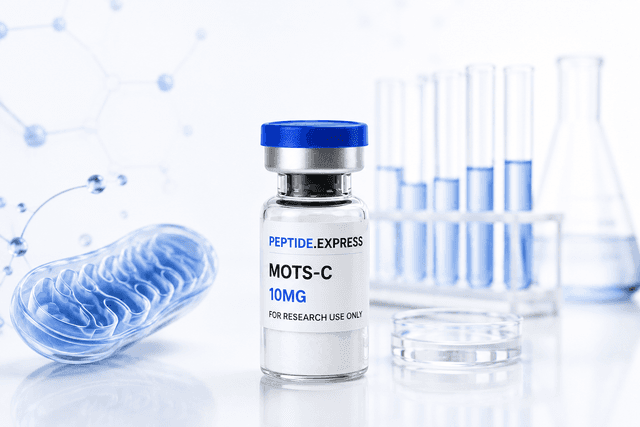
What Is MOTS-c and Why Does Its 2026 FDA Compounding Status Matter?
MOTS-c (Mitochondrial Open Reading Frame of the Twelve S rRNA type-c) is a 16-amino-acid mitochondrial-derived peptide encoded within the 12S ribosomal RNA of mitochondrial DNA. Its FDA compounding classification in 2026 directly determines whether licensed compounding pharmacies may prepare it for non-commercial research purposes, making this regulatory question one of the most consequential access points for laboratory scientists studying mitochondrial signaling.
The compound was first characterized in 2015 and has since accumulated a meaningful preclinical literature centered on AMPK pathway activation and metabolic-homeostasis modeling. With a molecular weight of approximately 2,174.6 Da and CAS number 1627580-64-6, it is one of the better-characterized peptides in the mitochondrial-derived peptide (MDP) class.
Definition: MOTS-c is a mitochondrial-derived 16-amino-acid peptide (molecular formula C101H152N28O22S2) encoded in mitochondrial 12S rRNA and studied for its role in AMPK signaling and metabolic-homeostasis models. Its compounding status under FDA bulk-substances authority governs whether pharmacies may prepare it for research distribution in the United States.
MOTS-c Molecular Identity
Before examining regulatory status, researchers sourcing this peptide for laboratory protocols should verify that any supplied material matches the canonical chemical identity below. Discrepancies in molecular weight or sequence indicate the wrong compound or a degraded preparation.
Compound identity data — CAS number, molecular formula and molecular weight — is maintained on the MOTS-c reference page, which is the one page on this site that keeps it current.
What Is the FDA Bulk Substances List and How Does It Affect MOTS-c Access?
The FDA's 503A and 503B bulk-substances lists determine which active pharmaceutical ingredients compounding pharmacies may use without an approved drug application. A substance placed on the bulk list may be compounded for patient-specific or research purposes; a substance removed or denied nomination is effectively off-limits for pharmacy preparation.
MOTS-c received a nomination for inclusion on the 503A bulk-substances list, placing it in the category of nominated substances under evaluation. As of 2026, the FDA has not issued a final rule placing MOTS-c on either the positive or negative list. This regulatory ambiguity means that individual state pharmacy boards and institutional legal counsel are the operative interpreters of what a given compounding pharmacy may do with the compound.
What this means in practice: research institutions that previously sourced MOTS-c through compounding channels may face supply interruption if their pharmacy chooses conservative compliance postures. Direct procurement from a research-grade MOTS-c supplier operating under research-use-only frameworks remains a parallel and, for many labs, more reliable supply path.
How Does 503A Differ from 503B for Research Peptides?
Section 503A of the Federal Food, Drug, and Cosmetic Act governs traditional compounding pharmacies that prepare drugs for individual patient prescriptions. Section 503B governs outsourcing facilities that produce larger batches without patient-specific prescriptions.
| Feature | 503A (Traditional) | 503B (Outsourcing Facility) |
|---|---|---|
| Prescription required | Yes, patient-specific | No |
| Batch size | Limited | Large-scale permitted |
| FDA inspection | State-regulated primarily | FDA-registered, inspected |
| Bulk-substances list | Nominates via 503A list | Nominates via 503B list |
| MOTS-c 2026 status | Nominated, not finalized | Not on positive list |
For laboratory researchers whose institutions do not operate through compounding pharmacy supply chains, the 503A/503B distinction is largely academic. The relevant question becomes where high-purity, third-party tested MOTS-c can be obtained with reliable documentation of identity and purity.
What Does the MOTS-c Bulk List Status Mean for Laboratory Research in 2026?
The practical implication of unresolved bulk-list status is supply-chain uncertainty, not a prohibition on research itself.
Researchers in the United States working under institutional review protocols and using peptides strictly for in-vitro or preclinical in-vivo studies are not subject to compounding pharmacy regulations. Compounding rules govern the preparation and dispensing of substances for clinical use, not the procurement of research-use-only chemicals for laboratory experiments. A biochemistry lab ordering lyophilized MOTS-c for cell culture studies is operating under an entirely different regulatory framework than a physician ordering compounded peptide injections for patients.
That said, staying current on FDA bulk-list decisions matters for two reasons. First, final listing decisions can signal broader agency attention toward a class of compounds, which sometimes precedes scheduling discussions. Second, if a researcher's institution uses compounding pharmacy sources as part of its procurement infrastructure, a negative listing would disrupt that specific supply path.
Purchasing, purity grade and Certificate of Analysis details for research compounds are maintained on the product pages: browse the research catalog.
MOTS-c Mechanism: AMPK Pathway and Mitochondrial Signaling Research
Understanding what makes MOTS-c scientifically relevant requires a brief look at its mechanism class. The peptide acts primarily through the AMP-activated protein kinase (AMPK) signaling pathway, which functions as a cellular energy sensor. When cellular AMP-to-ATP ratios rise (indicating energy deficit), AMPK activates a cascade of downstream effects oriented toward restoring metabolic balance.
MOTS-c is unusual among mitochondrial-derived peptides in that it can translocate from mitochondria to the nucleus under certain metabolic conditions. Published preclinical research has documented this nuclear translocation and its association with altered gene expression in metabolic-homeostasis models. This dual localization capacity makes MOTS-c a subject of interest in studies examining the communication between mitochondrial and nuclear genomes.
As a 16-residue MRP-encoded peptide, it is also shorter and more synthetically accessible than many biologically active proteins, which contributes to its tractability as a research tool. At 2,174.6 Da it sits at the upper boundary of what peptide synthesizers handle with high efficiency, which is one reason purity verification by HPLC is especially important: longer peptides accumulate more truncation sequences during solid-phase synthesis.
What Research Models Use MOTS-c?
Preclinical mitochondrial peptide research using MOTS-c has been conducted across several model systems:
- Cell culture models examining AMPK activation kinetics in metabolically stressed conditions
- Murine in-vivo models studying metabolic-homeostasis parameters including glucose disposal and lipid metabolism
- Aging biology models, given MOTS-c's origin in mitochondrial DNA and the established connection between mitochondrial function and cellular senescence
- Skeletal muscle cell lines used to interrogate the peptide's reported effects on insulin sensitivity signaling
All published work to date is preclinical. No human clinical trials have produced peer-reviewed findings establishing efficacy or safety in human populations. Researchers should frame any use of this compound within that preclinical context.
How to Evaluate MOTS-c Purity and Research-Grade Quality
Purity is not a single number. It is a standard, and the standard for research-grade peptides used in published studies is typically ≥99% by HPLC. This means the target peptide accounts for at least 99% of the integrated UV absorbance area in a reversed-phase HPLC chromatogram, with all impurities (truncations, deletions, oxidation products) collectively below 1%.
For MOTS-c specifically, two impurity classes are worth monitoring: oxidation at the two cysteine-containing sulfur atoms (captured in the molecular formula as S2) and deletion sequences arising from incomplete coupling during synthesis. A mass spectrometry trace confirming the observed monoisotopic or average molecular weight aligns with the theoretical value near 2,174.6 Da provides orthogonal confirmation that the primary peak in the HPLC trace corresponds to the correct compound.
- Request the HPLC chromatogram for the specific lot number, not a representative certificate
- Verify the retention time and peak symmetry match previous lots if reordering
- Confirm mass spectrometry data shows the expected molecular weight within instrument tolerance
- Check that the CoA carries a third-party laboratory identifier, not only internal quality control data
- Review storage and shipping conditions: lyophilized MOTS-c should arrive desiccated and, for long-term stability, stored at -20°C or below
Peptide.Express maintains a documented quality assurance process including third-party HPLC testing, and batch-specific documentation is accessible to purchasing institutions before order completion.
Mitochondrial-Derived Peptides in the Broader Research Context
MOTS-c belongs to a class of mitochondrial-derived peptides that has expanded considerably since the characterization of humanin in 2003. The class now includes SHLP1 through SHLP6 (small humanin-like peptides) and MOTS-c itself. What distinguishes the class is that all members are encoded in mitochondrial DNA rather than nuclear DNA, challenging the long-held view that mitochondria serve primarily as energy generators rather than as signal-producing compartments.
This reframing has practical consequences for research design. If mitochondria produce bioactive peptides that communicate with the nucleus and with distant tissues, then mitochondrial dysfunction may contribute to systemic metabolic dysregulation through peptide signaling deficits, not only through impaired ATP production. MOTS-c is the most studied member of this class in the context of metabolic physiology, which partly explains the level of research interest sustaining its procurement demand.
Researchers building protocols around MOTS-c can consult the broader research article library for published context on mitochondrial peptide signaling and related compound classes.
Practical Considerations for Ordering MOTS-c for Research in 2026
Supply logistics for a 16-amino-acid peptide at research scale differ from ordering small molecules. A few practical notes for procurement:
- Lyophilized powder is the standard shipping form; reconstitution is performed in-lab using sterile aqueous buffers or DMSO depending on the protocol
- Quantities for in-vitro studies are typically milligram-scale; in-vivo murine studies consume more depending on dosing regimen and group size
- Lead times vary by supplier; ordering with buffer time before a study start date is advisable given that peptide synthesis is not instantaneous and quality-release testing adds days to the timeline
Regulatory framing at point of purchase matters. Research-use-only suppliers issue materials with explicit labeling and documentation indicating the product is for laboratory research only and not for human or veterinary use. This framing is a legal and institutional requirement, not optional language.
Research-Use Disclaimer: MOTS-c supplied by Peptide.Express is intended exclusively for in-vitro laboratory research and preclinical investigation by qualified scientific personnel. It is not approved by the FDA for human administration. It may not be used as a drug, dietary supplement, or therapeutic agent. Researchers are responsible for compliance with all applicable institutional and regulatory requirements governing research with peptide compounds.
For researchers ready to source material, the MOTS-c product page provides current lot availability, pricing, and direct access to batch-specific documentation. Additional compound options for mitochondrial and metabolic research protocols are indexed in the full research peptide catalog.
Frequently Asked Questions
What is MOTS-c and what makes it a mitochondrial-derived peptide?
MOTS-c is a 16-amino-acid peptide encoded within the 12S ribosomal RNA of mitochondrial DNA, giving it the designation mitochondrial-derived peptide (MDP). Unlike most bioactive peptides, which are encoded in nuclear DNA, MOTS-c originates from the mitochondrial genome and is thought to function as a retrograde signal from mitochondria to other cellular compartments.
Its molecular formula is C101H152N28O22S2, its molecular weight is approximately 2,174.6 Da, and its CAS number is 1627580-64-6. Research interest centers on its ability to activate AMPK signaling and influence metabolic-homeostasis parameters in preclinical models.
How does MOTS-c activate the AMPK signaling pathway in research models?
In preclinical studies, MOTS-c engages the AMP-activated protein kinase (AMPK) pathway, which acts as a cellular energy sensor responsive to changes in AMP-to-ATP ratios. When cellular energy is depleted, AMPK activates downstream effectors involved in glucose uptake, fatty acid oxidation, and mitochondrial biogenesis. MOTS-c is thought to modulate this cascade by translocating from mitochondria to the nucleus under metabolic stress, where it may interact with gene regulatory elements. All mechanistic findings are from in-vitro and animal models; no human clinical efficacy data exists.
What is the difference between MOTS-c FDA compounding status and research-use-only procurement?
FDA compounding status under 503A and 503B governs whether licensed pharmacies may prepare MOTS-c for clinical dispensing. Research-use-only procurement operates under a separate framework: academic and biotech laboratories may purchase lyophilized MOTS-c from research chemical suppliers without reference to compounding pharmacy rules, provided the material is used exclusively for in-vitro or preclinical studies and not administered to humans. As of 2026, MOTS-c's nomination to the 503A bulk-substances list has not been finalized, creating uncertainty for clinical compounding channels but leaving laboratory research supply unaffected.
What purity grade should researchers require when sourcing MOTS-c?
The standard for research-grade peptides used in published studies is ≥99% purity by HPLC. Researchers should request lot-specific HPLC chromatograms and mass spectrometry confirmation showing an observed molecular weight consistent with the theoretical value near 2,174.6 Da. A third-party Certificate of Analysis traceable to the specific batch is preferable to internal quality control documentation alone. For MOTS-c, monitoring for cysteine oxidation products and synthesis truncation sequences is particularly relevant given the peptide's length and sulfur-containing residues.
Are research peptides like MOTS-c legal to purchase for laboratory use?
Yes. Research-use-only peptides are legal to purchase for qualified laboratory research in the United States and most other jurisdictions. They are not controlled substances. The relevant legal boundary is use: purchasing MOTS-c for in-vitro experiments or preclinical animal studies is permissible; administering it to humans outside an approved clinical trial protocol is not. Institutions should maintain documentation confirming research-use intent, and suppliers should provide explicit research-use-only labeling on all materials.
What storage conditions does lyophilized MOTS-c require?
Store lyophilized MOTS-c at -20°C or below in a desiccated environment. Once reconstituted, aliquot and freeze at -80°C to avoid repeated freeze-thaw cycles, which can promote aggregation and oxidation at the sulfur-containing residues. Reconstitution solvent selection depends on the experimental protocol; sterile aqueous buffers at physiological pH are common for cell culture applications.
Purchasing, purity grade and Certificate of Analysis details for research compounds are maintained on the product pages: browse the research catalog.
References
- Lee C, Zeng J, Drew BG, et al. The mitochondrial-derived peptide MOTS-c promotes metabolic homeostasis and reduces obesity and insulin resistance. Cell Metab. 2015;21(3):443-454. doi:10.1016/j.cmet.2015.02.009. PMID: 25738459.
- Kim KH, Son JM, Benayoun BA, Lee C. The mitochondrial-encoded peptide MOTS-c translocates to the nucleus to regulate nuclear gene expression in response to metabolic stress. Cell Metab. 2018;28(3):516-524.e7. doi:10.1016/j.cmet.2018.06.008. PMID: 29983246.
- Reynolds JC, Lai RW, Woodhead JST, et al. MOTS-c is an exercise-induced mitochondrial-encoded regulator of age-dependent physical decline and muscle homeostasis. Nat Commun. 2021;12(1):470. doi:10.1038/s41467-020-20790-0. PMID: 33473109.
- Hashimoto Y, Niikura T, Tajima H, et al. Mechanisms of neuroprotection by a novel rescue factor humanin from Swedish mutant amyloid precursor protein. Biochem Biophys Res Commun. 2001;283(2):460-468. doi:10.1006/bbrc.2001.4765. PMID: 11327724.
- Cobb LJ, Lee C, Xiao J, et al. Naturally occurring mitochondrial-derived peptides are age-dependent regulators of apoptosis, insulin sensitivity, and inflammatory markers. Aging (Albany NY). 2016;8(4):796-808. doi:10.18632/aging.100943. PMID: 27070352.
- Kim SJ, Miller B, Kumagai H, et al. Mitochondrial-derived peptides in aging and age-related diseases. GeroScience. 2021;43(3):1113-1121. doi:10.1007/s11357-020-00262-5. PMID: 32910336.
- PubChem. MOTS-c | C101H152N28O22S2 | CID 146675088. National Center for Biotechnology Information. Accessed 2026. CAS 1627580-64-6; molecular weight 2174.6 g/mol.
All mechanism, nuclear-translocation, AMPK, metabolic-homeostasis, and mitochondrial-derived peptide class claims in this article are drawn from the primary preclinical literature cited above. No human clinical efficacy or safety trials establishing MOTS-c as a therapeutic agent have been published. Researchers should consult the full primary sources via PubMed for experimental details, model systems, and limitations.