What Is HGH? Research Guide
Definition
HGH is the abbreviation researchers use for human growth hormone, the pituitary polypeptide hormone that signals through the growth hormone receptor and induces hepatic IGF-I gene expression. Alanine-scanning mutagenesis reported in Science in 1989 mapped the receptor-binding epitope on the hormone residue by residue, and a 2010 pharmacology reference volume summarises the wider growth hormone axis. The catalog previously attached an unrelated small-molecule identity record to this listing; those values are withheld because they do not describe somatropin.
Key Takeaways
- →HGH is the abbreviation researchers use for human growth hormone, the pituitary polypeptide hormone that signals through the growth hormone receptor and induces hepatic IGF-I gene expression. Alanine-scanning mutagenesis reported in Science in 1989 mapped the receptor-binding epitope on the hormone residue by residue, and a 2010 pharmacology reference volume summarises the wider growth hormone axis.
- →Sourcing specification: ≥99% purity by HPLC. Measured purity is reported on the lot's Certificate of Analysis where one is on file.
- →Third-party Certificates of Analysis are published where on file. Same-day US shipping.
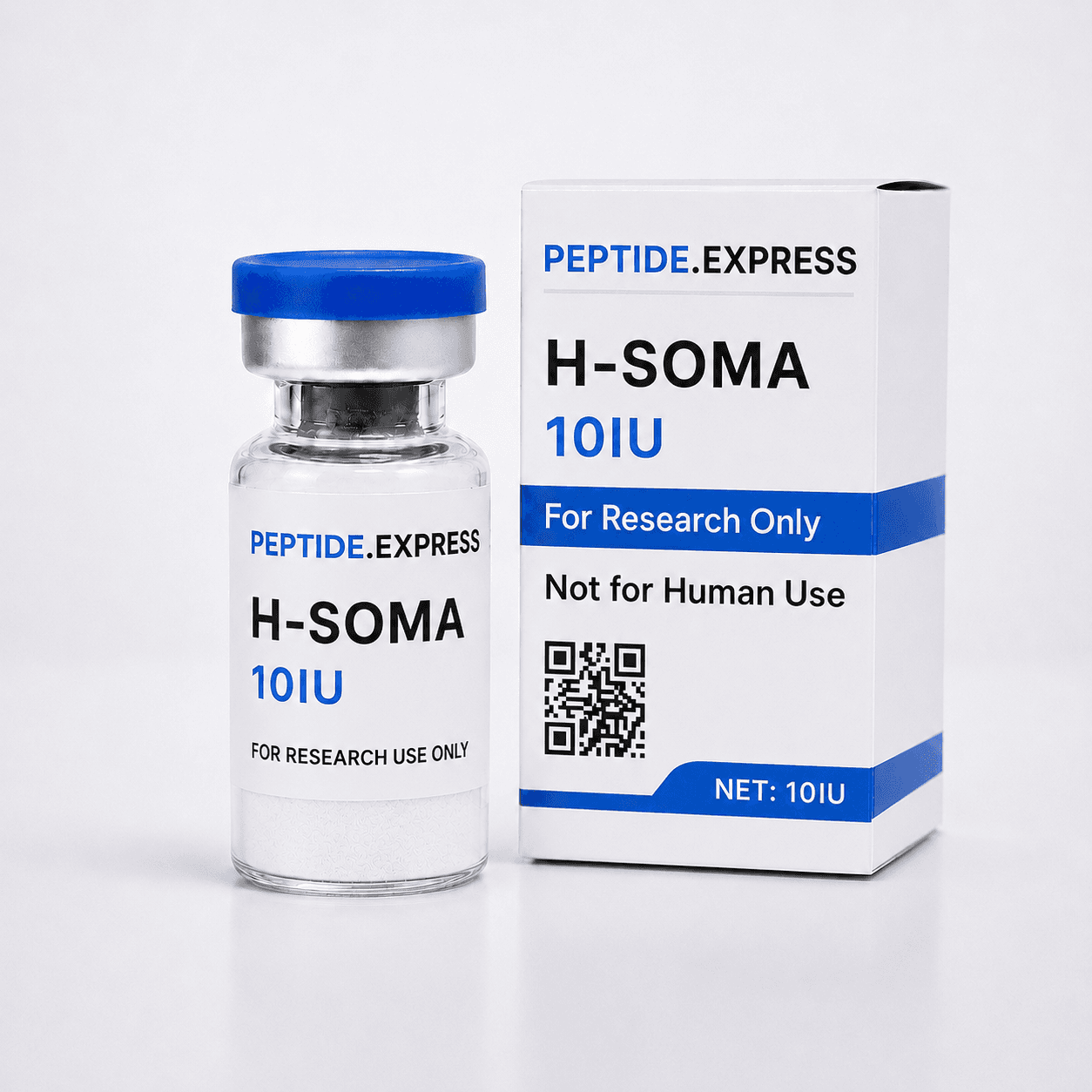
HGH Specifications
HGH (CAS Not publicly disclosed) is studied in in-vitro and animal models via Receptor binding and dimerization. This section covers molecular identity and specification data. Analytical standard: not stated in this reference profile. Stocked material is for laboratory research use only. Identity, structure, and handling values come from the existing profile.
| Property | Value |
|---|---|
| Catalog Reference | HGH |
| Common Names in Literature | Human growth hormone, hGH, somatotropin |
| CAS Number | Not publicly disclosed |
| Amino Acid Sequence | Not publicly disclosed for this listing |
| Molecular Target in Cited Literature | Growth hormone receptor; lactogenic receptor engagement also reported |
| Purity Standard | >=99% by HPLC |
| Identity and Purity Testing | Third-party HPLC with mass spectrometry confirmation |
| Physical Form | Lyophilized powder, white to off-white |
| Recommended Reconstitution Solvent | Bacteriostatic water or sterile water for laboratory use |
| Storage, Lyophilized | -20 C, desiccated, protected from light |
| Storage, Reconstituted | 2 to 8 C, protected from light |
| Reconstituted Stability Window | Not established for this material |
| Freeze-Thaw Handling | Aliquot before freezing; repeated cycles not characterised for this listing |
| Shipping Condition | Ambient shipping; re-freeze on arrival |
| Documentation Supplied | Batch-specific Certificate of Analysis with HPLC chromatogram |
| Highest Published Human Study Stage (pituitary hormone) | Human clinical literature on biosynthesised hGH published from 1983 onward |
| Sport Regulatory Status | Growth hormone is a prohibited peptide hormone in competitive sport; detection markers reviewed in 2003 |
| Intended Use | In-vitro laboratory research only |
| Prohibited Uses | Not for human consumption, clinical, diagnostic or veterinary use |
HGH Mechanism of Action
HGH (CAS Not publicly disclosed) is studied in in-vitro and animal models via Receptor binding and dimerization. This section covers the reported mechanism and its evidence limits. Analytical standard: not stated in this reference profile. Stocked material is for laboratory research use only. Identity, structure, and handling values come from the existing profile.
Receptor binding and dimerization. Human growth hormone binds the extracellular domain of the growth hormone receptor and drives receptor dimerization. High-resolution alanine-scanning mutagenesis published in Science in 1989 identified the individual surface residues that contribute binding energy at the hormone-receptor interface, which is why structure-function work on this hormone operates at residue resolution rather than domain resolution.
A 1999 report in the Journal of Molecular Endocrinology measured binding affinity of the 20 kDa isoform for the receptor extracellular domain and examined how that isoform assembles receptor dimers. A separate 1998 paper in Molecular Endocrinology reported that the 20 kDa form differs from the 22 kDa form both in complex formation with the cell surface receptor and in binding to the growth hormone binding protein circulating in plasma.
Both are receptor-level biochemical studies, not clinical outcome studies. No receptor-level characterization has been published for the low molecular weight identity record listed above. Every mechanistic statement in this section belongs to the pituitary hormone as described in the cited literature.
Downstream IGF-I induction and isoform differences. In Ba/F3 cells engineered to express the human growth hormone receptor, a 2000 study in Endocrine Journal reported that the 20 kDa isoform stimulated IGF-I gene expression at lower concentrations than the 22 kDa isoform.
That is an in-vitro cell line result and has not been shown to predict whole-organism outcomes. Isoform heterogeneity extends further. A 1996 paper in Biochemical and Biophysical Research Communications described a glycosylated 24 kDa variant of hGH-N, and a 2009 study in the American Journal of Physiology reported that 20 kDa placental hGH-V carried diminished diabetogenic and lactogenic activity relative to 22 kDa hGH-N while retaining antilipogenic activity.
Findings of that kind are preclinical and separate the hormone's metabolic actions from its lactogenic ones. Growth hormone also engages the lactogenic receptor. Site-directed mutagenesis of the 54-74 loop, reported in Molecular and Cellular Endocrinology in 1993, selectively modified lactogenic receptor-mediated activity without abolishing somatogenic signalling, giving researchers a way to separate the two arms in the same molecule.
Autocrine signalling in carcinoma cell models. A group of cell-culture studies has examined growth hormone produced by tumour cells themselves. Work published in Endocrinology in 2001 reported that the effects of autocrine hGH on human mammary carcinoma cell behaviour were mediated through the growth hormone receptor, and a 2008 Oncogene paper attributed autocrine repression of plakoglobin gene transcription to DNMT3A and DNMT3B.
A 2011 paper in the Journal of Clinical Endocrinology and Metabolism reported that autocrine proliferative effects persisted in primary cultures of human mammary carcinoma cells, and a 2017 Oncotarget study described stimulation of epithelial-mesenchymal transition and stem cell-like behaviour in human colorectal carcinoma lines.
These are in-vitro and cell-model findings. They are relevant to laboratory handling practice, since growth hormone behaves as a proliferative stimulus in several carcinoma cultures, and they do not establish a clinical relationship in humans. Species differences that limit extrapolation.
Binding of human growth hormone to hepatic membranes varies across species, as reported in Hormone Research in 1985, and a 1986 paper in Hormone and Metabolic Research characterised binding to liver macrophages as a distinct population from hepatocyte binding. Cross-species transfer of affinity data for this hormone is therefore not safe by default, and rodent-derived numbers should not be read as human numbers.
HGH Research Applications
HGH (CAS Not publicly disclosed) is studied in in-vitro and animal models via Receptor binding and dimerization. This section covers the model systems and analytical readouts. Analytical standard: not stated in this reference profile. Stocked material is for laboratory research use only. Identity, structure, and handling values come from the existing profile.
Epitope mapping reference: alanine-scanning mutagenesis reported in Science in 1989 assigned binding energy to individual hormone surface residues at the receptor interface.
Receptor dimerization assays: a 1999 Journal of Molecular Endocrinology study quantified isoform affinity for the receptor extracellular domain and the resulting dimerization mode.
Isoform comparison in vitro: IGF-I gene expression in receptor-expressing Ba/F3 cells separated 20 kDa from 22 kDa activity in a 2000 report.
Lactogenic versus somatogenic separation: 54-74 loop mutants described in 1993 shifted lactogenic receptor-mediated activity selectively.
Site-specific PEGylation chemistry: chemical and enzymatic conjugation at the N-terminus and at Gln141 was compared for stability and in-vivo activity in a 2016 Macromolecular Bioscience study.
Stabilized protein variants: bioefficacy of a stabilized form designated SP-hGH was evaluated in a 2013 report in Hormone and Metabolic Research.
HGH Storage Requirements
HGH (CAS Not publicly disclosed) is studied in in-vitro and animal models via Receptor binding and dimerization. This section covers the material's structure-specific handling requirements. Analytical standard: not stated in this reference profile. Stocked material is for laboratory research use only. Identity, structure, and handling values come from the existing profile.
Growth hormone preparations are studied in the formulation literature precisely because the protein class is prone to aggregation and surface adsorption, which motivated the PEGylation and stabilized-variant work cited on this page. Handle accordingly: slow addition of solvent, no shaking, minimal transfers.
The steps below are general laboratory practice for lyophilized research material and are not a dosing protocol of any kind. Reconstitution and handling guidance: Bring the sealed vial to room temperature on the bench before opening, so condensation does not form on cold lyophilized cake.
Wipe the stopper of both the compound vial and the diluent vial with a fresh isopropyl alcohol pad and let them dry. Draw the intended volume of bacteriostatic water into a sterile syringe, recording the exact volume, since every downstream concentration calculation depends on that single number.
Angle the needle against the inner glass wall and let the solvent run down the side rather than jetting it onto the powder, which limits foaming and the interfacial stress that promotes protein aggregation. Leave the vial undisturbed for two to three minutes, then roll or swirl it gently until the solution clears.
Never vortex or shake this material. Inspect the reconstituted solution against a dark background for haze, fibrils or undissolved particulate, and discard rather than use anything that does not go fully clear. Split the solution into single-use aliquots in sterile vials before cold storage, because freeze-thaw stability has not been established for this material.
Label each aliquot with compound name, reconstitution date, solvent and calculated concentration, then hold at 2 to 8 C for near-term work or at -20 C for aliquots not in immediate use. Log the batch number from the Certificate of Analysis in the experimental record so that assay results stay traceable to the tested lot.
HGH at Peptide.Express
HGH is sourced against a ≥99% HPLC purity specification. Independent third-party HPLC Certificates of Analysis, lot-matched to published batch records. Same-day US shipping on orders before 2 PM EST. For laboratory research use only. Not for human or veterinary use.
View HGH Product DetailsHGH Frequently Asked Questions
What is HGH used for in research?
Growth hormone is used in receptor pharmacology, in formulation science, and in analytical method development. Published examples include alanine-scanning epitope mapping of the hormone-receptor interface, PEGylation at the N-terminus and at Gln141 compared for stability and in-vivo activity in a 2016 study, and silica-collagen nanoformulations for extended release reported in 2023. All uses here are laboratory research uses.
What is HGH?
HGH is human growth hormone, the pituitary polypeptide hormone that signals through the growth hormone receptor and induces IGF-I gene expression in target cells. Its receptor-binding surface was mapped residue by residue by alanine-scanning mutagenesis published in Science in 1989. Material listed here is supplied as a research reference item for in-vitro laboratory use only.
What is the molecular identity of HGH in this listing?
Human growth hormone (somatropin) is a ~22 kDa, 191-residue protein. A prior catalog identity record for this listing described an unrelated small molecule rather than somatropin; those values are withheld and are not a replacement isoform or formula. Confirm identity against the batch Certificate of Analysis and primary hormone literature before designing around this material.
What is the difference between 20 kDa and 22 kDa hGH?
The two isoforms differ in receptor engagement and potency in vitro. A 1998 Molecular Endocrinology paper reported that the 20 kDa form differs from the 22 kDa form in complex formation with the cell surface receptor and with plasma growth hormone binding protein, and a 2000 Endocrine Journal study found the 20 kDa form stimulated IGF-I gene expression at lower concentrations than the 22 kDa form in receptor-expressing Ba/F3 cells. A glycosylated 24 kDa variant of hGH-N was described separately in 1996.
What receptor does hGH act on?
Human growth hormone binds the extracellular domain of the growth hormone receptor and drives receptor dimerization; a 1999 study in the Journal of Molecular Endocrinology measured that affinity directly and characterised the dimerization mode. Site-directed mutagenesis of the 54-74 loop, reported in 1993, showed the hormone also signals through the lactogenic receptor, and that activity can be modified separately.
How should HGH research material be stored?
Store the lyophilized vial at -20 C, desiccated and protected from light. After reconstitution, keep the solution at 2 to 8 C in single-use aliquots. Reconstituted stability has not been established for this material, so do not assume a shelf life.
Why is hGH PEGylated in formulation research?
PEGylation is used to extend the circulating half-life and improve the stability of the protein, and site specificity matters because random conjugation can hit the receptor-binding face. A 2016 Macromolecular Bioscience study compared PEG-N-terminal and PEG-Gln141 conjugates prepared by chemical and enzymatic routes, evaluating stability alongside in-vivo activity. A stabilized non-PEGylated variant designated SP-hGH was assessed separately in 2013.
Is HGH from Peptide.Express tested for purity?
Every lot is sourced against a >=99% by HPLC standard and ships with a batch-specific Certificate of Analysis that includes the HPLC chromatogram. That standard is a sourcing specification, not a claim about any particular vial's measured value; the figure on the CoA for your lot is the measurement.
Does HGH have human trial data?
Human growth hormone has a long clinical literature: a short-term study of biosynthesised hGH in man was published in Endocrinologia Japonica in 1983, and a 2012 review in the Indian Journal of Pediatrics traces the history of growth hormone therapy from pituitary extract to recombinant material. None of that clinical history applies to the research material listed on this page, which is not a drug product and is not for administration to humans.
Is HGH approved by the FDA?
Recombinant human growth hormone is regulated as a prescription biologic in the United States for defined endocrine indications. The research material listed here carries no FDA approval of any kind, is not a drug, and is sold strictly for in-vitro laboratory investigation.
References
- Cunningham BC, Wells JA. "High-resolution epitope mapping of hGH-receptor interactions by alanine-scanning mutagenesis." Science (New York, N.Y.), 1989. Read the Cunningham 1989 record on PubMed: High-resolution epitope mapping of hGH-receptor interactions by alanine-scanning mutagenesis
- Uchida H, Banba S, Wada M, et al. "Analysis of binding properties between 20 kDa human growth hormone (hGH) and hGH receptor (hGHR): the binding affinity for hGHR extracellular domain and mode of receptor dimerization." Journal of molecular endocrinology, 1999. Read the Uchida 1999 record on PubMed: Analysis of binding properties between 20 kDa human growth hormone (hGH) and hGH receptor (hGHR): the binding affinity for hGHR extracellular domain and mode of receptor dimerization
- Wada M, Uchida H, Ikeda M, et al. "The 20-kilodalton (kDa) human growth hormone (hGH) differs from the 22-kDa hGH in the complex formation with cell surface hGH receptor and hGH-binding protein circulating in human plasma." Molecular endocrinology (Baltimore, Md.), 1998. Read the Wada 1998 record on PubMed: The 20-kilodalton (kDa) human growth hormone (hGH) differs from the 22-kDa hGH in the complex formation with cell surface hGH receptor and hGH-binding protein circulating in human plasma
- Yoshizato H, Tanaka M, Fujikawa T, et al. "20 kDa human growth hormone (20K hGH) stimulates insulin-like growth factor-I (IGF-I) gene expression at lower concentrations than 22K hGH in hGH receptor-expressing Ba/F3 cells." Endocrine journal, 2000. Read the Yoshizato 2000 record on PubMed: 20 kDa human growth hormone (20K hGH) stimulates insulin-like growth factor-I (IGF-I) gene expression at lower concentrations than 22K hGH in hGH receptor-expressing Ba/F3 cells
- Sakal E, Tchelet A, Uchida E, et al. "Site-directed mutagenesis of hGH at the 54-74 loop selectively modifies its lactogenic receptor-mediated biological activity." Molecular and cellular endocrinology, 1993. Read the Sakal 1993 record on PubMed: Site-directed mutagenesis of hGH at the 54-74 loop selectively modifies its lactogenic receptor-mediated biological activity
- Haro LS, Lewis UJ, Garcia M, et al. "Glycosylated human growth hormone (hGH): a novel 24 kDa hGH-N variant." Biochemical and biophysical research communications, 1996. Read the Haro 1996 record on PubMed: Glycosylated human growth hormone (hGH): a novel 24 kDa hGH-N variant
- Vickers MH, Gilmour S, Gertler A, et al. "20-kDa placental hGH-V has diminished diabetogenic and lactogenic activities compared with 22-kDa hGH-N while retaining antilipogenic activity." American journal of physiology. Endocrinology and metabolism, 2009. Read the Vickers 2009 record on PubMed: 20-kDa placental hGH-V has diminished diabetogenic and lactogenic activities compared with 22-kDa hGH-N while retaining antilipogenic activity
- Kaulsay KK, Zhu T, Bennett W, et al. "The effects of autocrine human growth hormone (hGH) on human mammary carcinoma cell behavior are mediated via the hGH receptor." Endocrinology, 2001. Read the Kaulsay 2001 record on PubMed: The effects of autocrine human growth hormone (hGH) on human mammary carcinoma cell behavior are mediated via the hGH receptor
- Shafiei F, Rahnama F, Pawella L, et al. "DNMT3A and DNMT3B mediate autocrine hGH repression of plakoglobin gene transcription and consequent phenotypic conversion of mammary carcinoma cells." Oncogene, 2008. Read the Shafiei 2008 record on PubMed: DNMT3A and DNMT3B mediate autocrine hGH repression of plakoglobin gene transcription and consequent phenotypic conversion of mammary carcinoma cells
- Chiesa J, Ferrer C, Arnould C, et al. "Autocrine proliferative effects of hGH are maintained in primary cultures of human mammary carcinoma cells." The Journal of clinical endocrinology and metabolism, 2011. Read the Chiesa 2011 record on PubMed: Autocrine proliferative effects of hGH are maintained in primary cultures of human mammary carcinoma cells
- Wang JJ, Chong QY, Sun XB, et al. "Autocrine hGH stimulates oncogenicity, epithelial-mesenchymal transition and cancer stem cell-like behavior in human colorectal carcinoma." Oncotarget, 2017. Read the Wang 2017 record on PubMed: Autocrine hGH stimulates oncogenicity, epithelial-mesenchymal transition and cancer stem cell-like behavior in human colorectal carcinoma
- Moore WV, Draper S, Hung CH. "Species variation in the binding of hGH to hepatic membranes." Hormone research, 1985. Read the Moore 1985 record on PubMed: Species variation in the binding of hGH to hepatic membranes
- Kover K, Hung CH, Moore WV. "The characteristics of hGH binding to the liver macrophages." Hormone and metabolic research = Hormon- und Stoffwechselforschung = Hormones et metabolisme, 1986. Read the Kover 1986 record on PubMed: The characteristics of hGH binding to the liver macrophages
- Grigoletto A, Mero A, Zanusso I, et al. "Chemical and Enzymatic Site Specific PEGylation of hGH: The Stability and in vivo Activity of PEG-N-Terminal-hGH and PEG-Gln141-hGH Conjugates." Macromolecular bioscience, 2016. Read the Grigoletto 2016 record on PubMed: Chemical and Enzymatic Site Specific PEGylation of hGH: The Stability and in vivo Activity of PEG-N-Terminal-hGH and PEG-Gln141-hGH Conjugates
- Lee SB, Park H, Koh J, et al. "Evaluation of the bioefficacy of a stabilized form of human growth hormone (SP-hGH)." Hormone and metabolic research = Hormon- und Stoffwechselforschung = Hormones et metabolisme, 2013. Read the Lee 2013 record on PubMed: Evaluation of the bioefficacy of a stabilized form of human growth hormone (SP-hGH)
- Villarruel LA, Brie B, Municoy S, et al. "Silica-collagen nanoformulations with extended human growth hormone release." International journal of pharmaceutics, 2023. Read the Villarruel 2023 record on PubMed: Silica-collagen nanoformulations with extended human growth hormone release
- Tsushima T, Katoh Y, Miyachi Y, et al. "Serum concentration of 20K human growth hormone (20K hGH) measured by a specific enzyme-linked immunosorbent assay. Study Group of 20K hGH." The Journal of clinical endocrinology and metabolism, 1999. Read the Tsushima 1999 record on PubMed: Serum concentration of 20K human growth hormone (20K hGH) measured by a specific enzyme-linked immunosorbent assay. Study Group of 20K hGH
- Kniess A, Ziegler E, Kratzsch J, et al. "Potential parameters for the detection of hGH doping." Analytical and bioanalytical chemistry, 2003. Read the Kniess 2003 record on PubMed: Potential parameters for the detection of hGH doping
- Takano K, Hizuka N, Shizume K, et al. "Short-term study of biosynthesized hGH in man." Endocrinologia japonica, 1983. Read the Takano 1983 record on PubMed: Short-term study of biosynthesized hGH in man
- Blizzard RM. "History of growth hormone therapy." Indian journal of pediatrics, 2012. Read the Blizzard 2012 record on PubMed: History of growth hormone therapy
- Bidlingmaier M, Strasburger CJ. "Growth hormone." Handbook of experimental pharmacology, 2010. Read the Bidlingmaier 2010 record on PubMed: Growth hormone
How This Page Is Sourced
Molecular identity on this page (name, CAS number, molecular formula and molecular weight) is resolved from a single internal entity record and checked against primary registries (PubChem, CAS Common Chemistry) rather than retyped per page. A field with no verified value is left out instead of estimated. Literature is cited to a DOI, PMID or PMCID permalink so every reference resolves to the specific record it names.