What Is HCG? Research Guide
Definition
Human chorionic gonadotropin (HCG), CAS 9002-61-3, is a heterodimeric glycoprotein hormone that signals through the LH/hCG receptor (LHCGR) and is produced in quantity by placental trophoblast. Research-grade HCG ships as a lyophilized powder intended solely for in-vitro receptor pharmacology, immunoassay and reproductive biology work. The name covers a family of related molecules rather than one uniform substance. Published reviews of hCG-related molecules describe regular hCG, hyperglycosylated hCG, the free beta subunit, and nicked forms, each with different carbohydrate structures, different immunoassay behaviour and, in the case of the hyperglycosylated variant, different receptor potency. That heterogeneity is the reason analytical work on hCG has historically centred on which isoform an assay actually detects.
Key Takeaways
- →Human chorionic gonadotropin (HCG), CAS 9002-61-3, is a heterodimeric glycoprotein hormone that signals through the LH/hCG receptor (LHCGR) and is produced in quantity by placental trophoblast. Research-grade HCG ships as a lyophilized powder intended solely for in-vitro receptor pharmacology, immunoassay and reproductive biology work.
- →Sourcing specification: ≥99% purity by HPLC. Measured purity is reported on the lot's Certificate of Analysis where one is on file.
- →Third-party Certificates of Analysis are published where on file. Same-day US shipping.
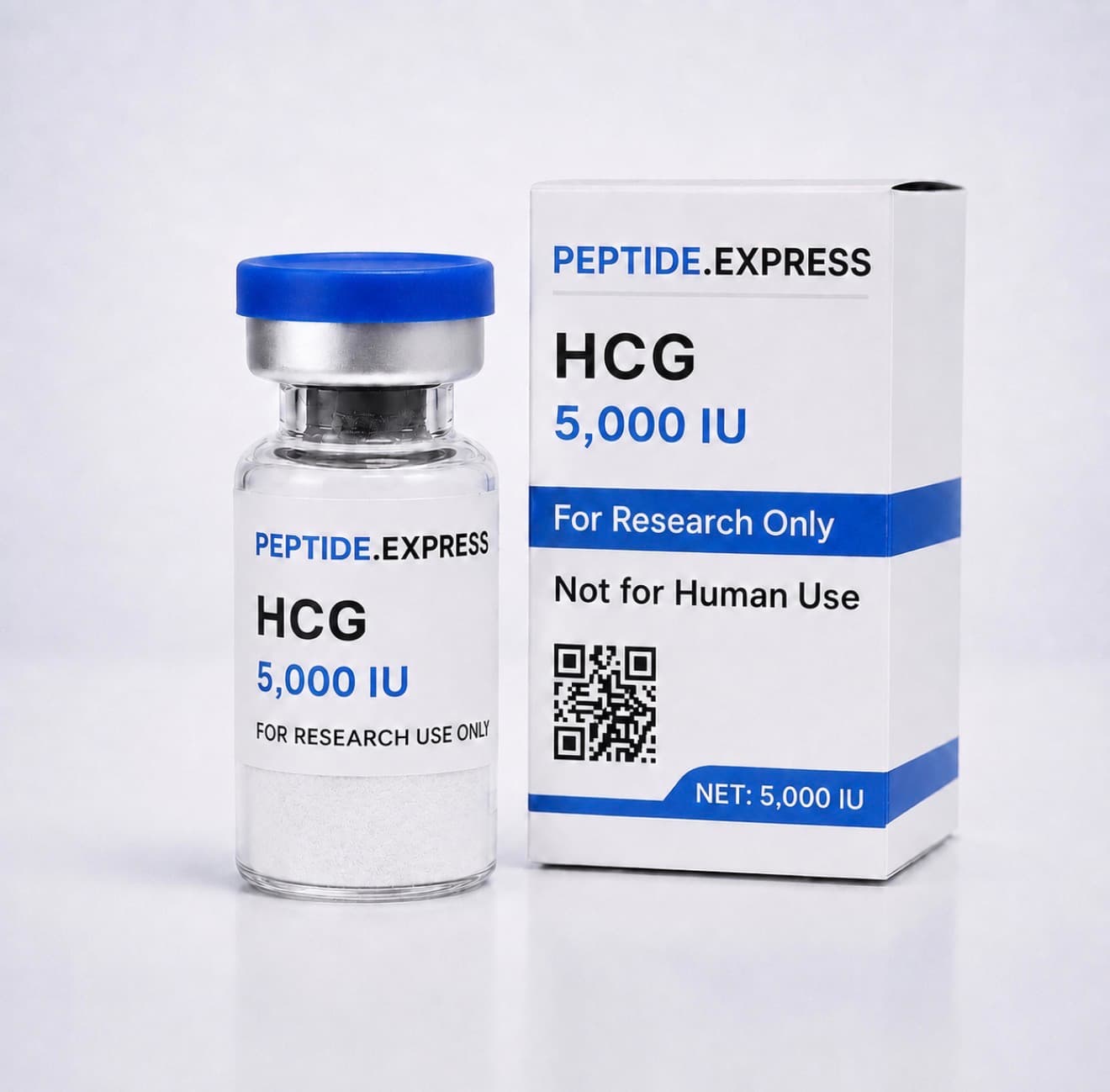
HCG Specifications
HCG (CAS 9002-61-3) is studied in in-vitro and animal models via LH/hCG receptor engagement and cAMP signalling. This section covers molecular identity and specification data. Analytical standard: not stated in this reference profile. Stocked material is for laboratory research use only. Identity, structure, and handling values come from the existing profile.
| Property | Value |
|---|---|
| Compound Name | Human chorionic gonadotropin (HCG) |
| CAS Number | 9002-61-3 |
| Molecular Class | Heterodimeric glycoprotein hormone (alpha subunit plus hormone-specific beta subunit) |
| Molecular Formula | Not publicly disclosed |
| Molecular Weight | Not publicly disclosed |
| Amino Acid Sequence | Not publicly disclosed |
| Primary Receptor Target | LH/hCG receptor (LHCGR) |
| Secondary Receptor Activity | Weak thyrotropic cross-reactivity reported in the pregnancy literature |
| Known Isoforms | Regular hCG, hyperglycosylated hCG, free beta subunit, nicked hCG |
| Physical Form | White to off-white lyophilized powder |
| Purity Standard | >=99% by HPLC (sourcing specification) |
| Identity Testing | HPLC purity profile; lot-specific results reported on the Certificate of Analysis |
| Third-Party Testing | Independent laboratory analysis per lot |
| Documentation Supplied | Certificate of Analysis with lot number and HPLC chromatogram |
| Recommended Solvent | Bacteriostatic water for laboratory reconstitution |
| Handling Caution | Avoid vortexing, jetting solvent onto the cake, and foaming; subunit dissociation deactivates hCG |
| Storage (Lyophilized) | -20 C, sealed, protected from light and moisture |
| Storage (Reconstituted) | 2 to 8 C, short term; avoid repeated freeze-thaw cycles |
| Shipping Condition | Ambient shipment of the lyophilized vial; refrigerate on arrival |
| Stability Concern | Nicking of the backbone and alpha-beta dissociation reduce activity while immunoreactivity may persist |
| Sterility | Not sterile-filled for human use; laboratory reagent only |
| Intended Use | Research use only. Not for human or veterinary use, not for diagnostic use, not for food or drug purposes |
| Catalog Slug | hcg |
HCG Mechanism of Action
HCG (CAS 9002-61-3) is studied in in-vitro and animal models via LH/hCG receptor engagement and cAMP signalling. This section covers the reported mechanism and its evidence limits. Analytical standard: not stated in this reference profile. Stocked material is for laboratory research use only. Identity, structure, and handling values come from the existing profile.
LH/hCG receptor engagement and cAMP signalling. HCG acts as an agonist at the LH/hCG receptor, a G protein-coupled receptor shared with luteinizing hormone, and the downstream cascade it drives is cAMP-dependent. Reviews of the biological functions of hCG and hCG-related molecules describe receptor occupancy at gonadal and placental targets as the organising mechanism behind the hormone's effects on steroidogenesis and trophoblast behaviour.
The shared receptor is why hCG is used experimentally as a long-acting LH surrogate in cell systems. Its beta subunit carboxy-terminal extension and heavier glycosylation slow clearance relative to pituitary LH in vivo, though clearance parameters are properties of the physiological system rather than values this page can assign to a particular research lot.
Glycoform-dependent potency: regular versus hyperglycosylated hCG. Glycosylation changes what the molecule does. A 2019 report in Molecular and Cellular Endocrinology found that hyperglycosylated hCG activated the LH/hCG receptor with lower activity than regular hCG in the systems tested, which argues against treating the two as interchangeable in a receptor assay.
Separate work on hyperglycosylated hCG has framed it as a functionally distinct variant rather than a modified version of the same signal, with a 2007 paper in Molecular and Cellular Endocrinology describing biological functions separate from those of regular hCG and a 2016 review in the American Journal of Reproductive Immunology positioning it as an implantation and invasion factor.
Where these papers describe invasion and implantation activity, the evidence base is trophoblast and cell-model work plus clinical association, not a characterised receptor-level mechanism identical to the cAMP pathway above. Loss of activity by nicking and subunit dissociation. The practical stability problem with hCG is documented in the primary literature.
A 1993 study in the Journal of Clinical Endocrinology and Metabolism reported that hCG is deactivated by nicking of the peptide backbone and by dissociation of the alpha and beta subunits, meaning immunoreactive material can remain measurable while biological activity falls.
For bench work the consequence is direct: a total-hCG immunoassay signal is not proof of intact, active heterodimer. Reviews of total hCG tests published in Clinica Chimica Acta discuss exactly this gap between what different assays capture and what the molecule is doing.
Cross-reactivity at the TSH receptor. Because the alpha subunit is shared across the glycoprotein hormone family, hCG shows weak thyrotropic activity. A 1991 review in Obstetrics and Gynecology examined the role of hCG in thyroid regulation during normal and abnormal pregnancy, and this cross-reactivity is the standard explanation offered for thyroid changes seen when circulating hCG is very high.
Quantitative selectivity ratios for the material supplied here have not been established and are not claimed. Endometrial and trophoblast signalling. Beyond the gonads, hCG has been studied as a local signal in the embryo-endometrial interface. A 2001 review in Seminars in Reproductive Medicine set out the case for hCG acting within that microenvironment on differentiation and implantation, drawing on cell and tissue models rather than on a single controlled human mechanism study.
HCG Research Applications
HCG (CAS 9002-61-3) is studied in in-vitro and animal models via LH/hCG receptor engagement and cAMP signalling. This section covers the model systems and analytical readouts. Analytical standard: not stated in this reference profile. Stocked material is for laboratory research use only. Identity, structure, and handling values come from the existing profile.
LHCGR agonist reference standard: hCG is the comparator against which glycoform potency is judged, following the 2019 finding that hyperglycosylated hCG activates the receptor with lower activity than regular hCG.
cAMP reporter and steroidogenesis assays: receptor-level work in cultured granulosa or Leydig-derived lines uses hCG as the stimulus because its receptor is shared with luteinizing hormone.
Assay specificity characterisation: reviews of total hCG tests and of hCG-related molecules and their measurement describe how intact hCG, free beta subunit and nicked forms are detected unequally by different antibody pairs.
Detection-method research: a 2014 review in Trends in Endocrinology and Metabolism discussed the direction of pregnancy testing with hCG, making the molecule a working reference material for method comparison.
Free beta versus intact hCG discrimination: first-trimester screening literature comparing free beta hCG with intact hCG illustrates why calibrator identity matters in any hCG measurement protocol.
Trophoblast invasion models: hyperglycosylated hCG has been characterised in review literature as an implantation and invasion factor, which is the framing behind in-vitro invasion assay designs.
HCG Storage Requirements
HCG (CAS 9002-61-3) is studied in in-vitro and animal models via LH/hCG receptor engagement and cAMP signalling. This section covers the material's structure-specific handling requirements. Analytical standard: not stated in this reference profile. Stocked material is for laboratory research use only. Identity, structure, and handling values come from the existing profile.
HCG is a glycoprotein held together by noncovalent alpha-beta association, so reconstitution technique matters more than it does for a short synthetic peptide. Published work reports that nicking and subunit dissociation deactivate hCG, so the goal of every step below is to dissolve the cake without shear, foaming or thermal shock.
Reconstitution and handling guidance: Let the sealed vial equilibrate to room temperature for 20 to 30 minutes before opening, so condensation does not settle onto the lyophilized cake. Wipe the vial stopper and the solvent stopper with 70% isopropanol and let both dry before the first puncture.
Calculate the solvent volume against the assay concentration you need and record it, since a glycoprotein lot is specified by activity or mass on its Certificate of Analysis rather than by a sequence-derived mass you can recalculate yourself. Draw bacteriostatic water into a sterile syringe and expel visible air before introducing the needle into the peptide vial.
Angle the needle so the stream runs down the inner glass wall and let the solvent enter over several seconds; never jet solvent directly into the cake, because shear at the air-liquid interface promotes subunit dissociation. Roll or swirl the vial gently until the powder clears.
Do not vortex and do not shake; visible foam signals surface denaturation of the glycoprotein. Allow 5 to 10 minutes for complete dissolution, then inspect against a dark background. A usable solution is clear and free of visible particulates or fibrils.
Aliquot into single-use sterile vials when the protocol spans multiple time points, which avoids repeated stopper punctures and repeated warming of the same stock. Label each aliquot with concentration, solvent, date and lot number, refrigerate at 2 to 8 C protected from light, and keep the lot number with your assay records for traceability back to the Certificate of Analysis.
HCG at Peptide.Express
HCG is sourced against a ≥99% HPLC purity specification. Independent third-party HPLC Certificates of Analysis, lot-matched to published batch records. Same-day US shipping on orders before 2 PM EST. For laboratory research use only. Not for human or veterinary use.
View HCG Product DetailsHCG Frequently Asked Questions
What is HCG used for in research?
In laboratory settings HCG serves three main roles: as an LH/hCG receptor agonist reference in cell-based cAMP and steroidogenesis assays, as reference material in immunoassay specificity and calibrator work where intact hCG, free beta subunit and nicked forms must be distinguished, and as a stimulus in trophoblast and endometrial culture models of implantation biology. All of these are in-vitro applications.
What is HCG?
HCG (human chorionic gonadotropin), CAS 9002-61-3, is a heterodimeric glycoprotein hormone that acts as an agonist at the LH/hCG receptor. Its alpha subunit is shared with luteinizing hormone, follicle-stimulating hormone and thyroid-stimulating hormone, while its glycosylated beta subunit is hormone-specific. Research-grade HCG is supplied as a lyophilized powder for laboratory use only.
What is the CAS number of HCG?
The CAS number for human chorionic gonadotropin is 9002-61-3. That identifier appears on the Certificate of Analysis for each lot alongside the HPLC purity result, and it is the value to use when cross-referencing HCG in a chemical inventory or safety record.
What is the molecular weight of HCG?
A molecular weight for HCG is not publicly disclosed among the verified values for this catalog item, and no figure is stated here. HCG is a glycosylated heterodimer whose apparent mass depends on carbohydrate content, so a single number does not describe every preparation the way it would for a defined synthetic peptide.
What is hyperglycosylated hCG and how does it differ from regular hCG?
Hyperglycosylated hCG carries larger, more complex sugar chains than regular hCG, and it does not behave identically at the receptor. A 2019 report in Molecular and Cellular Endocrinology found that hyperglycosylated hCG activated the LH/hCG receptor with lower activity than regular hCG. Review work has additionally described it as a functionally separate molecule and as an implantation and invasion factor, which is why receptor assays should specify which glycoform they used.
Does every HCG lot come with a Certificate of Analysis?
Every lot ships against a Certificate of Analysis carrying the lot number, the HPLC purity result and the identity testing performed by an independent laboratory. The >=99% figure is a sourcing specification; the measured value for the specific lot you receive is the number printed on that document.
What receptor does HCG act on?
HCG acts at the LH/hCG receptor (LHCGR), a G protein-coupled receptor it shares with luteinizing hormone, and signalling proceeds through a cAMP-dependent cascade. Review literature on the biological functions of hCG and hCG-related molecules treats receptor occupancy at gonadal and placental targets as the central mechanism. Weak cross-reactivity at the TSH receptor has also been described in the pregnancy literature.
How is HCG different from a synthetic research peptide such as BPC-157?
HCG is a glycosylated two-subunit protein of biological origin; BPC-157 is a short synthetic peptide with a fully defined sequence and a single calculable mass. That difference changes the analytics: a synthetic peptide is characterised by sequence and mass, while an hCG lot is characterised by purity profile and identity testing because glycosylation varies. It also changes handling, since hCG can be deactivated by shear and subunit dissociation.
Does HCG have human clinical data?
Yes. Human chorionic gonadotropin carries decades of clinical literature, including a 2018 Cochrane systematic review of intrauterine hCG administration in subfertile women undergoing assisted reproduction and a 2010 review and meta-analysis of hCG supplementation in recurrent miscarriage. That clinical record belongs to pharmaceutical hCG preparations used under medical supervision. The material sold here is a laboratory reagent and is not a drug product.
Is HCG banned by WADA?
Chorionic gonadotropin is prohibited in male athletes at all times under the World Anti-Doping Agency's peptide hormone category. Anti-doping status is listed here for completeness of the regulatory picture; it is not guidance for use in any person.
References
- Cole LA. "Biological functions of hCG and hCG-related molecules." Reproductive biology and endocrinology : RB&E, 2010. Read the Cole 2010 record on PubMed: Biological functions of hCG and hCG-related molecules
- Koistinen H, Koel M, Peters M, et al. "Hyperglycosylated hCG activates LH/hCG-receptor with lower activity than hCG." Molecular and cellular endocrinology, 2019. Read the Koistinen 2019 record on PubMed: Hyperglycosylated hCG activates LH/hCG-receptor with lower activity than hCG
- Cole LA, Khanlian SA. "Hyperglycosylated hCG: a variant with separate biological functions to regular hCG." Molecular and cellular endocrinology, 2007. Read the Cole 2007 record on PubMed: Hyperglycosylated hCG: a variant with separate biological functions to regular hCG
- Evans J. "Hyperglycosylated hCG: a Unique Human Implantation and Invasion Factor." American journal of reproductive immunology (New York, N.Y. : 1989), 2016. Read the Evans 2016 record on PubMed: Hyperglycosylated hCG: a Unique Human Implantation and Invasion Factor
- Cole LA, Kardana A, Park SY, et al. "The deactivation of hCG by nicking and dissociation." The Journal of clinical endocrinology and metabolism, 1993. Read the Cole 1993 record on PubMed: The deactivation of hCG by nicking and dissociation
- Cole LA, DuToit S, Higgins TN. "Total hCG tests." Clinica chimica acta; international journal of clinical chemistry, 2011. Read the Cole 2011 record on PubMed: Total hCG tests
- Szczerba A, Białas P, Pięta PP, et al. "hCG - related molecules and their measurement." Ginekologia polska, 2016. Read the Szczerba 2016 record on PubMed: hCG - related molecules and their measurement
- Kennedy RL, Darne J. "The role of hCG in regulation of the thyroid gland in normal and abnormal pregnancy." Obstetrics and gynecology, 1991. Read the Kennedy 1991 record on PubMed: The role of hCG in regulation of the thyroid gland in normal and abnormal pregnancy
- Licht P, Russu V, Wildt L. "On the role of human chorionic gonadotropin (hCG) in the embryo-endometrial microenvironment: implications for differentiation and implantation." Seminars in reproductive medicine, 2001. Read the Licht 2001 record on PubMed: On the role of human chorionic gonadotropin (hCG) in the embryo-endometrial microenvironment: implications for differentiation and implantation
- Craciunas L, Tsampras N, Raine-Fenning N, et al. "Intrauterine administration of human chorionic gonadotropin (hCG) for subfertile women undergoing assisted reproduction." The Cochrane database of systematic reviews, 2018. Read the Craciunas 2018 record on PubMed: Intrauterine administration of human chorionic gonadotropin (hCG) for subfertile women undergoing assisted reproduction
- Carp HJ. "Recurrent miscarriage and hCG supplementation: a review and metaanalysis." Gynecological endocrinology : the official journal of the International Society of Gynecological Endocrinology, 2010. Read the Carp 2010 record on PubMed: Recurrent miscarriage and hCG supplementation: a review and metaanalysis
- Santen R, Hasan F, Thoren K, et al. "Pituitary as a Source of HCG: Residual Levels After Bilateral Testicular Tumor Removal." Journal of investigative medicine high impact case reports, 2019. Read the Santen 2019 record on PubMed: Pituitary as a Source of HCG: Residual Levels After Bilateral Testicular Tumor Removal
- Berger P, Sturgeon C. "Pregnancy testing with hCG--future prospects." Trends in endocrinology and metabolism: TEM, 2014. Read the Berger 2014 record on PubMed: Pregnancy testing with hCG--future prospects
- Dirnhofer S, Wick G, Berger P. "The suitability of human chorionic gonadotropin (hCG)-based birth-control vaccines." Immunology today, 1994. Read the Dirnhofer 1994 record on PubMed: The suitability of human chorionic gonadotropin (hCG)-based birth-control vaccines
How This Page Is Sourced
Molecular identity on this page (name, CAS number, molecular formula and molecular weight) is resolved from a single internal entity record and checked against primary registries (PubChem, CAS Common Chemistry) rather than retyped per page. A field with no verified value is left out instead of estimated. Literature is cited to a DOI, PMID or PMCID permalink so every reference resolves to the specific record it names.