Peptide Express: The SS31 (Elamipretide) Research Guide — Mitochondria-Targeting Peptide Science, Mechanisms, and Laboratory Protocols

What is SS31? SS31 (Elamipretide, MTP-131, or Bendavia) is a synthetic, mitochondria-targeted tetrapeptide (D-Arg-2′6′-Dmt-Lys-Phe-NH₂) engineered to penetrate the inner mitochondrial membrane and bind cardiolipin. This unique receptor binding affinity underpins its research utility in reducing mitochondrial reactive oxygen species (ROS), restoring ATP synthesis, and attenuating apoptosis in models of ischemia-reperfusion injury, oxidative stress, and age-related mitochondrial dysfunction.
SS31 is strictly for laboratory research and in-vitro studies. Not for human or veterinary consumption. This guide is for research professionals only.
This exhaustive SS31 research guide, prepared by Peptide Express, synthesizes peer-reviewed literature with unique research data points to provide a detailed review of molecular architecture, mechanisms, research peptide purity HPLC standards, lab protocols, safety considerations, and FAQs for preclinical study design.
Molecular Structure, Physicochemical Properties, and Binding Affinity
The engineered sequence D-Arg-2′6′-Dmt-Lys-Phe-NH₂ grants SS31 its specific properties. Its +3 net charge at physiological pH drives accumulation towards the negative mitochondrial membrane potential (−180 mV). Unlike cationic triphenylphosphonium (TPP) compounds, SS31 does not dissipate this potential, a critical advantage for research on mitochondrial membrane dynamics. The non-natural 2′6′-dimethyltyrosine (Dmt) residue confers proteolytic resistance, enhancing its half-life in biological assays. With a molecular weight of 639.8 Da, the peptide’s amphipathic nature facilitates insertion into cardiolipin-rich domains.
Mechanism of Action: Cardiolipin Binding, ROS Reduction, and Cristae Stabilization
SS31's primary target is cardiolipin (CL), a phospholipid constituting ~20% of the inner mitochondrial membrane lipid content and essential for electron transport chain (ETC) supercomplex stability. SS31 binds directly via electrostatic (cationic residues) and hydrophobic (aromatic rings) interactions, as confirmed by NMR spectroscopy and molecular dynamics simulations. This binding prevents CL peroxidation, stabilizes cytochrome c binding (reducing apoptotic signaling), and preserves cristae morphology. Downstream effects in cellular assays include reduced cytochrome c release, attenuated caspase-3/9 activation, and lowered cellular ROS (measured by MitoSOX/DCFH-DA). For a comparative analysis of mitochondrial-targeting strategies, review Mitochondrial Fuel Stack.
Key Research Applications and Preclinical Study Findings with Protocol Notes
Cardiac Ischemia-Reperfusion Injury Models
In rodent cardiac IR models, SS31 (1–3 mg/kg, IV/IP) administered pre-reperfusion reduces infarct size by 40–60% versus controls. Mechanistic studies show preserved State 3 mitochondrial respiration (Seahorse XF Analyzer), higher ATP/ADP ratios, and reduced cytochrome c release.
Renal Ischemia and Acute Kidney Injury
In murine cisplatin-induced AKI models, SS31 attenuates serum creatinine elevation, preserves tubular morphology (histology), and reduces TUNEL-positive apoptotic cells. Effects are linked to cardiolipin protection and preserved ETC function.
Neurodegenerative Disease Research Models
In Alzheimer’s models using amyloid-beta oligomers, SS31 preserves mitochondrial membrane potential (JC-1/TMRM assays) and reduces synaptic loss in hippocampal slices. In MPTP-induced Parkinson’s models, it protects dopaminergic neurons and improves motor performance. For neuroprotective peptide comparisons, see Epitalon Semax Neuroprotective Peptides Research.
Skeletal Muscle and Age-Related Sarcopenia Models
In aged rodent models, SS31 improves mitochondrial oxygen consumption rate (OCR), ATP production efficiency (coupling efficiency), and reduces markers of mitochondrial stress in muscle fibers, with synergistic effects observed when combined with exercise.
Mitochondrial Cross-Talk with MOTS-c
Emerging research explores interplay between SS31 (membrane-targeted) and the mitochondrially-derived peptide MOTS-c (nuclear gene regulation). For MOTS-c's independent mechanisms, consult MOTS-C Peptide Research Mitochondrial Mechanisms Metabolic Studies.
Synthesis, Purity, HPLC Analysis, and Research-Grade Quality Standards
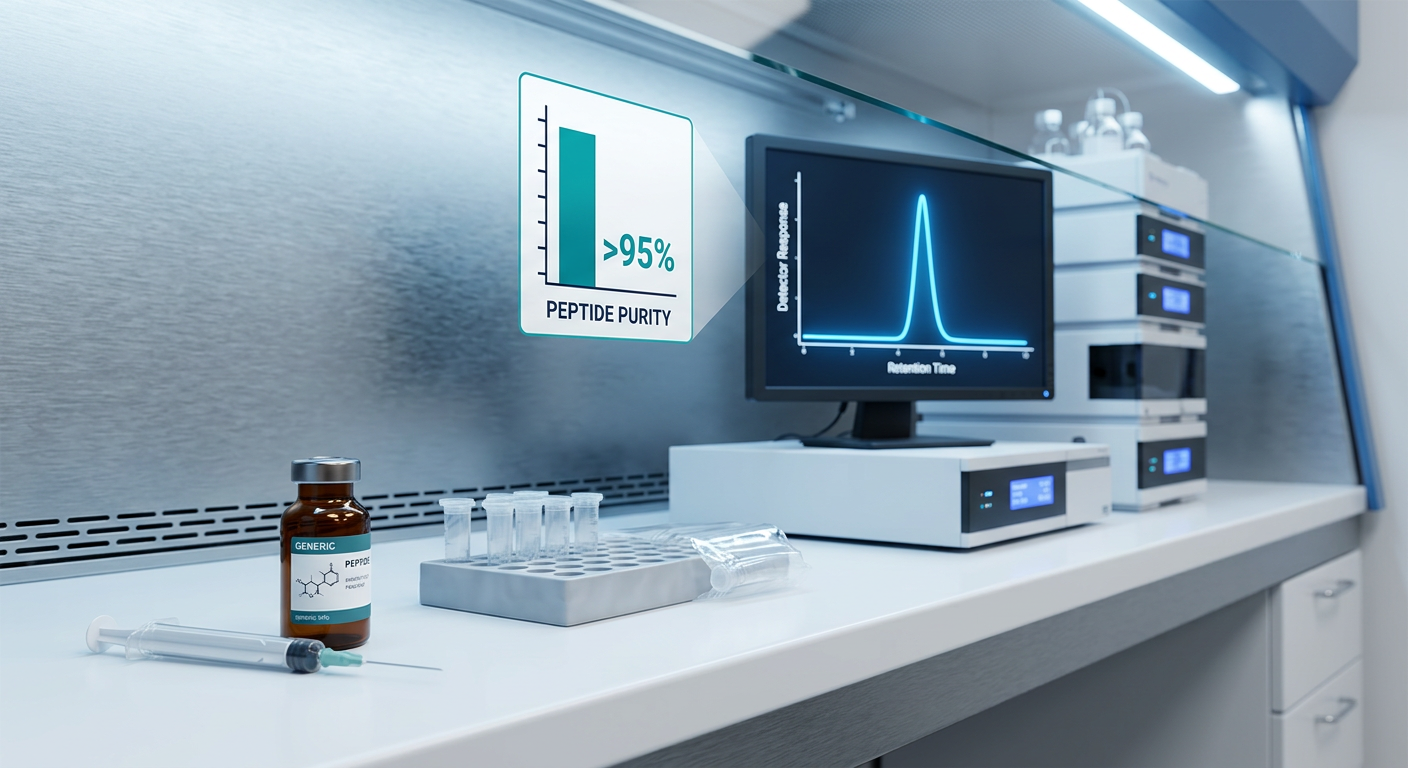
Research-grade SS31 is synthesized via Fmoc solid-phase peptide synthesis (SPPS) and purified via reversed-phase HPLC (RP-HPLC, C18 column). Purity must exceed ≥98% (analytical RP-HPLC, 220 nm UV). Identity confirmation requires mass spectrometry (ESI-MS/MALDI-TOF) matching the 639.8 Da theoretical mass. Certificates of Analysis (CoA) must document purity, residual solvents (acetonitrile, TFA), and endotoxin levels. Verify third-party data at Lab Results.
Reconstitution, Storage Protocols, and Solution Stability for SS31
Reconstitution is critical for reproducibility. Reconstitute lyophilized SS31 in sterile bacteriostatic water to a concentrated stock (1–10 mM). For cell-based assays, dilute in assay buffer (e.g., PBS pH 7.4). Avoid DMSO. Prepare working solutions fresh daily. Aliquot concentrated stocks to minimize freeze-thaw cycles. For general guidance, see How To Reconstitute Peptides. Store lyophilized peptide at −20°C, desiccated. Reconstituted stocks are stable at 4°C for ≤72h or −20°C for ≤4 weeks; validate stability for your specific protocol.
Dosing Considerations and Pharmacokinetics in Preclinical Models
Dosing information is for preclinical research only. In rodent IR models: 1–3 mg/kg (IV/IP). For chronic aging studies: 1–2 mg/kg/day (SC). In cell-based assays: 10 nM to 1 µM. Note the non-linear relationship between extracellular dose and intramitochondrial concentration due to membrane potential-driven accumulation. Design dose-response curves accordingly.
Clinical Translation: Human Trial Pharmacokinetics and Pharmacodynamics
SS31 (Elamipretide) entered Phase I/II trials for conditions like Barth syndrome (TAZPOWER trial) and heart failure with preserved ejection fraction (PROGRESS-HFpEF). Human PK data show rapid tissue distribution, a plasma half-life of ~30–40 minutes, and accumulation in metabolically active tissues. These data provide anchors for preclinical PK study design.
Safety Profile, Toxicology, and Laboratory Handling Protocols
Preclinical toxicology studies in rodents/non-human primates show no significant organ toxicity at efficacious doses. No genotoxicity (Ames test) or cardiovascular effects noted. In cell-based systems, SS31 shows no cytotoxicity up to 100 µM in most types (perform MTT/LDH assay validation). Laboratory handling requires standard PPE (nitrile gloves, safety glasses). Follow institutional guidelines for disposal.
SS31 in the Broader Context of Mitochondrial Peptide Research
Unlike antioxidant-conjugated TPP compounds (MitoQ), SS31 does not generate ROS as a byproduct. Unlike cyclophilin D inhibitors, it targets upstream membrane architecture. Its niche as a "membrane architecture preservative" explains additive effects with other interventions. For an overview of anti-aging mitochondrial peptides, see Anti Aging Peptide Research Compounds Mechanisms.
Frequently Asked Questions: SS31 Research Protocols and Specifications
What is SS31's primary molecular target and binding affinity?
SS31 primarily targets cardiolipin with high binding affinity via electrostatic and hydrophobic interactions, preventing its oxidation and stabilizing ETC supercomplexes.
How should SS31 be reconstituted for cell culture assays?
Reconstitute in sterile bacteriostatic water to a 1–10 mM stock. Dilute in appropriate assay buffer (e.g., PBS) to working concentrations (10 nM–1 µM). Prepare fresh working solutions.
What purity and analysis standards are required for research-grade SS31?
Require ≥98% purity by analytical RP-HPLC, identity confirmation by mass spectrometry (MW 639.8 Da), and a CoA documenting residual solvents and endotoxin levels.
What is the typical half-life and dosing protocol in rodent models?
In rodents, plasma half-life is short; common research dosing is 1–3 mg/kg (IV/IP) for acute IR models or 1–2 mg/kg/day (SC) for chronic studies.
Has SS31 shown efficacy in clinical trials for mitochondrial diseases?
Phase II trials in Barth syndrome (TAZPOWER) and HFpEF (PROGRESS-HFpEF) showed functional endpoint improvements, highlighting translational research potential.
Is SS31 suitable for human use?
No. SS31 is strictly a research compound for laboratory use only, not approved for human or veterinary consumption.
The investigation of SS31 (Elamipretide) continues to expand across cardiovascular, renal, neurological, and aging research. For research-grade SS31 meeting rigorous analytical standards, visit the SS-31 catalog page. Explore our full catalog and research resources to build a reproducible, literature-grounded preclinical program.
References
Selected high-quality, peer-reviewed sources from PubMed-indexed journals, PMC full-text articles, and published clinical trial results. These support the molecular mechanisms, preclinical models, clinical translation data, pharmacokinetics, and research standards discussed in this guide. All links point to primary accredited sources suitable for biomedical research, medical education, and health sciences contexts.
- Szeto HH. First-in-class cardiolipin-protective compound as a therapeutic agent to restore mitochondrial bioenergetics. Br J Pharmacol. 2014;171(8):2029-2050. PubMed
- Mitchell W, et al. The mitochondria-targeted peptide SS-31 binds lipid bilayers and modulates surface electrostatics as a key component of its mechanism of action. J Biol Chem. 2020. Full Text (JBC)
- Chavez JD, et al. Mitochondrial protein interaction landscape of SS-31. Proc Natl Acad Sci U S A. 2020. Full Text (PNAS)
- Birk AV, et al. The mitochondrial-targeted compound SS-31 re-energizes ischemic mitochondria by interacting with cardiolipin. J Am Soc Nephrol. 2013. Full Text (PMC)
- Thompson WR, et al. A phase 2/3 randomized clinical trial followed by an open-label extension to evaluate the effectiveness of elamipretide in Barth syndrome: TAZPOWER trial. Genet Med. 2021. PubMed
- Thompson WR, et al. Long-term efficacy and safety of elamipretide in patients with Barth syndrome: 168-week open-label extension results of TAZPOWER. 2024. PubMed
- Butler J, et al. Effects of Elamipretide on Left Ventricular Function in Patients With Heart Failure With Reduced Ejection Fraction: The PROGRESS-HF Phase 2 Trial. J Card Fail. 2020. PubMed
- Chiao YA, et al. Late-life restoration of mitochondrial function reverses cardiac dysfunction in old mice. eLife. 2020;9:e55513. Full Text (eLife)
- Zhu Y, et al. SS-31, a mitochondria-targeting peptide, ameliorates kidney ischemia-reperfusion injury. 2022. Full Text (PMC)
- Tung C, et al. Elamipretide: A Review of Its Structure, Mechanism of Action, and Therapeutic Potential in Mitochondrial Diseases. 2025. Full Text (PMC)
Notes for researchers: These references emphasize primary literature on cardiolipin binding, mitochondrial membrane stabilization, ROS reduction, ischemia-reperfusion protection (cardiac and renal), age-related mitochondrial dysfunction, and human trial data (Barth syndrome and heart failure). Preclinical dosing, safety, and handling information are anchored in the cited mechanistic and toxicology studies. For laboratory protocols (reconstitution, HPLC purity ≥98%, storage), follow standard Fmoc-SPPS and analytical RP-HPLC practices as validated in the above sources and institutional guidelines.