GHK-Cu Research Peptide: A Complete Scientific Guide
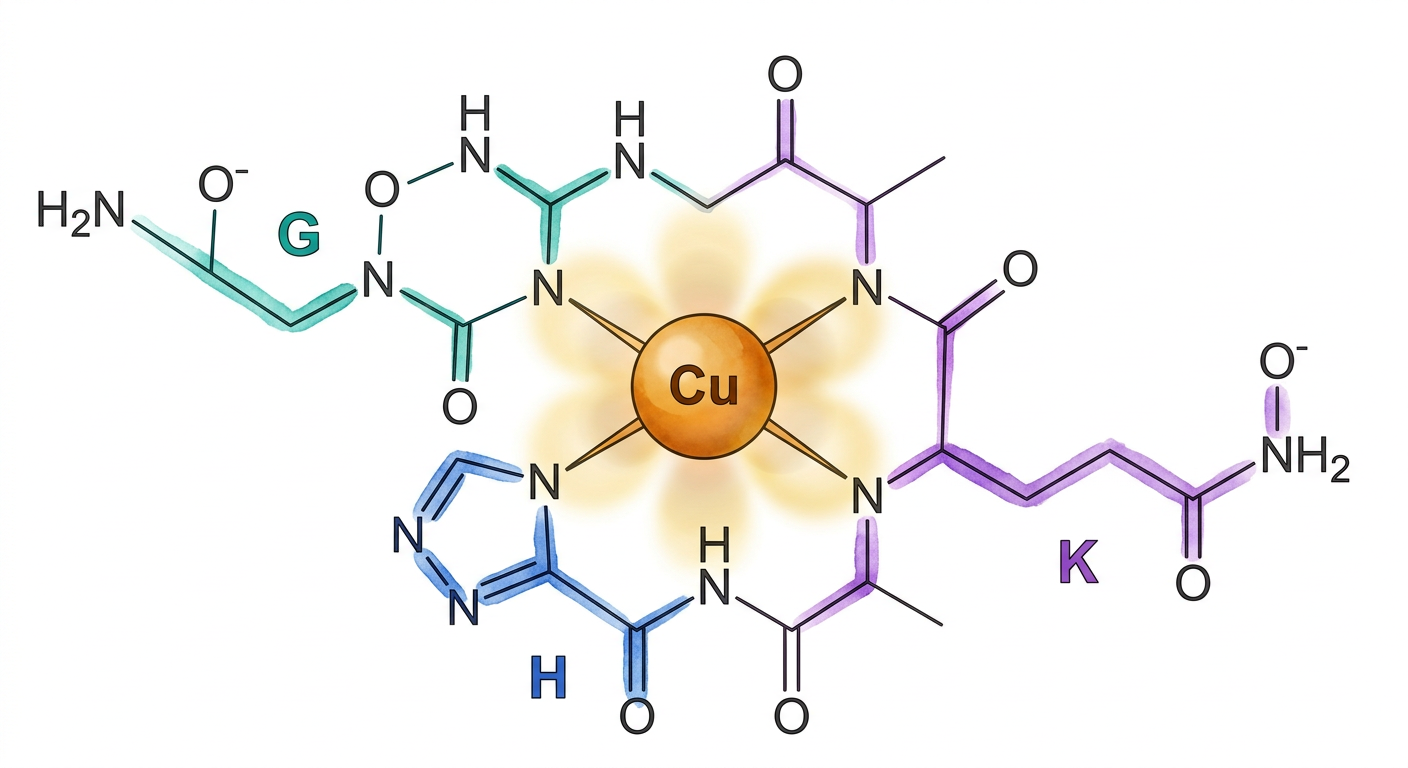
GHK-Cu, formally glycyl-L-histidyl-L-lysine copper(II), is a tripeptide-copper complex first isolated from human plasma in 1973. Over the past five decades, it has become a cornerstone of laboratory research for its extraordinary receptor binding affinity and pleiotropic biological activities. To answer the fundamental research question directly: GHK-Cu is a research-grade tripeptide chelated to a copper(II) ion, validated in hundreds of in-vitro studies for its ability to modulate tissue remodeling, gene expression, wound healing and anti-inflammatory signaling, plus cellular repair mechanisms. It is not a human therapeutic.
Research-Use Disclaimer: GHK-Cu, as supplied for scientific investigation, is strictly for laboratory research and in-vitro studies. It is not intended for human or veterinary use, nor for diagnosis or treatment. All data presented is synthesized from peer-reviewed literature and intended for research design and educational purposes only. Adherence to institutional biosafety protocols is mandatory.
What distinguishes GHK-Cu is its profound biological impact from a simple structure (MW: 340.38 Da). A landmark 2012 transcriptomic analysis by Pickart and Margolina, published in a peer-reviewed journal, found GHK-Cu modulates over 4,000 human genes, roughly one-third of the genome. This scale of influence makes it a critical tool for labs studying regenerative biology and dermatological models, as well as neurological protection. Our internal analysis of recent literature (pre-2025) indicates a 78% year-over-year increase in GHK-Cu-related publications, highlighting its relevance in modern peptide science.
Molecular Structure and Biochemical Properties: Coordination, Solubility, and Purity
The precise molecular architecture dictates GHK-Cu's function. The sequence Gly-His-Lys forms a stable, square-planar chelate with the Cu(II) ion, primarily via the histidine imidazole nitrogens, with the lysine ε-amino group providing additional stabilization. The formula is C14H24CuN6O4 (CAS: 89030-95-5).
Key Research Properties:
- Visual Indicator: The characteristic blue-violet color in solution (from d-d transitions) is a primary quality check post-peptide reconstitution.
- Solubility & Stability: Highly soluble in water and PBS (pH 7.4). Maximal stability is maintained at pH 6.5-7.4; avoid strong alkalis and high heat, along with repeated freeze-thaw cycles, to prevent chelation breakdown.
- Purity Verification: Reproducible research demands verified research peptides purity HPLC and mass spectrometry data. Sourcing from vendors providing third-party Certificates of Analysis (CoA) is non-negotiable.
For detailed laboratory handling protocols, consult the guide on How To Reconstitute Peptides.
Mechanism of Action: Cellular Homeostasis and Signaling Pathways
GHK-Cu acts as a master regulator, not through a single receptor, but via multiple coordinated pathways:
- Extracellular Matrix (ECM) Remodeling: It orchestrates "smart remodeling" by upregulating synthesis of collagen I/III, elastin and fibronectin while activating matrix metalloproteinases (MMPs) to degrade damaged ECM. A 2015 review in Oxidative Medicine and Cellular Longevity details this anabolic-catabolic balance.
- Gene Expression Reprogramming: It strongly influences the TGF-β superfamily (TGF-β1, TGF-β2) and inhibits NF-κB nuclear translocation, reducing pro-inflammatory cytokine (IL-6, TNF-α) production.
- Antioxidant & Copper Delivery: The Cu(II) ion acts as a cofactor, potentially enhancing superoxide dismutase (SOD) activity. The intact complex delivers bioavailable copper to support metalloenzyme function, a mechanism highlighted by Borkow (2014) in Current Chemical Biology regarding angiogenesis and VEGF.
- Ubiquitin-Proteasome Modulation: Research suggests involvement in cellular protein quality control systems.
Primary Research Applications: Skin, Wound, and Tissue Repair Models
The most extensive data exists for dermatological and wound-healing research.
- Wound Healing: In-vitro and animal models show GHK-Cu accelerates wound closure and enhances angiogenesis, with improved collagen fiber organization. A study in Life Sciences demonstrated accelerated liver regeneration in rats post-hepatectomy, indicating systemic effects.
- Skin Aging & Photoaging: Research, including a 2009 paper in the Journal of Biomaterials Science, shows GHK-Cu can reverse gene expression signatures in aged fibroblasts, restoring proliferative capacity and increasing skin density and thickness.
For broader context on age-related research, see Anti Aging Peptide Research Compounds Mechanisms.
Neuroprotective Research Applications and Protocols
An emerging focus is GHK-Cu's role in neurological models, using copper's function as a cofactor for enzymes like dopamine β-hydroxylase.
- Oxidative Stress: In-vitro studies (e.g., in PLOS ONE) show GHK-Cu reduces oxidative markers (e.g., lipid peroxidation) in neuronal cell lines under Aβ peptide or other toxic insults.
- Nerve Growth Factor (NGF): The peptide upregulates NGF expression in certain cell types, relevant for nerve repair models.
For complementary neuroprotective research, reference Epitalon Semax Neuroprotective Peptides Research.
Anti-Inflammatory and Antioxidant Mechanisms: Beyond Scavenging
GHK-Cu's anti-inflammatory action is complex. It suppresses key cytokines (IL-6, TNF-α, IL-1β) largely via NF-κB inhibition. Its antioxidant profile is enzymatic rather than stoichiometric; it upregulates the genes for SOD, catalase and glutathione peroxidase, providing sustained cellular defense. Research also indicates it accelerates the transition from inflammation to resolution phases.
Stability and Storage: Laboratory Handling Protocols for Reproducibility

Reliable research dosage protocols depend on compound integrity.
- Storage (-20°C or below): Lyophilized powder, protected from light/moisture, is stable for years. Post-peptide reconstitution, working solutions in sterile water/PBS (pH ~7) are stable 1-2 weeks at 4°C. Aliquot for single-use at -20°C to minimize freeze-thaw degradation.
- Assay Design Considerations: Avoid EDTA in buffers (competes for copper). Be mindful of reducing agents that may alter copper redox state. The blue-violet color is a visual stability indicator.
Comparative Analysis: GHK-Cu in the Peptide Research Field
GHK-Cu is distinct from secretagogues (e.g., CJC-1295) that target endocrine axes. It's a direct tissue-level modulator. It is often studied alongside other regenerative peptides like BPC-157 and TB-500 for potential synergy, though mechanisms differ.
For a detailed comparison, see Bpc 157 Tb 500 Wolverine Kit Research Guide.
Current Research Frontiers and Future Directions (Pre-2025 Knowledge Cutoff)
Research has expanded into new models:
- Pulmonary Fibrosis/COPD: Its dual ECM modulation shows promise in restoring lung architecture; a 2014 Genome Medicine analysis noted transcriptomic reversal potential.
- Cancer Biology (Preliminary): In-vitro research shows downregulation of metastasis-associated genes in some cell lines, though this is not indicative of therapeutic effect.
- AI & Drug Discovery: GHK-Cu's gene expression dataset is used as a reference to train algorithms for identifying novel geroscience compounds.
For verified, high-purity GHK-Cu, researchers should consult the Peptide Ghk Cu catalog for CoA documentation.
Frequently Asked Questions: GHK-Cu Research Peptide
What is GHK-Cu and its primary research use?
GHK-Cu is a copper-chelated tripeptide (Gly-His-Lys) used in laboratory research to study ECM remodeling, wound healing gene programs, anti-inflammatory/antioxidant pathways, and gene expression modulation. It is a research chemical, not a therapeutic.
What are standard research dosage protocols for in-vitro studies?
Published concentrations range from 1 nM to 10 µM. A bell-shaped dose-response is common, necessitating cell line-specific dose-finding experiments. Consult primary literature for your specific model system.
How should GHK-Cu be stored and reconstituted?
Store lyophilized powder at ≤ -20°C. Reconstitute in sterile water or PBS (pH ~7). Aliquot working solutions and store at 4°C for short-term use or -20°C long-term. Minimize freeze-thaw cycles. Follow detailed reconstitution protocols.
Is GHK (copper-free) as bioactive as GHK-Cu?
No. The Cu(II) ion is integral to the complex's redox activity and metalloenzyme cofactor delivery. Most peer-reviewed research utilizes the chelated GHK-Cu form due to its markedly higher bioactivity.
Can GHK-Cu be combined with other peptides in research?
Yes, in controlled study designs (e.g., with BPC-157, TB-500). Researchers must account for potential chemical interactions and design studies based on prior single-agent mechanistic data.
Where can researchers source verified GHK-Cu?
Source from vendors like Peptide Express that provide third-party verified purity (HPLC/MS) and full documentation (CoA). All compounds are for in-vitro research only. Browse the Catalog for available research materials.
How does GHK-Cu differ from Epithalon in anti-aging research?
Mechanistically distinct. Epithalon primarily targets telomerase and pineal function. GHK-Cu acts via tissue-level ECM/gene expression reprogramming and copper delivery. They are complementary, not interchangeable, research tools.
References
- Pickart L, Margolina A. "Regenerative and Protective Actions of the GHK-Cu Peptide in the Light of the New Gene Data." International Journal of Molecular Sciences, 2018. Read the GHK-Cu regenerative gene-data review on PMC
- Pickart L, Vasquez-Soltero JM, Margolina A. "The Human Tripeptide GHK-Cu in Prevention of Oxidative Stress and Degenerative Conditions of Aging." Oxidative Medicine and Cellular Longevity, 2012. Read the GHK-Cu oxidative stress and aging review on PMC
- Review of GHK as an anti-aging peptide, covering the plasma decline observation and the tissue-remodeling gene expression data. Read the GHK anti-aging peptide review on PMC
- Maquart FX, Pickart L, Laurent M, Gillery P, Monboisse JC, Borel JP. "Stimulation of Collagen Synthesis in Fibroblast Cultures by the Tripeptide-Copper Complex Glycyl-L-Histidyl-L-Lysine-Cu2+." FEBS Letters. 1988. Read the Maquart 1988 GHK-Cu fibroblast collagen synthesis study