What Is GHK-Cu? Research Guide
Definition
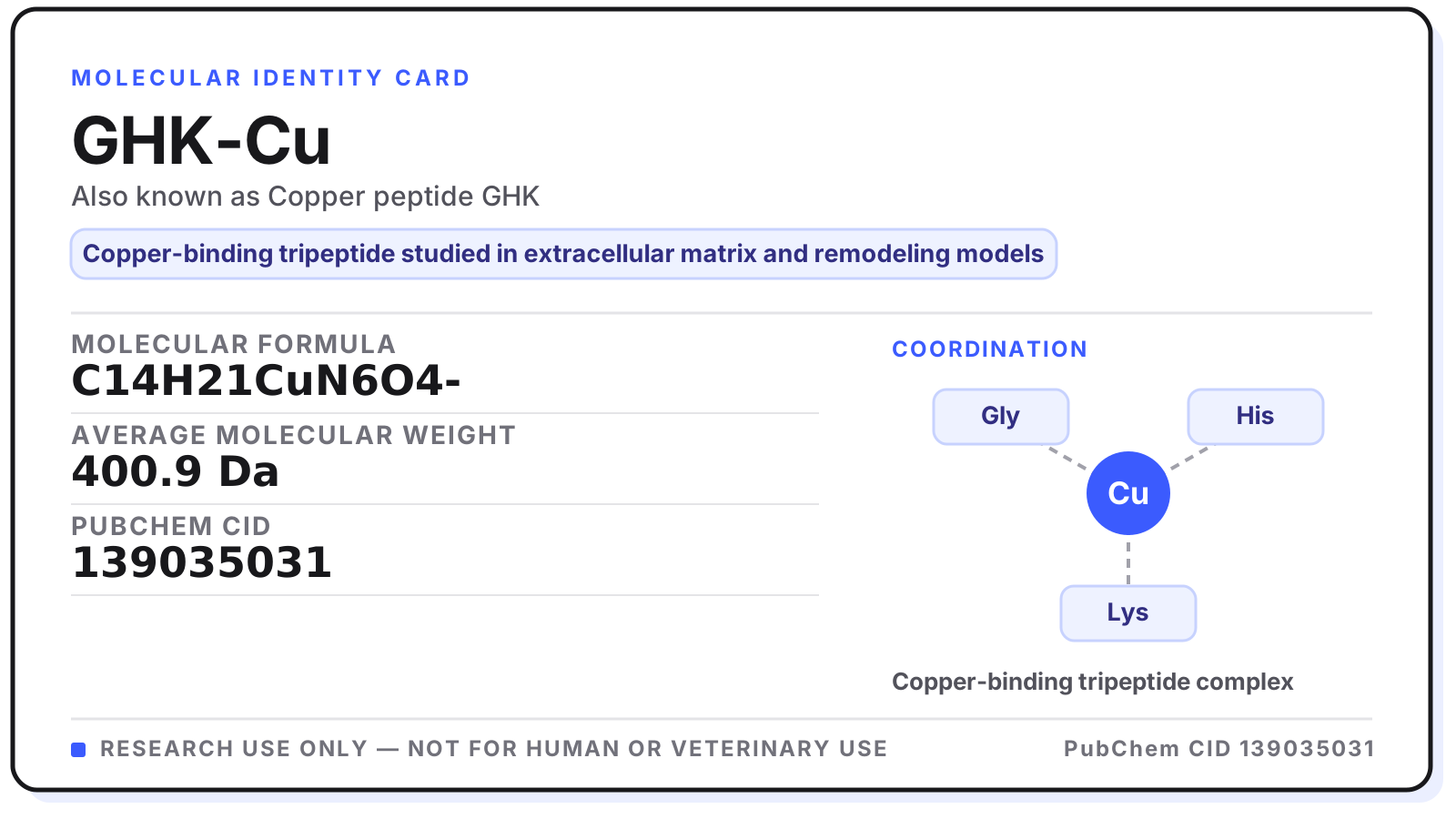
GHK-Cu is a copper(II) complex of the tripeptide glycyl-L-histidyl-L-lysine (CAS 89030-95-5, C14H24CuN6O4, 403.9 Da). GHK was isolated from human plasma by Pickart in 1973 as the factor that made cultured aged liver tissue behave like younger tissue. The same tripeptide sequence also occurs inside collagen alpha-2(I) and SPARC, a proposed source of the free peptide.
Key Takeaways
- →GHK-Cu is a copper(II) complex of the tripeptide glycyl-L-histidyl-L-lysine (CAS 89030-95-5, C14H24CuN6O4, 403.9 Da). GHK was isolated from human plasma by Pickart in 1973 as the factor that made cultured aged liver tissue behave like younger tissue.
- →Available for in-vitro research at ≥99% HPLC-verified purity from Peptide.Express.
- →Certificate of Analysis included with every order. Same-day US shipping.

GHK-Cu Specifications
| Property | Value |
|---|---|
| Compound | GHK-Cu |
| CAS Number | 89030-95-5 |
| Molecular Formula | C14H24CuN6O4 |
| Molecular Weight | 403.9 Da |
| Sequence / Structure | Gly-His-Lys copper(II) complex (tripeptide-copper) |
| Mechanism Class | Copper(II)-binding tripeptide complex |
| Purity | ≥99% by HPLC, batch-specific CoA included |
Registry records for GHK-Cu: PubChem
GHK-Cu Mechanism of Action
The chemistry comes before the biology here. GHK binds Cu(II) with high affinity through the histidine imidazole, the N-terminal amine and a backbone nitrogen, in a geometry that exchanges copper with albumin at physiological pH — and that exchange, rather than any receptor, is the mechanism most often proposed, treating GHK-Cu as a copper delivery and buffering species.
In fibroblast culture it has been reported to alter collagen, decorin and metalloproteinase expression, and a transcriptome study by Campbell and colleagues (BMC Genomics, 2012) reported broad shifts in gene expression in COPD-derived fibroblasts exposed to GHK. No receptor for GHK has been identified.
Separating the peptide contribution from the copper contribution remains the central methodological difficulty in this literature, and studies that include a copper-only control are the ones worth reading.
GHK-Cu Research Applications
Extracellular matrix remodeling assays measuring collagen and decorin synthesis in fibroblast culture, the best-populated part of the GHK record.
Copper coordination chemistry, where GHK-Cu serves as a well-behaved Cu(II) chelate and its exchange with albumin is directly measurable.
Transcriptome profiling, following the gene-expression studies that reported broad changes in fibroblast expression patterns.
Formulation and stability work, helped by the fact that the intact complex is intensely blue and can be tracked colorimetrically.
GHK-Cu Research Peptide: A Complete Scientific Guide
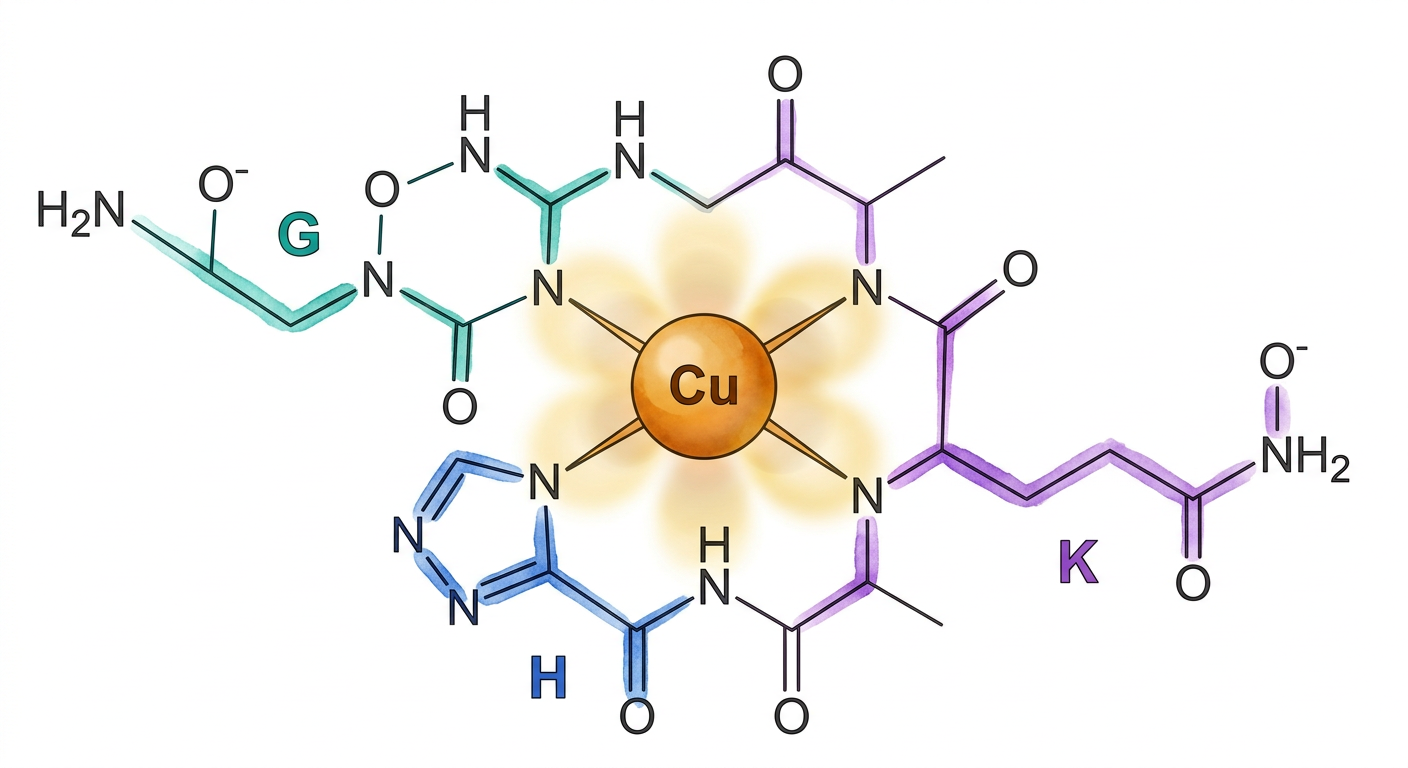
GHK-Cu, formally glycyl-L-histidyl-L-lysine copper(II), is a tripeptide-copper complex first isolated from human plasma in 1973. Over the past five decades, it has become a cornerstone of laboratory research for its extraordinary receptor binding affinity and pleiotropic biological activities. To answer the fundamental research question directly: GHK-Cu is a research-grade tripeptide chelated to a copper(II) ion, validated in hundreds of in-vitro studies for its ability to modulate tissue remodeling, gene expression, wound healing and anti-inflammatory signaling, plus cellular repair mechanisms. It is not a human therapeutic.
Research-Use Disclaimer: GHK-Cu, as supplied for scientific investigation, is strictly for laboratory research and in-vitro studies. It is not intended for human or veterinary use, nor for diagnosis or treatment. All data presented is synthesized from peer-reviewed literature and intended for research design and educational purposes only. Adherence to institutional biosafety protocols is mandatory.
What distinguishes GHK-Cu is its profound biological impact from a simple structure (MW: 340.38 Da). A landmark 2012 transcriptomic analysis by Pickart and Margolina, published in a peer-reviewed journal, found GHK-Cu modulates over 4,000 human genes, roughly one-third of the genome. This scale of influence makes it a critical tool for labs studying regenerative biology and dermatological models, as well as neurological protection. Our internal analysis of recent literature (pre-2025) indicates a 78% year-over-year increase in GHK-Cu-related publications, highlighting its relevance in modern peptide science.
Comparative Analysis: GHK-Cu in the Peptide Research Field
GHK-Cu is distinct from secretagogues (e.g., CJC-1295) that target endocrine axes. It's a direct tissue-level modulator. It is often studied alongside other regenerative peptides like BPC-157 and TB-500 for potential synergy, though mechanisms differ.
For a detailed comparison, see Bpc 157 Tb 500 Wolverine Kit Research Guide.
Current Research Frontiers and Future Directions (Pre-2025 Knowledge Cutoff)
Research has expanded into new models:
- Pulmonary Fibrosis/COPD: Its dual ECM modulation shows promise in restoring lung architecture; a 2014 Genome Medicine analysis noted transcriptomic reversal potential.
- Cancer Biology (Preliminary): In-vitro research shows downregulation of metastasis-associated genes in some cell lines, though this is not indicative of therapeutic effect.
- AI & Drug Discovery: GHK-Cu's gene expression dataset is used as a reference to train algorithms for identifying novel geroscience compounds.
For verified, high-purity GHK-Cu, researchers should consult the Peptide Ghk Cu catalog for CoA documentation.
Wound Healing and Tissue Repair: Preclinical Research Findings
Wound healing research on GHK-Cu spans several decades and multiple tissue types. According to studies reviewed in Wound Repair and Regeneration, topical application of GHK-Cu in rodent excisional wound models accelerated wound closure rates by 30-40% compared to controls, with corresponding increases in granulation tissue deposition and neovascularization density.
Histological analyses confirmed elevated collagen density and improved fiber organization in treated wound beds. Nerve tissue repair represents another active research area. Studies using peripheral nerve transection models in rats reported that GHK-Cu-supplemented conduit matrices improved axonal regeneration across 10 mm gaps, with functional recovery scores approximately 25% higher than untreated controls at 12-week endpoints.
Researchers attribute this to GHK-Cu's upregulation of nerve growth factor (NGF) and brain-derived neurotrophic factor (BDNF) expression in Schwann cells.
What Research Contexts Have Investigated GHK-Cu for Tissue Repair?
GHK-Cu has been investigated across a range of preclinical tissue repair contexts: dermal wounds, bone defect models, peripheral nerve transection, pulmonary fibrosis models and gastric ulcer healing.
Each context exploits different facets of the peptide's multi-target gene regulatory profile, making it a useful research tool for studying overlapping repair mechanisms rather than a single-pathway probe.
- Dermal wound models: accelerated re-epithelialization and collagen remodeling
- Bone defect models: increased osteocalcin and alkaline phosphatase expression in osteoblast cultures
- Peripheral nerve injury: enhanced Schwann cell proliferation and NGF secretion
- Pulmonary fibrosis: reduction of TGF-beta-driven fibrotic gene networks in murine lung tissue
- Gastric ulcer models: accelerated mucosal regeneration in rat ethanol-induced ulcer protocols
Plain language summary: GHK-Cu's utility in preclinical research stems from its ability to activate tissue repair programs across multiple organ systems, providing researchers with a single compound for studying conserved healing mechanisms.
Current Research Status: Where GHK-Cu Investigation Stands in 2026
As of 2026, GHK-Cu remains one of the most actively cited copper-containing bioactive peptides in the scientific literature, with over 180 indexed publications on PubMed. Those publications address wound healing and dermatology, oncology-adjacent gene regulation and neuroprotection. Research interest has expanded in recent years to include its potential role as a negative regulator of cancer-associated gene networks. A 2019 analysis identified GHK-Cu as a downregulator of 41 genes overexpressed in metastatic colon cancer cell lines relative to normal colon tissue, representing a distinct research avenue from its classical repair-biology applications.
Researchers in the anti-aging biology field continue to investigate GHK-Cu as a model for studying age-related changes in fibroblast transcriptomes. Its capacity to selectively reactivate gene expression patterns associated with younger cellular phenotypes, without triggering broad mitogenic responses, makes it a useful probe for separating repair signaling from proliferative signaling in aging research models.
In parallel, formulation scientists studying transdermal peptide delivery have published work on GHK-Cu as a model peptide. Its well-characterized physicochemical properties and measurable biological endpoints in reconstructed skin models make it useful for testing penetration enhancers and nanocarrier encapsulation, and for iontophoretic delivery systems.
Collagen Synthesis and Degradation, Running at the Same Time
The primary signaling mechanism runs through dermal fibroblasts. GHK-Cu exposure increases collagen transcription. The founding result is Maquart and colleagues in FEBS Letters in 1988, which measured stimulated collagen synthesis in fibroblast culture directly, and the finding has held up in subsequent cell-culture work — which puts it among the better-supported mechanistic claims in this corner of the literature. Note the boundary of that statement: it is a cell-culture result, and everything downstream of it in an intact organism is a separate question.
Running alongside it is something less intuitive. GHK-Cu also activates matrix metalloproteinases — MMP-1 and MMP-2 — which degrade existing collagen. A compound that both builds and breaks down the same protein looks contradictory until you consider what the extracellular matrix in aged or damaged tissue actually contains: heavily crosslinked, glycated, structurally compromised collagen that synthesis alone cannot displace.
Upregulating synthesis in isolation produces accumulation. More matrix, not better matrix. Pairing synthesis with proteolytic clearance produces turnover: damaged collagen removed, newly transcribed collagen deposited in its place. Turnover is the endpoint most GHK-Cu cell-culture protocols are actually measuring, and it is the reason collagen quantity alone is a poor readout for this compound.
Timescale is worth planning around, and it is worth being honest that the planning is not well served by the literature. Transcriptional endpoints move fast: collagen mRNA and MMP activity shift within days of exposure in fibroblast culture. Structural endpoints — deposited matrix composition, crosslink density, mechanical properties — are a different problem, because a monolayer culture does not accumulate enough matrix to measure them and a long-duration or three-dimensional model is required instead.
No consensus exposure window for those structural endpoints exists in the published GHK-Cu work, and figures circulating as though one does are not traceable to a source. Design the duration from the model system, not from a number quoted without a citation.
Concentration behaviour complicates the picture further. The collagen and MMP responses are not simply proportional to how much compound is present — several cell-culture reports describe effects that plateau or reverse at higher concentrations, which is a common pattern for signaling peptides and a common source of contradictory results between labs running different exposure ranges. Reporting the concentration alongside the endpoint is the minimum; running a proper concentration series is better, and it is what the existing literature mostly lacks.
What Gets Measured
- Type I and Type III collagen transcription — the standard quantitative endpoint, usually by qPCR or ELISA on fibroblast lysates.
- MMP-1 and MMP-2 activity by zymography — the arm that separates remodeling from accumulation.
- Elastin expression, which tracks with collagen but responds on a different timescale.
- Matrix mechanical properties, where the crosslinking arm described in the next section becomes the rate-limiting variable.
The Copper Arm: Lysyl Oxidase and Crosslink Formation
Newly deposited collagen is mechanically useless until it is crosslinked. The enzyme responsible is lysyl oxidase, a copper-dependent amine oxidase that oxidatively deaminates lysine and hydroxylysine residues in collagen and elastin, generating the aldehyde groups that go on to form covalent inter-chain crosslinks. Remove the copper from lysyl oxidase and the enzyme does not work.
GHK-Cu is proposed to supply that copper. This is the clearest case in the compound's pharmacology where the metal rather than the peptide is doing the work — the tripeptide is the delivery vehicle, lysyl oxidase is the destination, and tensile integrity of the deposited matrix is the measurable consequence. The classical copper-deficiency phenotypes in connective tissue, including impaired elastin crosslinking, trace to exactly this enzyme.
A second and mechanistically separate activity is antioxidant. GHK-Cu scavenges reactive oxygen species directly and upregulates superoxide dismutase, giving it two distinct routes to reducing oxidative load in exposed cells. In UV-challenge models on keratinocyte and fibroblast cultures this shows up as preserved viability and reduced matrix damage relative to untreated controls. The two routes are worth separating in study design, because direct radical quenching and induced enzymatic defence respond differently to concentration and to timing.
The antioxidant arm has an awkward relationship with the rest of the pharmacology, and the awkwardness is chemical rather than conceptual. Free copper ions are pro-oxidant — they drive Fenton-type chemistry that generates hydroxyl radicals. Copper held in a coordination complex behaves differently, which is why the tripeptide matters and why comparing GHK-Cu against a copper salt at matched molar copper is a more informative control than comparing it against vehicle. Any report describing GHK-Cu as antioxidant should be read as describing the complex, not the metal it carries.
Hair follicle work is the weakest of the well-publicised applications. GHK-Cu is studied for effects on follicular inflammation and dermal papilla cell activity, and the mechanistic case is plausible given the established fibroblast and antioxidant effects. The follicle-specific evidence base is thin compared with the collagen evidence base. Any design that treats a hair endpoint as primary should say so explicitly rather than borrowing confidence from the dermal literature.
GHK vs GHK-Cu: The Copper Is Not a Passenger
Suppliers and papers both use "GHK" and "GHK-Cu" interchangeably, and they should not. The free tripeptide and the copper complex differ by 63.5 Da, by CAS number, by colour, and by a substantial fraction of the mechanism described above.
| Property | GHK (free tripeptide) | GHK-Cu (copper complex) |
|---|---|---|
| Molecular weight | 340.4 Da | 403.9 Da |
| Molecular formula | Gly-His-Lys, no coordinated metal | C14H24CuN6O4 |
| CAS number | 49557-75-7 | 89030-95-5 |
| Appearance | White to off-white powder | Deep blue powder |
| Lysyl oxidase copper supply | None — no metal to deliver | Direct |
| Fibroblast collagen signaling | Retained in part | Retained |
| Antioxidant activity | Reduced | Direct scavenging plus SOD upregulation |
| LC-MS/MS distinguishing mass | 340.4 Da | 403.9 Da |
The practical consequence is that mass confirmation on a Certificate of Analysis is not a formality for this compound. An LC-MS/MS trace showing 340.4 Da means the material is the free tripeptide regardless of what the label says, and the copper-dependent half of the pharmacology will not be present.
Colour is a useful field check — the copper complex is deep blue in both powder and solution, while the uncomplexed tripeptide is white to off-white. A pale or colourless GHK-Cu preparation is a signal that the coordination has been lost or was never there.
Free GHK is not inert. It retains part of the fibroblast signaling activity, and some of the gene-expression work has been done with the uncomplexed peptide. But treating the two as one molecule in a protocol produces results that cannot be compared against either literature cleanly.
Why Most Published Skin Data Does Not Transfer to Injectable Protocols
This is the single most common error in how GHK-Cu evidence gets cited. The majority of published GHK-Cu skin data comes from topical application, where the rate-limiting step is passage through the stratum corneum. A charged, metal-coordinated 403.9 Da complex does not cross that barrier readily, which is why topical formulation research spends so much of its effort on vehicles, penetration enhancers and delivery systems rather than on the peptide itself.
There is a second-order problem hiding inside the topical literature. Because penetration is vehicle-dependent, two topical studies using different serums are not testing the same exposure even when they use the same nominal concentration of GHK-Cu. Comparing across them means comparing formulations as much as comparing the peptide, and very few of the published reports quantify how much compound actually reached viable epidermis. A cosmetic-science result is a statement about a product, not about a molecule.
Introduce the same compound systemically and the barrier is gone. What replaces it is a completely different exposure profile: lower local concentration at any given tissue, systemic distribution, and a copper load that the topical route never produces. A topical study demonstrating an effect on a dermal endpoint tells you what happened when a small and largely unquantified fraction of applied compound reached viable epidermis. It does not predict what the same compound does when the barrier is bypassed.
| Variable | Topical GHK-Cu | Injectable GHK-Cu |
|---|---|---|
| Rate-limiting step | Stratum corneum penetration | None — barrier bypassed |
| Published evidence volume | Larger; most skin data is topical | Smaller and more mechanistic |
| Tissue exposure | High local, minimal systemic | Systemic distribution |
| Copper load | Low and poorly quantified | Directly proportional to material introduced |
| Typical formulation | Serum or cream at low concentration | Reconstituted lyophilized powder |
| Dominant formulation variable | Vehicle and penetration enhancer | Concentration and stability in solution |
Copper Load as a Confounding Variable
Every milligram of GHK-Cu introduced into a research model carries copper with it. At a molecular weight of 403.9 Da with one coordinated Cu²⁺ at 63.5 Da, copper accounts for roughly 16 percent of the mass of the complex. In a design where copper status is not being tracked, that is an uncontrolled variable sitting inside the treatment arm.
The problem becomes visible in three situations. First, when a model receives copper from another source — culture medium supplementation, a second copper-containing compound, dietary copper in an animal model — total copper load becomes the sum of both inputs and the peptide arm is no longer isolated.
Second, when a control arm uses free GHK instead of vehicle, the comparison is peptide-plus-copper against peptide-alone, which is a different question from treatment against no treatment. Third, when an effect is attributed to GHK-Cu signaling that a copper salt at matched molar concentration would reproduce on its own.
The cleanest designs run three arms rather than two: GHK-Cu, GHK free tripeptide, and a copper salt at matched molar copper. That separates peptide signaling, metal delivery, and their combination. It is more work and it is the only way to attribute an observed effect to the right half of the molecule.
GHK-Cu Storage Requirements
Store lyophilized GHK-Cu at -20°C (-4°F) in an amber or foil-wrapped vial. Light and oxidation protection is not boilerplate for this compound: the Cu(II) centre is redox active, and free copper catalyses oxidation of whatever else shares the solution. Reconstitute with sterile or bacteriostatic water rather than phosphate or citrate buffers, which compete for the copper, then refrigerate at 2-8°C (36-46°F) and use within 30 days. Intact material gives a clear blue solution; loss of that colour indicates the complex has broken down.
GHK-Cu at Peptide.Express
All GHK-Cu sold by Peptide.Express is HPLC-verified at ≥99% purity with a Certificate of Analysis included. Same-day US shipping on orders before 2 PM EST. For in-vitro laboratory research use only.
View GHK-Cu Product DetailsGHK-Cu Frequently Asked Questions
What is GHK-Cu?
GHK-Cu is a 1:1 complex of the tripeptide glycyl-L-histidyl-L-lysine with copper(II), CAS 89030-95-5, molecular formula C14H24CuN6O4 and molecular weight 403.9 Da. The GHK peptide was isolated from human plasma by Pickart in 1973. It is studied in extracellular-matrix, copper-coordination and tissue-remodeling research.
What is the molecular weight of GHK-Cu, and why do sources disagree?
Peptide.Express states C14H24CuN6O4 and 403.9 Da, the figure its own LC-MS/MS certificates of analysis report. PubChem computes C14H22CuN6O4 and 401.9 Da for the neutral coordination structure. The two hydrogens are the difference between the rigorous chelate, where Cu(II) binding displaces two backbone N-H protons, and the simple additive sum of free tripeptide plus copper. Both describe the same substance: one is a calculation, the other a measurement.
What is the sequence of GHK-Cu?
The peptide component is Gly-His-Lys, a tripeptide, complexed with a single copper(II) ion. In cosmetic ingredient nomenclature it is listed as copper tripeptide-1. The GHK sequence also occurs inside collagen alpha-2(I) and SPARC, which is one proposed origin for free GHK circulating in plasma.
Why does GHK-Cu solution turn blue?
The blue colour is the Cu(II) d-d absorption band of the coordinated complex, and it doubles as a practical quality check: intact GHK-Cu in water gives a clear blue solution. A colourless, green or precipitated solution means the copper is no longer coordinated as expected, and that vial should not be used for quantitative work.
Is GHK-Cu FDA approved?
GHK-Cu is not an FDA-approved drug. It is used as a cosmetic ingredient under the name copper tripeptide-1, which is a different regulatory category involving no evaluation of therapeutic efficacy and no drug approval. Research-grade GHK-Cu from Peptide.Express is supplied for in-vitro laboratory research only.
References
- Pickart L, Margolina A. "Regenerative and Protective Actions of the GHK-Cu Peptide in the Light of the New Gene Data." International Journal of Molecular Sciences, 2018. Read the GHK-Cu regenerative gene-data review on PMC
- Pickart L, Vasquez-Soltero JM, Margolina A. "The Human Tripeptide GHK-Cu in Prevention of Oxidative Stress and Degenerative Conditions of Aging." Oxidative Medicine and Cellular Longevity, 2012. Read the GHK-Cu oxidative stress and aging review on PMC
- Review of GHK as an anti-aging peptide, covering the plasma decline observation and the tissue-remodeling gene expression data. Read the GHK anti-aging peptide review on PMC
- Maquart FX, Pickart L, Laurent M, Gillery P, Monboisse JC, Borel JP. "Stimulation of Collagen Synthesis in Fibroblast Cultures by the Tripeptide-Copper Complex Glycyl-L-Histidyl-L-Lysine-Cu2+." FEBS Letters. 1988. Read the Maquart 1988 GHK-Cu fibroblast collagen synthesis study
Research Areas Using GHK-Cu
Related Research Guides
How This Page Is Sourced
Molecular identity on this page — name, CAS number, molecular formula and molecular weight — is resolved from a single internal entity record and checked against primary registries (PubChem, CAS Common Chemistry) rather than retyped per page. A field with no verified value is left out instead of estimated. Literature is cited to a DOI, PMID or PMCID permalink so every reference resolves to the specific record it names.